Podcast: Play in new window | Download | Embed
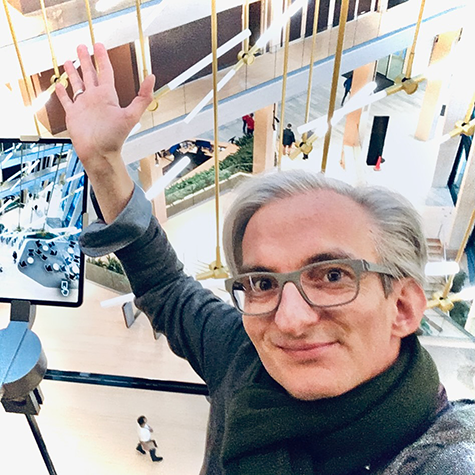
Few theme parks existed in West Germany when Alexander Bresinsky grew up during the ’80s. An interest in technology and engineering led him to an industry that was just getting started. He formed his first company Lichtwerk in 1986 for laser show technology, and that was just the beginning. Alexander is my guest on this episode of the Tomorrow Society Podcast to talk about his career in Germany and beyond.
During his time in school, Alexander worked in the U.S. at Dream Quest Images, which later became the Secret Lab under Disney. His experience with attractions like Batman for Warner Bros. Movie World in Australia and the Star Quest Pavilion for Expo ’93 got him more interested in themed entertainment. In 1999, he ultimately founded flying saucer in Berlin to create rides, attractions, and more. On this episode, we talk about Alexander’s variety of innovative projects at flying saucer for 20 years.
Alexander has been director of the European and International Board at the Themed Entertainment Association (TEA). We talk about what advice he would give to listeners hoping to work in the industry. He is currently on the executive board at MKTengineering and describes their worldwide projects. I really enjoyed learning more about Alexander’s themed entertainment career in Germany on this episode.
Show Notes: Alexander Bresinsky
Learn more about Alexander’s background on his LinkedIn page.
Check out MKTengineering’s official website for more information on their services.
Transcript
Alexander Bresinsky: I think it’s important, and this is something really Joachim used is like the authenticity, the real things. Something where you don’t look through a window of a screen or you have some flat projection. There’s something to that that gives some poetry to that. I mean, it’s an art form. It’s an art form and I still believe that there’s potential for that in the entertainment world.
Dan Heaton: That is Alexander Bresinsky, and you’re listening to The Tomorrow Society Podcast.
(music)
Dan Heaton: Thanks for joining me here on Episode 189 of the Tomorrow Society Podcast. I am your host, Dan Heaton. One of the things that I hoped to do when I started this podcast was to remind myself as much as anyone that there is more out there than just the Disney parks and Universal and around the world. There are so many cool places that I hope to visit one day in themed entertainment. The industry just keeps spreading and working in more interesting areas.
And that makes me really excited about this week’s guest, Alexander Bresinsky, who grew up in West Germany while the Berlin Wall was still up, got interested in laser show technology, started his first company in 1986, and then had some connections with Disney where he worked at Dream Quest Images while he was in school and that company ultimately was bought by Disney and became the Secret Lab later, but he got to work on attractions like Batman for Warner Brothers Movie World, Starquest Pavilion for Expo ‘93, so much other cool stuff, but ultimately ended up starting his own company in Germany, Flying Saucer, essentially helping to build the themed entertainment industry in that country, which has grown significantly since the ‘80s and ‘90s.
He’s also been very involved in the Themed Entertainment Association as a director of the European International Board, currently works at MKT Engineering on the executive board, and tells what I think is a really interesting story where he would pivot into different areas, get really interested in a certain technology, and then change. And so that led to a diverse but also really cool career working in themed entertainment. I hope you enjoy this interview with Alexander. Let’s do it. Here is Alexander Bresinsky.
(music)
Dan Heaton: Alexander, thanks so much for talking with me on the podcast.
Alexander Bresinsky: Pleasure to be here. Thanks Dan. Thanks for having me.
Dan Heaton: Oh, it’s great. I’m very interested in a lot of what you’re doing and what you’ve done in the past because I feel like you’ve had a really interesting career in certain areas of the themed entertainment industry that I don’t talk about as much. So I think it’s really good that we’re able to talk. And I know you grew up in West Berlin, so I’m curious for you, how did you get interested even in effects and illusions and entertainment and working in that field when you were just growing up?
Alexander Bresinsky: That’s a good question to start actually. I never decided on purpose to get into that field. I mean, West Berlin back in the ‘70s had no theme park at all. We had no special attractions. I was particularly driven by passion and curiosity in a way. I remember taking toys apart, spending more time taking toys apart and figuring out how they work instead of playing with them probably. And it all started back in high school, back in high school and I always found myself on the intersection of art and science, art and technologies.
So we had to take some electives back at high school and I found myself with, I had chosen music and art on one side and physics and math on the other side. I had this kind of interesting combination that pretty much tells what I’m interested in; I think it probably has been my physics teacher somehow that initiated that spark in a way. I was lucky to have a very funny and exciting physics teacher who was interested in telling stories besides the usual book and class book you had. He implemented or he added to the normal courses, some work groups, working groups in the afternoon.
And looking back to that, it’s actually quite exciting because he decided to do setting up little tiny lasers to do real holograms. Something I wouldn’t expect nowadays from high school. And it was exciting. So we were doing holograms with tiny helium neon lasers, which were like shoebox size, size of large scale show lasers nowadays, but back then it was like the power of a laser pointer, but enough to do holograms, real 3D holograms, splitting and interferences on a high definition photographic plate. This was like one thing I remember that somehow got me a laser in my hands. And on the other hand in the music course I was really bad in singing.
So we had the choir and we had to sing and we were preparing that big presentation, that big show on it was like a bombastic medieval composition. I’m not sure if you heard about Carl Orff Carmina Burana. So it was like a 1930 piece composition loud choir and still my teacher thought I’m not good at singing, and he asked me to do something else and I didn’t want to play an instrument. I remembered the lasers and some stuff I did when we were doing these holograms.
I just took some whatever rippled glass and put it in the beam and got fascinated by what it did. And I said, okay, I’m using this too. To add something visual to the choir presentation was like our final year and we had that presentation. So there was this later, there was some really interesting experimental technical setups and I had another course at the physics teacher which was on 3D photography.
So he was back at the time on analog day slide film. He was doing some 3D images and we figured out how to do polarized productions. And so we had this final presentation in the last year of my high school where the choir was singing Camina Burana and I was experimenting with tiny helium yon lasers. So this was pretty much the foundation I started. I never did this on intent.
I never thought, okay, now I make the big money or big bucks. So I thought, okay, now I have to do something for living probably. And I thought this was quite interesting. So I bought for several hundred Deutsche Marks at that time helium neon laser back. I was still living at the living children’s room in the apartment of my parents and this was the start. Basically I was taking every technology that was somehow vibrating.
You could mount mirror two and do some scanning effects. So I took apart the electrical toothbrush of my parents I guess, and we had an aquarium pump and everything that was capable of doing laser scanning with cheap technology. And this is pretty much the start. I remember some clients coming to the apartment of my parents and I made the first money out of that and this was back at that time and I got out of school, I had a tiny company, a friend of mine became a partner taking care of sound and light and we were doing events and probably we were out of three companies in Germany that started with later shows, one of three companies.
And this somehow was the start into that whatever entertainment industry with special technology and there were a couple of things happening. It was really great, exciting time. Probably the highlight back at the time was that we got hired or I got hired to do the show for the single National Day celebration and I found myself in an airplane and we had a company shipping all these lasers.
These were lasers back at that time of refrigerator size, water cooled technology, amazing stuff, high voltage water and glass tubes somehow while made me, got me busy and I didn’t think about education in a way, but somehow my parents told me, you should besides that, think about some proper education. I still remember reading an article about a new course at the university or it was actually collaboration of the University of the Arts and Technical University about a new course teaching entertainment technology and technical theater.
So it was beginning of the ‘90s; they figured out that all this show technology became more complex and proper educational was missing for people being able to understand the technology, use the technology at one time and on the other hand listen to creative people, listen to a director or listen to people who wrote a story and figuring out how to implement that technology.
So I did that. I was still having the company, tiny company. At the same time I had my partner who somehow backed me and said, yeah, go ahead and do that. And there was other thing I got interested in. Well we all know Star Wars somehow influenced our careers one way or the other. Back at that time, to be honest, I thought theater is a bit boring. I’m really at a different point of view nowadays. But back at that time I thought, wow, visual effects. That’s interesting.
I mean I was like in Berlin I had some interesting experiences with experimental art. There was some visual things. Brian Eno had amazing exhibitions in Berlin and I had all these ideas about what I want to do and laser had only been Vector graphics. So if you think still nowadays beautiful laser shows but it’s still graphics and I got a little bit bored and I got fascinated by stuff industrial Light and Magic was doing back at that time.
So I had all these books on the effects. I was reading Cinefex and I thought, okay, how to do that, but what should I do to get into that field? I now have this interesting education. But there was pretty much the guy heading that new course at these two universities. He was an American guy and they got him to implement a new course and we were supposed to do a practical semester internship at whatever company, usually at theaters.
And I myself thought, okay, this could be my chance. And I’m not sure, probably wasn’t naive, but I thought this would be exciting and I just took the phone and I called ILM, I somehow made it through. I got someone at the desk and got a name. I mean no e-mails back at that time way. So I had a second call and then I got a fax back.
At that time, no letter would’ve taken too long from the states to Germany. I got a fax telling me, no, sorry, we do not accept international interns and I’m so thankful to that person. I forgot her name. It was Human Resources at ILM and he said, we have another company, we have a good relationship to a company called Dream Quest Images. I have to be honest, I had not heard of them. I was focused to the big guys, Dream Quest at that time was probably like, I think the only big visual effects company back in the analog days that had large motion control, gantry system, amazing technology.
They were all manufacturing that by themselves. Motion controls, several motors running 30 meters, 90 feet gantry thing moving by the precision of the thousands of the nation in a way. They got the Academy Awards for Total Recall and The Abyss, Jim Cameron back at the time, probably the year before they accepted me into the internship, I was blown away.
I still remember it was actually was my birthday. I got that okay to do that internship my partner at said, okay, do it, sounds like an amazing chance. And I supposed, I think it was supposed to be at least six months. It ended up to be almost a year. And then I returned the year after and the year after for a couple months doing things.
This was the next thing that kind of sparked this was fascinating because due to the capabilities of their emotion control system, they worked back at the time on right films. I never actually, I’ve been to Epcot Center I think in ‘87 when I fell in love with Epcot Center, but I haven’t seen Star Tours back at the time, was opened 1987 I think, and I got there in 1991 and two and this was the year when Dream was collaborating with ILM on the Back to the Future ride for Universal Studios.
So they gave their gimbal their motion control thing to ILM and they were helping out each other and was working on, I arrived there when they were finishing the Batman ride for Warner Brothers in Australia thinking, well nowadays visual effects companies were totally different. Obviously this was the analog days. They had a large model shop, amazing people doing handcrafted detailed models and these engineering machine shop building, these motion control gantries. When I arrived I was told I’m supposed to do my internship at the commercial division, which we had the feature division and the commercial division.
So I was first floor in between people organizing from their desk commercial shots and nothing really practical and I was sneaking down on the stage level. They had five huge stages, different sizes of motion control, different types. I was like, wow, I would never have thought about that. This was the first thing that really, really kept my attention. And the second thing was when we, or no, I have to say before that I sneaked down in the evenings or in the afternoons, but I wasn’t allowed to do that. Interns weren’t, weren’t supposed to go downstairs and somehow made it to help out setting up lights or helping cleaning the floor. They somehow appreciated that. And more and more I got involved in the network and I somehow made it to being a video assist and unloading cameras and stuff like that.
So I got part of true working till four in the afternoon upstairs and then sneaking down. And due to the fact that Batman was in the final production stage, they worked late hours. And the second big thing, and I’m not sure how many people had that experience, was that we dailies when we checked the motion control stuff, we did dailies at a nearby industrial building where they set up or another company set up a motion base, six degrees of freedom, hack the pot, same technology start to use.
But even being to start, you never are able to see that big thing moving from the outside and suddenly from one excitement to the other, I got to that stage standing nearby this 30-seat theater, moving light charm, moving lightweight beautifully and sitting inside was even more exciting.
This has been the start of my internship and I got really lucky because they were so successful because they could do with the motion control, they could do long shots without cuts. So they got the Academy award for Total Recall with that long flight over the Martian surface and The Abyss, all these submarines. And so Batman was one thing, this was a 35-millimeter Vista vision project.
The second one I got part of had been for Landmark Entertainment back at the time, Landmark Entertainment, an amazing company. They were working on the pavilion for Samsung Zone for the Korean expo in ‘93. So this was like, okay, now you go from 35 to 70 mil. It was dome projection theater, little bit like the Back to the Future ride and it was another set up new motion base, other company programming motion base. And we did daily, daily with 70 mil film, but black and white developed at images and car film as well.
So I had to drive down to Burbank, get all these films and I got part of that crew in a way and I was really lucky and excited. And the third amazing thing had a connection to Germany. They reused the sets from Star West, from the Korean Expo pavilion. They reused it for a street adventure at the German Phantasialand. Germany back at that time had family owned small family owned theme parks, but one of the biggest ones, Europa Park certainly as well, but Phantasialand somehow made it possible to invest in this 48 frames, 70 mil projection theater with simulator technology called F Street Adventure.
I was still part of the true, I think at that time I was allowed to even go during daytime supporting them because this was still under development and they were thinking about some real time laser effects. I still remember calling German companies figuring out how much an interactive labor system would be for that ride. So it was like for the university, I had to write a big compilation of what I did and final chapter was, okay, I did the calculation for laser stuff but they never made that happen because this was out of budget and a little bit too vague but it felt amazing. So what else? I mean it sounds like paradise.
Dan Heaton: Can I ask you a question? You mentioned that you fell in love with Epcot Center and I’m just curious real quick, I think you went there you said in ‘87, what was that like? I mean why did that connect with you? Because that park at that time was just something, it’s still incredible now, but for the time was just incredible. I mean it’s so different.
Alexander Bresinsky: Yeah, definitely. It’s different. I mean the whole theme park world changed in a way in terms of pricing and the way you visit the attractions back at that time. I mean it’s very vivid still and I think know a couple people that went to Epcot the first time and then fell in love. So there was something special about that. I remember the first ride I did was Spaceship Earth and I had no idea what to expect out of that.
I was going with a friend from Germany and it was a little bit in the event business also doing whatever evening events and somehow know about show technology a little bit. But going through Spaceship Earth, we got out of that ride and while my knees were shaking, I was catching my breath and I was like, oh boy, this is amazing. I mean thinking of that, and I mean this was way before attractions became packed with this place and projection mapping.
This was like the real thing. And even all the animatronics in there, all these additional technologies, whatever smell trickling of fire and tiny little perspective forced perspective transitions between scenes. And I still remember the fiber optics at the end. We later on, and this is something probably we have time today to talk about as well, I met people of later than Spectra Entertainment, the people who really were taking care of these fiber optics and knew every tiny little fiber of that. I’ve never seen something like that. In addition, World of Motion, Horizons, all this first half. World Showcase is another story in American Adventure, at that time I couldn’t appreciate the technology behind American Adventure thinking of it nowadays.
And I know all these crazy stories or amazing stories about Epcot like listening to Steve Alcorn or reading Steve Alcorn’s book and these groups of young people achieving something like that. It sounds unbelievable. But from a visitor’s perspective, I probably had been a good example of how what effect it has had to people visiting and this was so touching in a way and touching not because of, well probably because of some innovative technologies, but was story driven. There was some great rhythm to it. Spaceship Earth was an amazing storytelling in a way. Yeah, so I mean I could keep talking experience on and on.
Dan Heaton: We’ll circle back to what you’re doing. I just had to mention because I went so young.
Alexander Bresinsky: Just one additional thing, I had an amazing Epcot behind the scenes experience years later. I was still being attached to that laser show family, worldwide family. There’s an association called ILDA, ILDA, and they have the ILDA Awards, laser show awards. And I actually don’t remember the year exactly.
A couple of years later, they invited me to become a judge on the awards and I got invited to go there and I know that we were invited to go behind the scenes during the great show at the lagoon and I was part of being in the boat reloading fireworks and during, remember that big ball in the middle of that lake and this whole display, which obviously nowadays has a totally different technology in this LED driven back at that time there were two of these large lasers inside and there were scanning, scanning on the block of fiber optics, which was probably like 31 foot, 30 centimeters wide and thousands of fibers.
So they were scanning that and this was then distributed each point of light to the outside with all these fibers and I was inside that spear on a lake invited to see that technology. I was like, wow, that’s much more fascinating, the real show for me as being laser expert. And then we were standing on the rooftop on one of the buildings with the master control checking lit, no airplanes were going above the leg and all these behind the scenes stuff. So there was this additional behind the scenes Epcot experience that even more made this part well known.
And I’m quite curious seeing Epcot nowadays with all these interesting changes. I haven’t been there yet, looking forward to that. But for me personally, I mean it all goes back even before when you’re reading about the initial ideas about Epcot, which were different in a way Disney had, but there’s such an interesting transition and technology and a new type of rights always or quite often were tested at Epcot and I had no, we wait for that. I had this kind of interesting experience and later on I figured out that WDI was checking something like that at. But we do this a little bit in a couple minutes.
Dan Heaton: We can circle back to kind of what you were doing next too. I mean I’m fascinated by a lot of what you mentioned about being inside that globe because I’ve been by when they move it out into the lagoon and it’s much bigger than you think from far away. It’s huge. But I want to make sure we get to talk about your career too. But I know circling back you were at Dream Quest and worked on those projects. What were the next steps then when you either went back to Berlin or what your career went from there?
Alexander Bresinsky: Probably if I wouldn’t have had to finish my study and had that, I would have desperately tried to get a green card. I checked out ways and was pretty hard back at that time to there was that lottery, I think it still is. So I attended that lottery even a year later, but I never got a green card. So I got back excited about all the changes and the stuff I learned and I sold.
I said, okay, it’s time to go ahead. I cannot carry flight cases with lasers and carrying water hoses for late night shows. So I sold my shares of the company to my partner and he does still exist and he’s still running it and I’m very, very happy about that. But for me it was time to move on and I did actually two things with the money I got.
I didn’t save the money, I used it for two things. One thing was to buy a, and I actually have to step back. I bought a small silicon graphics rendering computer and bought a soft image license; when I got back to Dream Quest the year after and the year after, they were transitioning to a digital visual effects company. I remember joining a meeting with soft image, which had been one of the 3D CGI companies very early amazing CGI companies and Dream Quest purchased a couple licenses and I was part of that meeting.
We worked with Metro Light back at that time on digital effects for Starquest. So I thought, okay, there is simulation, the physical stuff, hydraulics, there were no electro illustrators and there’s 3D in the future. And somehow, I don’t know how I split it up, but I bought that license, I bought the Silicon graphics and on the other hand I took the rest of the money to buy some hydraulics.
Wasn’t enough money because you would’ve needed much more or complex and higher quality hydraulics. But I had a friend who was programming some exopod stuff and we had a basement like all these really weird and wacky stuff and we totally failed. I mean I still remember coming up and this was the interesting story. I know get back to the WDI, we thought, okay, we cannot afford a big motion base like Batman, Star Tours, whatever.
So we thought we’d do a one person flight simulator, and I had this idea and the concept of a magic carpet ride. So we had a little tiny model with Lego exopod stuff with a woven tiny puppet house carpet and I think it was Captain Kirk figure lying on there to present that companies to try to get money and it was actually a concept of A CRT projector, one of these sold CRT projectors.
They were no digital projectors lying on that with a curved mirror. And we estimated this for a very low budget and we never made it happen to do real hydraulics presentation. This thing was shaky and vibrating and we had all the oil, everything. At a certain point I decided, okay, what’s kind of interesting, and this is something I learned from working in the states or learned from the American way of doing business in Germany, failing is a terrible thing or you are taught failing is a terrible thing.
And there was some positive business energy that said, okay, it might be a risk and you might fail, but you learned and you had fun. So we never made it. I know I visited Epcot Center a year later again and there was this WDI lab with the Aladdin Magic Carpet ride. I’m not sure if you remember that.
Dan Heaton: I remember; I never rode it. I think it was at the Innoventions area or something that they had it in there.
Alexander Bresinsky: It was behind the scenes presentation with choosing people from the audience and having them very heavy head mounted display putting on with some counterweight balance and they were sitting on a motorbike and it was kind of interesting. We failed with the hydraulic stuff and there was almost similar idea. I mean they had the IP and they were really successful with providing an interesting experience that you could find it later on, I think in one of the DisneyQuest centers.
Another story of Disney. But yeah, so I got back, I spent all my money on that and I thought, okay, what should I do? I have to tell to finish that story. I finished my study with a thesis that probably did another thing. It’s quite interesting to think about my career because I was really lucky meeting the right people at the right time.
So I wrote that thesis on, I thought, well no, back doing, working on simulators makes you think about the human senses. I learned from the guys programming the motion basis about returning them to zero position where you have the whole range of motion, again without your senses noticing that you are moving at a slow speed.
So I learned about the vision you have and the frames per second and projecting. It was like back at the time when Doug Trumbull was doing tests with show scan and he figured out that like 60 frames per second were even better. But back at the time he was working on Back to the Future. So I thought, okay, I do a thesis on with two separate parts. One was about human senses and what human senses are important to do simulation in the entertainment industry. And the other half was about examples.
I used some examples of my study of my time at Dream Quest and no one, because we were so theater-focused, no one at our school was of the professors was willing to be the godfather of that thesis. So they were looking for someone and we had that collaboration with the University of the Arts and this was like boom. This was the start of probably one of the most important mentors I had in my career.
There was a young, I think he was the youngest professor at the university, he just started one year before by the name of Joachim Sauter was a scientist career at the University of the Arts, was one of the founders of the company called ART+COM or ART COM. Really interesting group of people in Berlin. They were like coders; they were artists, visual artists and probably him as the visionary and the head of new ways of implementing media, implementing technology.
They were very early researching on VR and they were coding interesting things there. You might’ve heard about and some might’ve seen the Netflix series, I think it’s called Billion Dollar Code. ART+COM back at the time was working on an attraction called Terror Vision. They were developing this sphere, this whatever, one meter, diameter sphere, three feet you could move and you could actually move the earth in real time on screen and you got better data and all stuff.
And there’s a long story behind that and there were different opinions, but basically they use silicon graphics and some money. They got part of the code of Google Earth and there were some claims, and this is Netflix series, but this tells a little bit the story where this company had been and what Jo at that time was as a visionary thinking of. So they got me to meet him and I was with my thesis back from Los Angeles and we got excited about that.
He was really taking part of that and enjoying reading my draft. And we started a connection that lasted well till last year. Unfortunately he passed away last year, but he became a very important person in my life. But not just mentoring but, and this will be something we will be touching later. He was doing all this beautiful kinetic stuff and had some very interesting ideas that are probably the foundation of my work today. Well back to that, did my thesis, had amazing time with hydraulic oil and had the Silicon graphics and were doing 3D animations with an artist together in Berlin.
And this was around I think ‘95, ‘96 and something. There was this new thing of interactivity. There was suddenly computers became, multimedia was another term. So it was like CD-ROMs were suddenly on the market and you could use large amounts of data to display on the screen, put some interactivity. And there were great examples of, I remember Peter Gabriel doing CD-ROM and David Bowie doing the CD-ROM. And there was this company called Pixel Park. Pixel Park and other startup you would call it today that they were I think 10 people back at that time.
They were so successful that in the next couple of years they were growing to thousand I think with three offices or four offices over Germany. And I became part of their entertainment division. So I got a job as a, I think I started as a project manager, but it was more than that. I love to work creative way with the artists who were doing some music c drums. The problem was this, I came from that large format, 48 frames per second IMAX thing and ended up at Pixel Park. They were doing innovative things, but it was like tiny little flickering movies on the screen.
And I thought, okay, I can’t do that. It’s like, okay, it’s like a step back in terms of visual storytelling. It was interesting because there was this non-linear work, non-linear storytelling. But I have to admit, I never got so attached to content or storytelling. I always get more fascinated by immersion in a way and technologies that make you feel you are somewhere else.
And I always appreciated other people thinking about the stories. But at the time, so another thing I was lucky was that after two years or three years, I think it was almost three years, I heard about a huge endeavor, a huge project that was supposed to happen nearby or at Studio Babelsberg. The wall was down by the time and there were a lot of exciting things going on, even this would be not the right word, but like a tiny theme park, theme park nearby.
Studio Babelsberg had this, I’m not sure if you’re aware of this, was this famous place where Metropolis, Fritz Lang’s Metropolis had been produced in the 1930s. Long history, amazing soundstages, but they were lacking off a digital visual effects facility. And I’m not sure about the states, but in Germany and in Europe, it seemed to be easy back at that time to acquire public funding money. And there were things or models of private public partnerships.
So there were a couple of smart people and exciting people as well that were able to collect money from Bertelsmann, a large content driven company in Germany and the German telecom and European Union money. So somehow, I don’t know, I don’t know how many millions it were, but they got a lot of money and they were capable of developing this, I think it was supposed to be called Resolution, independent digital effects facility.
And they couldn’t find anyone in Germany running that. They figured out to, I don’t know how they got him there. There was this amazing person and he unfortunately passed away as well by the name of Godfrey Pye. Godfrey Pye was one of the visual effects pioneer in the UK. He was running, I think Rushes, and Rushes was acquired by Richard Branson later on.
So I think he was doing what he liked and he somehow enjoyed getting to Germany and setting up that little effects house. And I don’t know how someone called me at Pixel Park who heard about my career in a way and said, hey, you should talk to that person. I got to him and he immediately hired me out of Pixel Park from the tiny stuff to this modern resolution independent digital visual powers. And I was like, oh, okay, that’s the future.
It was like a gold rush. We got all the quantums and all these large scale silicon graphics, I think outcome at the time. And this visual effects house got all the Silicon graphics or most of them that were installed in Germany. I have no idea. It was an exciting setting this up. It had been as well exciting to join some of the feature film productions. But in the end they failed by firing enough visual effects work. This was huge.
I mean this was like a four story visual effects, house, new build, fancy futuristic building and interesting architecture and all the things, all the tools you needed in there to pretty much everything. We had a virtual studio back at the time, a little bit like what you have nowadays at whatever Mandalorian started with the XR LED streams is still blue screen technology, but motion tracking of the camera and virtual sets.
So this was exciting, but in the end, the money wasn’t there or it wasn’t enough money to keep this beast alive and they decided to split this apart and make smaller companies. We’d be able to rent out parts of that. And another lucky incident I got in touch with, well, VW Volkswagen at that time, Volkswagen was doing some commercials, digital production at that facility. I got in touch with one of their head of productions and she was aware, and this is another gold rush time, amazing time at the turn of the century at 2000 there were things moving pretty fast, not in the theme park world, but more in the brand lands commercial experiences.
And probably one of the biggest had been the auto in Wallburg. Wallburg where most of the cars were manufactured back at the time. They invested lots of money in a brand land and a theme park p little bit like an expo for car building stories, very interesting concept.
This reflected a little bit the approach of many companies or the opinion of many companies that entertainment couldn’t be done in Germany. They hired companies like Jack Ross back at the time, companies from the U.S., companies from the UK to set up their pavilions. I couldn’t remember of any German company. So she knew about me leaving the FX center and she asked me to join the group of people who were heading the VW provision, which was supposed to be again a dome projection thing. Very interesting thing.
And I was for a while joining them until, and this is another story when you look at VW, there are different forces and something is driven by fear in a way and things can change pretty fast. And this group of people heading that VW, like the heart of this brand land was stopped working on that because someone was talking to company in the UK and they fell in love with their concept for the Autostadt.
So it was all taking apart and we lost our job from one day to the other. This was one of the examples where even failure can be a great chance above my desk, I had graphics I bought at Disneyland, which was, there had been this very early flying saucer attraction at Disneyland. And I had, I think was telling “Fly Your Own Flying Saucer”.
And I had this thing about my desk and I thought, okay, what should I do? It was from one week to the other, I lost my job and it was a very well paid job. I saved some money and I thought, okay, there’s no such company like WDI here in Germany; I did apply at Disneyland Paris back at the time. I think I heard back in the three line page saying, no, sorry, we don’t have any job for you.
And I wasn’t that disappointed because I had this exciting idea of setting up something in Germany for permanent special technology exhibits. So this was like the birth of Flying Saucer Attraction Design and Engineering. And so I took this wonderful graphics artwork, Flying Saucer. I thought it interesting working title. It stayed for 15 years, the title of the company.
And I had an amazing partner from Pixel Park who joined me, was taking care of all software issues and I somehow took my enthusiasm for this world and I had a couple of contacts and the other time in Los Angeles companies I was with and got to know. So we immediately, immediately started as somehow a extension to American companies. So I remember one of the first jobs, and this goes back to the story I told about the fiber optics was with Spectra Entertainment with Chris Brown’s company engineering crew of people who were supplying technology.
And I think actually, I’m not sure about the concept, but they were doing a lot of work on the Sony Entertainment Music World in Berlin was an indoor experiential educational thing about music. They had a yellow sub light with the Beatles, a laser harps, stuff like that. Pretty spectacular fountain with fiber optics and laminar water. So there was laser stuff, there was mechanics and they needed help. They were having a tough time, they couldn’t afford all the flights, they needed some continuous support.
So we immediately got a job like that. So working in Spectra Entertainment, Sony Entertainment World, which was working for an American attraction basically not that much German besides, we had to take care of the German QV. There were some things rocky about that. And this was interesting. And on the other hand I was in touch with Bob Rogers, and BRC and VW had some problems with non-German companies at the Autostadt.
So they made their experience and that person, I was in touch, she was still remembering me and she said, okay, we have a new endeavor, we have this idea of a luxury car and there’s a special manufacturing site nearby Dresden, which is called the Glaserne Manufaktur transparent factory, really, really high end, high value facility, all glass. You could watch the procedure of setting up the first luxury car for VW and BRC was hired to do the visitor attractions around that.
Very interesting, again, spherical interactive projection thing, some virtual production tour. And VW asked BRC, if you’re going to do that, please hire Flying Saucer or work with Flying Saucer on that as a German partner. And immediately we had these two projects and this was really fun, was a great crew in Berlin. We were supporting all the logistics, we were even doing constant production on that.
And this is how I met Bob Rogers. We even won the award, themed entertainment association on that. We produced the film and was like start for our company and we thought about more jobs like that and there wasn’t that much going on in the following years with international companies. So the initial international exciting start, which made me feel really happy about that, changed to some, well we had some other things for German companies like the Kuka robo coaster was developed and we were doing the initial designs, but besides that, it got more and more into a full service company.
We were able of winning million euro budget for doing visitor center for chemical company BASF at the time, big job, big budget, but not any more special ingenuity technology. And this pretty much had been a time when I was talking more and more to Joachim Sauter again, they changed their philosophy back at that time it was like from going from digital more to physical, they were doing spatial communication, they were doing concepts for attractions and he proclaimed, okay, we should start the renaissance of the physical.
And this pretty much was the time. I’m not sure if you’ve ever seen that there had been seven, that iconic attraction of 700 plus little spheres moving like magic in space. The first kinetic installation that really got many people goosebumps and that had been copied over and over again in more event type of presentation. But this permanent installation at BMW Museum nearby Munich was done by a company called MKT, a different MKT back in that time.
But they were the only one dared to come up with a kinetic mechanical installation. It was 10, 10 hours a day, but permanent installation. And this was developed by Joachim and we somehow figured out how this poetry, poetry of motion and beauty of motion made a difference in terms of getting the attention of people or getting an emotional connection. I remember visiting him and talking to him and he showed me some behind the scenes footage.
I was there from Flying Saucer doing some full concept stuff and somehow desperately looking for technical challenges. And there was this piece of parking spheres floating in space. The concept was about box three-dimensional pixels, getting physical, telling the story about design and the design of cars. Again, most of the money in the German car industry made that possible.
I got more and more into the role which I really loved on the intersection of the engineers that the art comm needed someone in between talking to the engineers and the artists. So back to my initial education and it was like a process over a couple of years that they decided to acquire Flying Saucer and merged and got a little bit like a speedboat for special attractions, but my heart and my fascination for the technology. And I remember getting into that machine shop at NKT was a different side back then and I was like, oh boy, that’s feels like back at Dream Quest being at the pantry.
So to make that long story short, that’s the company I’m working now, working today for. And they have done, we have done many amazing attractions with focus on these precision permanent installation stuff. Things like loads moving above people’s heads at airports without any operator for years. And this is what I’m really doing right now, talking to artists that have ideas, have ideas about what can we do that’s physical in a way. There’s still always digital technology for the laws of physics. Quite often I find myself with our amazing team. I’ve been talking about feasibility and checking things and doing stuff like that. So that’s like the ups and downs of my career, but I’m really, really lucky that always there was some kind of new thing and new spark.
And today being back at that international business, working for a tiny company, we’re about 20 people, but we have the boutique workshops and engineers that have such a diverse career coming from roller coaster design and aerospace making things like that possible. There’s some special thing that even made companies, we just recently, we lost that job, but we were I think the second on installation on a skyscraper in New York, which required heavy knowledge about media technology, kinetic feeling for outdoor and environs. And in the end we unfortunately lost it. But I was back in head in a way. Yeah, that’s what I’m doing right now.
Dan Heaton: Well you mentioned physical spaces and the importance of that. I feel like coming off of the shutdown that had happened and everything, I mean why do you think given all these new technologies where you and I can talk from across the world and everything, why is it so important though for people in your interest in actually getting people into those physical spaces where you can kind of interact with really cool things?
Alexander Bresinsky: A lot of things has to do with, well actually two things. I mean the most obvious is that after lockdown and somehow limitations due to enjoying to screens. And even my children who had to sit in front of the computer to do their school classes, people enjoying that obviously really very much to get out into the real world and enjoy things together with other people.
But that’s too easy. I mean there are all these, especially in the entertainment industry, there are these new influences and VR became so popular for one reason or the other. And there’s the metaverse thing, but I think it’s important, and this is something really Joachim used is like the authenticity, the real things. Something where you don’t look through a window of a screen or you have some flat projection, there’s something to that gives some poetry to that. I mean it’s an art form.
I think art is an art form and I still believe that there’s potential for that in the entertainment world or I mean look at what WDI does, what a really expensive animatronic the Pandora attraction makes you feel. They do know very well why they invest so much into these figures and into the real movement, three-dimensional stuff. And so yeah, I come back to perception and human senses you can treat. But even 3D projection or the reason why 3D movies really do not succeed, Jim Cameron thought about that is that you’re still cheating. You have stuff in on your head. Same thing with VR. You go to a place and enjoy the real thing. You concentrate on content, you concentrate on all the tiny little things that make this whole experience enjoyable.
Dan Heaton: I know you’ve been very involved too with the TEA, the themed entertainment association, for many years. And a big part of that is trying to inspire the next generation or get them involved. So I mean if people are looking to get involved in the industry or what do you think, what advice would you give someone or what kind from what you’ve learned the approach or kind of how they should approach things?
Alexander Bresinsky: Well, I do think if people are attracted or that industry is somehow there for live or wanted as a job, it’s an easy way because that industry, and this is what I felt and what I experienced, especially you mentioned TEA and I’ll tell something about that in a minute. It’s an industry of people that are really helpful in a way and interested in having the next generation being part of what they do.
In my career, speaking of the themed entertainment association, the TEA, really brings me to my first contact in that relation. That was a call from a guy called Nick Farmer and he was calling me and asked me if I would like to join the association. And this was just an example, how easy you can get into the industry and how open people are and embracing your interests, embracing your curiosity.
And I’ve never experienced another industry that’s helping position in terms of supporting next gen, next generation. Obviously I good member of IAAPA, which is the other big association, which is quite a thing, but TEA is more on the people, the people who do invent conceptual part of that to make things real on a whole and not just invent pop machines or it’s not about machines, but TA is like for people who do not really know yet what they want to do.
I mean, it’s like these, if you look at WDI and I think Marty Sklar, who I met once, I’m not sure, but there’s like 130 something disciplines at WDI and this shows as an example what’s needed in that industry. So first thing is you should be somehow inspired, you should be somehow being interested in that and everything else. People, I mean nowadays for instance, it’s a great thing to get in touch with people.
So be curious and learn and talk to people. It’s really easy and it’s fun. I’m a shy German. It took me a long way to really be open and we have these TEA mixers and in the beginning I was like, oh my God, I should do small talk to people I somehow admire or I got starstruck, and I should talk to him or her. And I remember walking with Joe Rohde at Disneyland Paris when we had a mixer there, and it was back at the time when he was working on flying mountains for Pandora. And he was talking to me in such a nice way and inspiring me that I was like, oh boy, in what other industry could you imagine? Something like that.
Dan Heaton: I have one had a last big question. I know you’re working now, I mean you’re with MKT and there’s projects trying to go on, but overall in terms of the industry looking ahead, whether it’s technology or just where things are going, what is exciting you? What is something that you look at what you’re doing or even just the industry at hold that you think, wow, this is something that could be really cool and exciting going forward?
Alexander Bresinsky: That’s a question that’s really not easy to answer. I mean, if you’re dedicated and passionate about that industry, you constantly think about this and there’s one day where you think, okay, that’s the new idea. And the other day you think that has been pretty stupid. There are two things that really constantly drive my thinking about that. One is related to a project we weren’t able to carry out, weren’t able to realize due to Covid.
When I started setting up this new chapter with MKT Engineering and we moved into our new space, I met Chuck Fawcett, the president of the TEA or the past president of the TEA, who was owning an max design spec at the time, amazing company doing Medtronics. And he was working with Adam Bezark on an interesting attraction for a big theme park. And this was like a big marionette, a big puppet, an animal that was ideal to do big puppeteering initially something, originally something that works close in a close distance to people.
But this was just upscaling, usual puppeteering. They were approaching us with our knowledge about winds. And I thought is ideal to do a kinetic that’s not pure beautiful art that gets some magic approach, but this did not happen due to covid unfortunately. So this is one thing where I think using the excitement about close tiny approaches, it’s like in magic there are these magic tricks that only work at the table and thinking about upscaling stuff, but giving it a different rhythm, giving it a different approach from new terms of excitement.
Besides all these spectacular IP driven ride the movies. One thing I’m thinking about in terms of the themed attraction industry, which I still would love to do project like that, but let me tell you another thing. And getting older, you got fascinated by other fields and we got a job awarded last, well beginning of this year actually.
And we are doing an installation at a large hospital in Switzerland. It’s actually one of the biggest hospitals or even the biggest in Switzerland. And we do an installation with the agency and creative people and foreign hospitals. So it’s nothing at an airport where people rush through and you suddenly start thinking about what can you take from the power and the magic of other industry or the entertainment industry to put into a space like in hospital where you are not just visiting something for a couple minutes, no, you probably are there when you’re an employee all the time, every day.
Or if you are a patient, you have your different story and problems and what can you put into somehow give whatever relaxation, tell stories, and use that power of what we appreciate in the surrounding of the theme park in different fields. I mean, there have been things in retail, there have been things in whatever, entertainment, dining, but this really excited me to talk to the creative people and tell them, think about that.
You are doing a choreography, you are telling whatever a visual story for a different audience and this goes all back to how theater works and stuff like that. And it’s a different audience than feedback. So to summarize that, I think there are many other forms of entertainment that have not even touched yet in a way. And looking at all these price changes and larger things at theme parks, it’s nice look to other fields and think about what we learned or what I learned in other fields and do something new somewhere else, totally something different, but use the power of this magic of what we know and the tools.
Dan Heaton: I think that’s a great point, especially given what we’ve seen even with museums and science centers, but beyond that, places like hospitals. I think that’s great. Well, Alexander, this has been great. I’ve really enjoyed learning so much about your career and everything you’ve done, so thanks so much for talking with me here on the podcast.
Alexander Bresinsky: It’s been a pleasure. Thanks a lot, Dan.


Leave a Reply