Podcast: Play in new window | Download | Embed
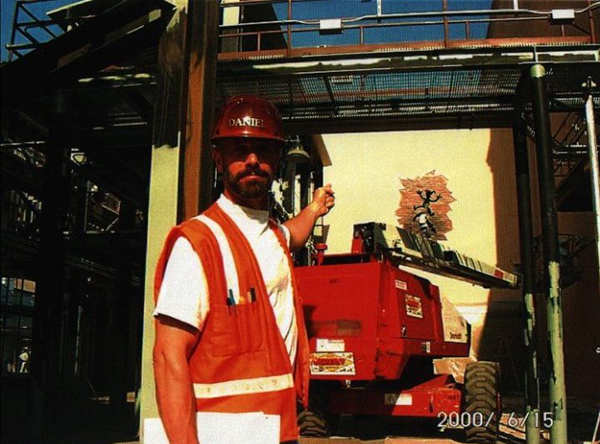
Daniel “Rover” Singer began his entertainment career in the theater world, and he found great success there before joining Walt Disney Imagineering. As a co-founder of the Reduced Shakespeare Company, he helped create The Complete Works of William Shakespeare (Abridged). His arrival at Disney in 1988 was a change of pace for Rover but fit with his background. He stayed there for more than 12 years and worked closely on many classic attractions.
Rover is my guest on this episode of the Tomorrow Society Podcast to talk about his background and theme park projects. He started with ‘it’s a small world’ at Disneyland Paris, which was more than just a copy of past versions. His work on complicated models for Toontown and Roger Rabbit’s Cartoon Spin helped shape what was built in that land. He also tells a fun story about working inside the massive Indiana Jones Adventure at Disneyland and interacting with the crew for that attraction.
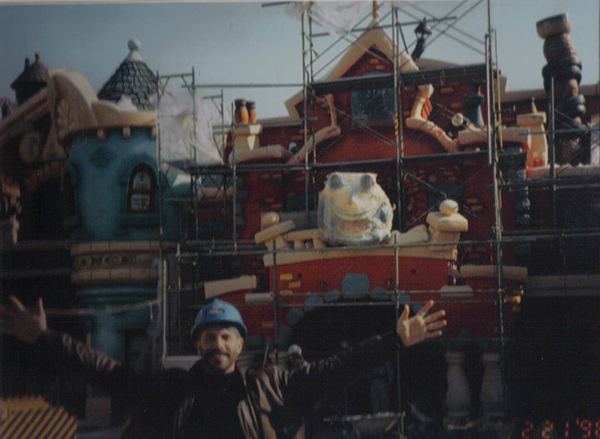
I loved the chance to ask about Rover’s work on the unbuilt Beastly Kingdom, which was planned for Disney’s Animal Kingdom. He describes what interested him about that land and how it fit within the overall park. Rover also did rock work on DinoLand and talks about that intricate process. We also chat about MuppetVision 3D at Disney California Adventure and Splash Mountain at Tokyo Disneyland. Rover performs in the pirate vocal group QuarterMaster, and we close the interview talking about that band.
Show Notes: Daniel “Rover” Singer
Learn more about the Quartermaster pirate vocal band on their Facebook page.
Make a one-time donation and buy me a Dole Whip! Thanks so much for supporting the Tomorrow Society!
Transcript
Daniel “Rover” Singer: The classic mythology, the mythological beasts that have been a part of our storytelling lore for hundreds of years. I think that really resonates with people and it always will. I mean, that’s why so much Disney theme park product focuses on things that have a classic appeal and a classic style.
Dan Heaton: That is Imagineer Daniel “Rover” Singer, and you’re listening to The Tomorrow Society Podcast.
(music)
Dan Heaton: Hey there, thanks for joining me here on the Tomorrow Society Podcast. I am your host, Dan Heaton. My guest today is Daniel “Rover” Singer, who’s done so many interesting things in his career, even beyond his more than 12 years as an Imagineer at Disney, mostly in the 1990s. He’s done so much in the theater. I mean, you could do a whole show just about all the plays he’s written and his performances and everything else in the theater, but we are a theme park podcast and I have to say just two words that’ll get you excited for this show. Beastly Kingdom.
Yes, Rover was involved in Beastly Kingdom and also a lot of other attractions. Splash Mountain, small world, Toon Town, Indiana Jones, Roger Rabbit, so many more, and beyond that, I just really enjoyed learning more about Rover’s story and including what he’s doing now, performing in the pirate vocal group Quartermaster. Lots of fun stuff. So let’s get right to it. Here is Daniel “Rover” Singer.
(music)
Dan Heaton: Well I am here with a director, writer, performer and theme park designer who’s worked in a wide range of entertainment, including more than 12 years at Walt Disney Imagineering. His work for Disney included projects like “it’s a small world” in Paris, Toon Town, and Roger Rabbit’s Cartoon Spin, was involved with DinoLand U.S.A., so much more. He’s also worked extensively in the theater and performs with the pirate vocal group Quartermaster, and that is just a small percentage of the things he’s done. It’s Daniel “Rover” Singer. Rover, thank you so much for talking with me on the podcast.
Daniel “Rover” Singer: I am delighted, Dan. It’s a pleasure to be here.
Dan Heaton: Oh yeah. You’ve done so many interesting things at Disney and then well beyond. There’s no way we could cover all of it, but I’m interested to dive into a lot of it. But I want to start with your background. I mean, how did you get interested in becoming an artist and a performer even as your career when you were younger?
Daniel “Rover” Singer: Well, Disney was a huge inspiration, and when you were a kid in the ‘60s, you were devoted to the Sunday night TV show, and I was one of those kids who was sitting there like a foot away from the screen with your parents saying, get away from the TV set, and you were like, no, it’s Disney. And back in those days before, long before the Internet, but even before home video, those little glimpses that they would show on TV of here’s a little chunk of Peter Pan and here’s a little chunk of Cinderella.
So you didn’t have to wait seven long years for the movies to be. There was just something about the Disney animated classics that were so richly appealing. If I saw a couple of minutes of Pinocchio on TV, I was so fascinated by the richness of the artwork. And of course when the movies were released in theaters, I would be tugging on my parents saying, you got to take me.
Got to go. There was an evolution as a child, as being an artist child that was very Disney driven. I grew up in Northern California and I would say, please take me to Disneyland. And so about every two years, my family would drive down to Southern California and I went to Disneyland probably for the first time in 1962.
So I was probably about three years old, and believe it or not, I have actual memories from that visit as a 3-year-old, the strangest one being that I was just the right height on the Mark Twain steamboat, that my mouth was about the height of the handrail and this is the weirdest thing to confess, but I just opened my mouth and was chewing on it. Maybe I was just a very oral child, I don’t know. And my dad was so horrified by all the germs that I was sucking up that he smacked me and I started crying.
So one of my earliest memories of going to Disneyland is my dad hitting me and me having a terrible, traumatic experience on the Mark Twain. For what it’s worth. I loved, there’s even some home movies on Super 8 of me at that trip where you can see me looking at the castle in awe and being frightened by the big bad build. Anyway, Disney was really a part of my creative soul as a really little kid. As I got older, I became so fascinated by Disneyland that I would get little pieces of cardboard and scissors and tape and actually build Sleeping Beauty Castle and The Haunted Mansion and all my favorite buildings in the park without any kind of supervision or read a book about how to build models or anything. I just instinctively did it.
So when I heard or understood or oh, here was the big thing when Walt himself, while he was still alive would show up on the Sunday night TV show and be there at the model shop looking at models of Pirates of the Caribbean or whatever, that glued me to the set more than anything else. I was fascinated by miniatures, and that’s what prompted me to want to make my own. So by the time I was a teenager, I was just making stuff and I didn’t know why; I couldn’t explain it. I drew maps of Disneyland and put them on the wall, so it was deeply ingrained in me when I was super young.
Dan Heaton: Well, that’s interesting that it played such a role. I mean, you were, that’s perfect time in the ‘60s too with, I mean, when Walt Disney was on TV and there was so much going on, but I know well before you joined Disney in the late ‘80s, I know you went and studied drama and then were working in theater, doing Shakespeare, so many other things. So I’m curious to learn a little bit about that, and I mean that also fits really well with making stuff at Disneyland and everything else. But I mean, were you interested then at some point in becoming an Imagineer, or did you think, okay, I’ve had some success with theater, I’m going to continue to do that as I go forward?
Daniel “Rover” Singer: Right, so how that evolved was I decided I would be an animator. I thought, hey, I’m going to draw these animated films. But by the time I graduated from high school in 1977, the animation industry was changing. Walt was gone.
The Nine Old Men were either dead or retiring, and the animated films that were coming out in the ‘70s were clearly not up to the same standards of the ones from the late ‘30s and ’40s and ‘50s. And so I kind of changed my mind about that. Also, I was a little hyperactive and thought I can’t sit at a desk for 10 hours a day. So I went into drama instead, I trained as an actor and a director. I also do a lot of writing, and so I went to drama school and when I came back, I went to drama school in England.
Actually, I was a big Anglophile, got a really great education there. When I came back to California, I got a job as a director at the Renaissance Fair. Renaissance Fair was a great creative destination for somebody with a lot of different types of talents, like me, interested in the classics, interested in comedy, and immediately started creating entertainment there in the early ‘80s. And one of the things I created was the reduced Shakespeare company, and that started as creating little half an hour stage shows that took one of a couple of Shakespeare’s plays and reduced them down to half an hour long.
Those were very successful. And so by the mid to late ‘80s Jess and Adam and I, the three guys who were the backbone of this group, took our show out of the background or the context of the Renaissance Fair and took it into the world where we went to the Edinburgh Festival and we were a big hit. We started touring college towns, comedy festivals, and before you know it, we had created this stage show called the Complete Works of Williams Shakespeare abridged, and a couple years later that was going on to run in London and did really well. It has become kind of a global sensation at this point, been translated into 30 languages. There’s constantly productions of it around the world. So that was sort of how I spent my twenties in the 1980s was creating the Reduced Shakespeare Company.
Dan Heaton: Well, that’s interesting and awesome that it did so well and was so successful. So that raises the obvious question though, is that then from there you kind of made the transition where you ultimately switched gears and joined Disney in the late ‘80s. What made you decide, okay, I want to move and do this? I mean beyond your Disney background, which I know was very strong.
Daniel “Rover” Singer: So I knew all about Imagineering because I was a fan. So when I first moved to Southern California in the early ‘80s working at the Renaissance Fair, I had created a piece of stationary for myself in which I had drawn in the margins of the page, all of my favorite little fantasy characters, Disney characters, images of Walt Disney, but also Charles Dickens and Lewis Carroll, and there were John Tenniel drawings from Alice in Wonderland.
And I had reinterpreted all these images in the sort of backgrounds of old London and Mad Tea parties and flying over Big Ben, and it was just this really sensational piece of stationary that represented my creative soul. And so in 1981 or two, early ‘80s, I used the stationary to send a letter to Imagineering and said, hi, I’d like to work for you folks someday. And they immediately replied and wanted me to come in.
So I was thrilled and went in to see them and the person in charge of human resources at the time, Imagineering was a very small company, then said, let’s see your slides. And I said, oh, what are you talking about? She said, your binder full of images on Kodachrome of all the shows you’ve built. I was like, I don’t have any slides. I have some really crappy photographic prints of the shows that I designed in high school.
They’re not very good, but you can tell from my stationary that I’m a very good artist and I’m interested in all these different things and I can build things. And she sent me away apparently as I drove away, she came running out into the street waving, but I didn’t see her waving. I just kept driving because she immediately called someone at the Tujunga production facility and said, I’m sorry to tell you, I’m so disappointed in that interview.
He didn’t bring in any slides, and the guy at Tujunga said, I wanted to meet that guy. Go catch him. She didn’t catch me. So I got a phone call later, which was difficult. I was kind of living in my car back then. I was a Renaissance fair gypsy. We didn’t have cell phones. They finally got ahold of me. I went to the Tujunga facility.
They said, listen, you’re a really terrific young artist. We are in the midst of building Epcot and building Tokyo Disneyland, and we really need trained fabricators and we don’t have time to train you. You’re obviously talented, but you’re inexperienced and we can’t use you right now. But they gave me a tour of the production facility, and so I’m looking at all of this stuff in production and I was in heaven. It was just the most thrilling tour I could have imagined.
But then it was over. I walked away from it. Years later, I met Imagineer Kent Elofson, very, very talented guy, and he looked at what I did and he said, listen, I know you’re very busy with the Reduced Shakespeare Company, but I was just put in charge of “it’s a small world” for Paris, and the Paris Magic Kingdom is going to have a very different design philosophy from our parks from the past because we’re under a lot of scrutiny to use exquisite good taste in building this park. We can’t just be crass Americans and throw whatever up in front of Europeans because they will just hate us.
So everything has got to be designed to the hilt, and so we’re actually going to throw away all the old design drawings from “small worlds” of the past and completely redraw all the sets to be a little more sophisticated looking.
And he said, and I need a model maker to help me with this. The model makers who are in the shop right now, they don’t have anyone to help me with this, that I can be right over their shoulder, right over the skill size, you’re cutting, saying no, make that taller, bigger, whatever. And so I was hired as a consultant then in ‘88 working specifically with Kent Elofson on “small world”, and his designs for that show are incredible. It’s such a beautiful version of the ride. So I single-handedly built all of the models for that show for both the interior of the show and for the exterior, which is a fresh design as well.
Dan Heaton: Yeah, I went there once to Disneyland Paris in 2006, but I do remember that “small world” being particularly impressive. Everything felt very fresh and cool. So when you’re doing a model like that though, how detailed was that model or we talking like the old school Pirates of the Caribbean where it’s like you basically get your head up in it and go through the entire thing and it’s that level of detail?
Daniel “Rover” Singer: That level of detail, yes. You want to make it as specific and exact as possible because it goes to the scene shop, whoever’s building the scenery, and they make an exact recreation from your scale model.
So if there’s a mistake on the model, it’ll be a mistake 10 times bigger in real life. So what we did is first of all, we took all of Kent’s designs as they evolved and put them on foam core and just cut them out with exact dough knives and glued pins on the back so that we could set it at eye level and you’d move your head through the center of the model where the boat canal would be and test each one so that if you need to move a model a little bit or raise a figure a little higher, you tested all of that with your cardboard model.
And then while all that was approved and Tony Baxter gave his thumbs up and Marty Sklar had had a chance to look at it, and Michael Eisner probably went through when everyone had approved it, then everything is built out of harder materials like wood Masonite, all the stuff that’s going to survive rough handling when it’s in the field. So I basically built the model twice, one temporary version and one permanent version, and that version has the sets are all pegged so that they sit in holes on the floor so you can remove them so that the person building that piece takes that piece to their desk, the whole thing comes apart and goes back together again.
So there’s a huge amount of planning to make sure that the model is usable, but also is tough enough to withstand a lot of rough use when you use it. And they’re beautiful too. These models are just exquisite. We spend so much time making sure that the colors are perfect and that everything about it is perfect so that there’s no mistakes as it goes to the field.
Dan Heaton: Well, you mentioned that you started out there as a consultant. I mean, how did that go? Were you interested in then moving and working full time? How did the process go where you went from consulting on one project to then working there on so many?
Daniel “Rover” Singer: Yeah, and it was a dream job. I just loved it there; I mean, even though we were, the Euro Disney crew was working in the Chastain building part of the Grand Central Business Park, but we had just moved in to this old unrestored building and it was hot and no air conditioning, and we had dead flies falling out of the swamp coolers onto our models, and all of our artwork on the bulletin boards was peeling, and I didn’t care. I loved it, loved it, loved it. There were a few old timers around like Claude Coats, and I just wanted to rub elbows with them and just glean anything I could from the old generations who were still there.
It was thrilling. So when my contract ended, I begged them pleased to have me back, and it took a couple of months, but finally they hired me as a full-time Imagineer and got the benefits and the Silver Pass and everything, and then I was there for 11 more years and just loved it, loved it, loved it. It was totally a dream job.
Dan Heaton: Oh yeah. And especially, I’m curious to know, you referenced even Michael Eisner and Marty Sklar and then the old guard being there that time period, there was so much happening. I mean, they were making so many attractions that was the beginning of the Disney Decade as they called it. What was that atmosphere like for you once you started there? Paris on its own was such a big project, but then there was so much more happening.
Daniel “Rover” Singer: So yeah, the Disney Decade, the weird thing was to be part of the design process of a new project that didn’t end up going all the way to production. I was so lucky that just about everything I worked on got built, so that was thrilling to know that I wasn’t just making models that were going to end up getting thrown away or whatever. It was really great to know that all this was going to the field, that I’d be able to be on that attraction someday and be able to point and say, I helped with the design of this and that it would be seen by millions of people.
I immediately started working on two Splash Mountains, one for Tokyo and one for Florida, which is the one I worked with Don Carson on just really quickly about these two Splash Mountains, the one for Tokyo, obviously being funded by the Oriental Land Company who really understand the old fashioned Disney design concept that it has to be super high quality and you have to invest as much as you can to get the show to the best possible level so that it can be really appreciated for generations to come.
The Florida version of Splash Mountain didn’t have that same philosophy. They had a very tight budget. They had to keep things simple and tight, and I built some of the same scenes for both shows. And I remember in the up ramp for Tokyo Splash Mountain where you’re heading for the big drop, there were a bunch of stalactites and everything in the ceiling, and the art director kept saying more and more, I need more stalactites, and I’d make more and more and pin them in place on my phone model. And then I’d go over to the Florida model and they’d say less, we need fewer stalactites. They’re really expensive. So I would take them out and we’d have like five instead of 30. So that was the comparison between those two shows.
Dan Heaton: That’s so interesting. And it’s interesting too that now Florida’s is gone for Tiana’s, which I haven’t ridden, but looks cool, and the Tokyo is still there. So all those stalactites are still there in Tokyo, but still there. That’s an interesting contrast that you worked on those. Well, I know you also worked on Toon Town and Roger Rabbit, which is such a cool attraction working on, and that Anaheim and also Tokyo, but I’m curious to know, especially Roger Rabbit, where you’re having to create those models, which that ride is just so inventive and so complicated I guess.
Daniel “Rover” Singer: So first we worked on just the development of Toon Town itself, which was fun for me because at first I was the only model maker assigned to it, and I had to lay out the entire land, and I went to the area development team and said, can you give me the topographical shape of how the berm is going to be formed around it? And they said, oh, we’re months away from developing all that. So I would just carve foam and just make stuff up and keep my fingers crossed that someday it would all work and make sense.
So I had a lot of freedom and a lot of power in those early days as the only model maker, but it all got corrected later. At one point they assigned me then to be the production designer of Roger Rabbit, and of course everyone knows it went through a big iteration of being a two-story ride because you can still see the old balcony where the vehicles were going to pop out of the building, drive around and then pop back in.
And all that sort of got simplified later to just be a vehicle that’s just on a flat floor in a one story building, but still it was a large building and a tall ceiling. So I felt like as a dark ride, we were going to really benefit from having a lot of elbow room that on Mr. Toad or some of those earlier rides that it’s a really tight space, and Roger Rabbit was just so much square footage.
So by the time that we got all the storyboard finished and Rob’t Coltrin laid out the attraction, so we knew the path and where the walls would be and everything, then I got to build all the sets. And again, we worked with Kent Elofson who basically drew every bit of scenery. I mean every visual thing that you see in the Roger Rabbit ride, taking all the concept art from Joe Lanzisero and Marcelo Vignali and translated into actual set drawings, which I then translated into a model.
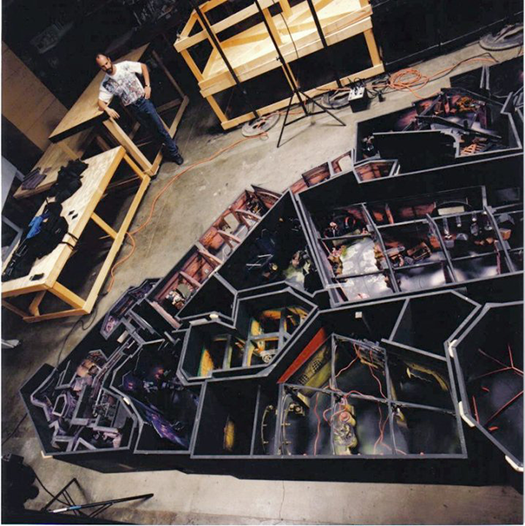
All of that was just incredibly fun. And the greatest thing from the legacy of those models is that they were all photo documented, just beautiful, clear, crisp photos that I got 8×10 prints of all photographed under black light. So I have those in a binder. And then I got a whole series of photographs taken, documentation of the attraction once it was built. When you take those two binders of images and hold them next to each other and turn the pages, the pictures of the model look exactly like the pictures of the show, it’s almost hard to tell the difference. That’s how perfect the model had to be, and that’s how perfectly they interpreted it when they built the show.
Dan Heaton: That’s so interesting too, because that attraction, just like you mentioned Joe Lanzisero, who I’ve talked with, the designs of some of those are so, I mean, I hate to say zany in a good way. They’re almost like Mr. Toad, but taken to this other extreme and for you to have to do a model then and then have it match so well, that had to take a long time to kind of get it all to line up, right?
Daniel “Rover” Singer: Oh yeah. It takes months and months and months. Well, our inspiration for Roger Rabbit, aside from just the movie of Who Framed Roger Rabbit?, but we wanted to capture the spirit of cartoon shorts, not even necessarily Disney cartoon shorts, because there was a big tradition of people growing up with watching cartoons on Saturday morning TV shows where it was more of that Tex Avery style from MGM or Warner Bros., where the cartoons were a lot zanier than Disney-style cartoon shorts, which had more of a homespun quality, and we wanted people to, and Roger Rabbit really adopted that same zany quality as well in the film.
So we knew that we weren’t just going to be taking a Disney animated product and bringing it to life as an attraction, but we wanted to have that energy of the seven-minute cartoon squeezed into what is, I guess about a three-minute ride through attraction. So that’s why we wanted the intense music and that little tinge of violence and that feeling of everything being squashed and stretched and exploding and falling to earth. All that was really important along with the story that we wanted to tell.
Dan Heaton: Oh, yeah. And I think it comes across really well and feels like otherworldly where even a lot of younger riders might not have seen Roger Rabbit, even though it’s a very popular movie, but still can get the idea of it that it’s very different than your typical Disney animated experience, I will say in a good way.
Daniel “Rover” Singer: Yeah.
Dan Heaton: Well, I want to ask you too about Indiana Jones Adventure, which I know you were involved with that one too because in a very different way, but that one, I feel like the sets and everything to convey the right feeling are just so detailed too and just if you were involved with models.
Daniel “Rover” Singer: It’s such a great show, it’s such a great show. I had more limited involvement with Indiana Jones. I’m still very proud to have been a part of that team. I just think they did an amazing job, but I was not part of the original design team, but the show got to the point where the models were all finished but hadn’t been painted.
And they were really concerned about how the show was going to get colored because there are many situations in the ride that are black light and with black light, you can take flat surfaces and walls that are closer to you or creating a more enclosed flat space that you want to seem like there’s more depth and more sort of the audience’s awareness of the space is more limitless. So you do that with darkness and then the occasional black light painted objects that then stand out in an dimensional way because of the way the fluorescence makes them glow in the middle of all this were fireballs.
You’d have your beautifully designed black light set and then a burst of flame would create all this incandescent light and ruin the illusion that your black light had created. So they put together a little team of colorists, and I was among them and said, okay, here’s your challenge. How do we make a blacklight show that is occasionally ruined by fireballs? And so we mixed paint and did a lot of experimenting, and we didn’t have a lot of time to experiment. So over a couple of weeks we tried mixing incandescent and blacklight paints together and just doing a lot of samples until we finally came up with a presentation that was pretty convincing.
I mean, if anybody has ever been in a blacklight attraction where maybe it had to be evacuated and they turn on the fluorescence to get you safely out of the building, and you look at the walls and you’re horrified by how awful the black light paint looks in normal incandescent light, this is traditionally a problem, but you don’t worry about it in that situation because it’s an emergency situation.
But in Indiana Jones, this was going to be riding through. The attraction was always going to be an issue with those fireballs going off all the time. So we came up with a new paint mixing system that worked really well. Our presentations were really impressive, and we thought, okay, we just have to keep this in mind as we paint things that they’re going to look good under black light and they’re going to look good under incandescent light, even though no one’s really experimented with that before. So it was a risk, and we had our fingers crossed, and it turned out really well.
There’s one section that has mummies, so there’s a big mural across the back wall that’s all mummies and a couple of mummies pop out at you. And that area was all blacklight paint, and we had to make sure that there was a light trap at the entrance to that area where none of that firelight intruded on that scene that was all going to be ruined if any incandescent light got in. So that was a really fun part of the process.
Dan Heaton: No, I was going to say, I think about when you go into that big room and it lights up, that then hits all the other rooms, like you said, if you’re not careful, and it’s very, very effective. I’ve never gone in and thought, oh, I can see the walls. So whatever you did to make everything look like it’s limitless. I mean, what you just described, I think it worked out great.
Daniel “Rover” Singer: I think you’re right. Yeah, and it’s really stood up in the test of time. The other fun thing I got to do was they needed someone to go down to the park and help sculpt all those miles of stone walls that you walk past when you’re waiting in the queue. And they had a union crew of plasterers down there with their trowels sculpting cement.
But as is very typical with Disney projects, sometimes you have to hire tradesmen who aren’t necessarily familiar with creating themed architecture. I mean, you can hire scenic painters who are theatrical painters who can paint show sets, but having people sculpt cement, they’re used to making it smooth and even not uneven, cracked, aged, all that kind of stuff. And so they sent me down with no training and say, oh, you’ll be fine with this. And so my first day I had to go to the top of the scaffold in the load unload area.
If you remember the area where you get on and off of the Jeep in Indiana Jones is this really tall vaulted space with a bunch of moss hanging in it and a big shaft of sunlight shining through it, but it’s like, I don’t know how high it is, it’s like 40, 50 feet off the floor. And I’m like, where’s my crew? And they said up at the top of that scaffold. So I am climbing up to the top of the scaffold and a little nervous. I am not really used to heights.
And I introduced myself as their new, I guess art director, and they all just kind of looked at me up and down and went and went back to work. I thought, oh boy, this is going to be fun. So I picked up a trowel and I just started working alongside them and I’m kind of terrified, and so they’re razzing me and making fun of me, and I thought, oh, this is just going to be the worst experience of my life and I hope I don’t fall to my death.
I got used to it and the guys got used to me and it all went really well, and I spent, I don’t know, a month down there, they splash a whole bunch of wet cement at 7:00 AM and if it’s a hot day, that stuff is dry in three hours. So you’ve got to work mad to trowel everything that they’ve sprayed before your lunch break. And because if you mess it up, then somebody has to come back in with a jackhammer and respray it. There’s no budget for that.
So the crew and I got together just got along really, really well. And when I stand in line for that ride now I can look at all of those walls and look at those cracks and it’s the same kind of stuff, but you don’t want it to look repeated. Each one has to look unique to give that natural feeling like all of these stones were we’re just kind of naturally stacked on top of each other and cracked in a random way. Achieving that randomness is so challenging, but the guys got better and better and I got better and better at directing them, and I just think it all looks great.
Dan Heaton: Oh yeah, that room is really impressive and it’s just a load area, the fact that there’s that much there and in that entire queue. So did you get to use those skills again on any other projects now that you became a master ratchet?
Daniel “Rover” Singer: No, I don’t think I ever had another task like that at Disney. I have since my partner and I own a really beautiful home up in the mountains of Santa Barbara, and it has a feature of a tower, a three-story, 14-foot diameter building that’s just kind of like a folly on the property. And yes, I have sculpted that stone and used those skills from Indiana Jones. It looks better down at the park because the concrete is thicker down there, and I only had a couple of inches worth of concrete to work with, but it still looks pretty good.
Dan Heaton: I wanted to ask you briefly about, I know you worked on Muppet*Vision 3D, this is at Disney California Adventure, which was the later version and no longer is there. But I’m curious about your experiences with that with, because it’s still going strong right now in Florida. Hopefully it’s going to continue, but I’m curious about what you did on that show.
Daniel “Rover” Singer: Well, I love the Muppets. I was addicted to The Muppet Show and it was originally aired and the way that it kind of kept vaudeville alive into new generations, I have so much respect to that. And actually I’ve watched all the whole cycle of Muppet shows recently on Disney Plus and just had to relive all of that. I thought that the Muppet*Vision 3D show was just an incredibly outstanding show.
When I look at it now, I think yes, the 3D film part of it does feel dated even though it’s incredibly well written and well made, it would’ve been nice to consider redoing the film because I thought that the in-house effects, the way that the theater encompasses so much more than just what’s in the film with Waldorf and Statler in the balcony and the Swedish Chef in the back and Sweetums comes out in a costume and hangs out with the audience.
I mean, there’s so much going on that’s fun in that show. And yes, the California version was pretty much an exact copy of the Florida version, so they just needed someone in California to supervise that reproduction, and I was honored to be a part of that. I wish it was still there. I really miss it. And I got to design a really fun queue that had the “Pigs in Space” ship crashed into the ground, and we built a Beaker who was a crash test dummy. There was so many fun things I got to do. I’m so sorry it’s gone. I wish that they would’ve considered redoing the film for a fresh generation. That would’ve been nice.
Dan Heaton: Yeah, it still works though. I mean, my daughter is now 11 and we went there again and watched it this year in Florida, and she still thought it was hilarious. So I mean, the writing and all the gags and stuff, they still work. They don’t feel dated. So I appreciate that side of it and I agree it would’ve been nice to, especially, I don’t think I ever actually went to the one in California. I’ve seen it in Florida a lot of times, but now I really wish I had for some of the things that were put into the queue that I’ve never seen. So that’s really awesome you got to do that too.
Daniel “Rover” Singer: I was very honored to be able to work with the Muppet team on that.
Dan Heaton: Alright, well, I have to ask you about Disney’s Animal Kingdom and some of the work you did there, because I think that’s just a really cool park. And I know you were involved with DinoLand first, which is still there.
Daniel “Rover” Singer: Not for long.
Dan Heaton: For now, is still there, parts of it. But I’m curious, and I definitely have to ask you about the unbuilt part that you worked on that you referenced with Beastly Kingdom. But I guess just I’d love to hear about your experiences with all of it starting maybe with DinoLand.
Daniel “Rover” Singer: Right. So when I started on Animal Kingdom, I was really skeptical because obviously Animal Kingdom is not a typical Disney product. And so I used to look at all the projects that people were working on and kind of keep score in my head of what was going to get all the green lights necessary to actually get built and what wouldn’t. Remember Disney’s America, I knew that wouldn’t get built.
Dan Heaton: Oh yes.
Daniel “Rover” Singer: But I was pretty sure that Animal Kingdom was not going to go all the way. And I’m so glad it did because it’s a magnificent park and it has such a different vibe and Joe Rohde’s direction of it is so incredibly masterful. So when we started it, I thought, this is probably going to be the project I work on that never goes anywhere, but of course you still give it everything you’ve got. And so I’m assigned to Beastly Kingdom and I love it. It’s the part of the park that’s going to have all the mythical creatures.
So there’s dragons and unicorns and this sort of Explorers Club kind of feel like we’re going into these unknown realms and we’re encountering these wild beasts that are going to come to life. And I couldn’t have been more thrilled to work on something so intriguing. And to me it was important because to me, it connected the audience with traditional Disney entertainment at the parks.
If you weren’t sure about going to a Disney zoo or whatever it was going to be, you could always know that there was at least going to be like a roller coaster that took you through a dragon’s lair and a boat ride through. What was the boat ride? It was through Fantasia’s Pastoral, Beethoven’ Sixth, creatures and a maze that led you to a unicorn, and that was going to be the way the audience connected to the park.
So when Joe Rohde took me aside and said, we’re having to shelve it, we don’t have enough money to build it and it doesn’t have any live animals in it anyway, and that’s our mandate is to make sure that the audience encounters as many live animals as possible. When I was working on the dragon coaster, when you were in the queue, there was going to be a crushed medieval village that you kind of wandered through on your way to loading onto the ride.
So I was building little crushed cottages that had toads and lizards and things kind of running around them, but actually encased in terrariums so that they couldn’t get loose. And so that took a lot. I was actually looking at those designs this morning; I thought, what have I still got from Beastly Kingdom? I saw some of my sketches of that stuff and thought, yeah, this all would’ve been really cool. So I built tons and tons of rock work for that.
It was an entire land, so there was lots of rock and streams and all that, bridges all that stuff that you develop and it all got boxed up and put away, and I don’t know if Disney keeps that stuff for all eternity or if at some point somebody says, ah, you can throw all that stuff away, but man, that land was so beautiful, it was a heartbreaker to see it go.
Dan Heaton : Yeah, the fact that Disney fans, some still talk about like, oh man, what if we would’ve had, I mean, I think there’s a lot of cool stuff that’s been added Expedition Everest, Pandora, lots of great stuff, but I think those do kind of what Beastly Kingdom would’ve done and make it different than just, which I love animals, but just, I hate to say just, but animals in that park, man, it still kills me.
Daniel “Rover” Singer: Well, I think the classic mythology, the mythological beasts that have been a part of our storytelling lore for hundreds of years, I think that really resonates with people and it always will. I mean, that’s why so much Disney theme park product focuses on things that have a classic appeal and a classic style as opposed to using IPs that have a more temporary resonance. But you never know about that. And the stuff that Animal Kingdom has been built out with Everest is this magnificent attraction. I haven’t been to Pandora yet, but I will someday. The photographs look stunning. So yeah, sometimes you just have to leave part of a theme park empty for future development because you don’t have all the ideas upfront and those ideas will come to you later.
Dan Heaton: Well, I would still love to have any of those kind of Beastly Kingdom ideas, which I know probably will not happen, but I think you also did some work on DinoLand too. Did that actually end up happening?
Daniel “Rover” Singer: Right. Yeah, so DinoLand needed a lot of rock work, and so you’ve probably heard me say the word rock work now about 40 times because I was carving foam at Imagineering for years and years and years, and I’m glad I was wearing a mask because that foam is really toxic and I was just immersed in that dust eight hours a day for years and years, and I remember when I first started at it, I wasn’t terribly good.
There was a wonderful artist there named Ann Malmlund who took me under her wing when I first started, and she said, those are terrible. She’d say, give me a rock, give me a good rock. You give me a good tree. And so after a month of Ann’s mentorship, I got a lot better. And after a couple of Splash Mountains, I felt like, give me a knife, give me a block of foam.
I can carve just about anything. That was back in the days where they would take your finished foam model and they would slice it on every inch on the bandsaw this direction and then glue it all back together again and then rotate it and then cut it every one inch in the other direction and trace all the lines and then bend the rebar. It was such an amazing process. I assume that’s all just done digitally now, but back then it was just kind of fun doing it all by hand.
So I created all the rock work for DinoLand, and now when I look at the photographs of it and see that a lot of it is going to disappear, it’s kind of interesting that when you build stuff like that, it’s so expensive and so much careful thought and approval and review goes into every square inch of it, and then you think how many people get to see it and how long does it last before eventually maybe somebody wipes it all away and turns it into something else.
You kind of want your Disney theme park contribution to go on forever. And sometimes it does, sometimes it doesn’t. Like on California Adventure, I worked with the Hollywood team, so I not only worked on Muppet*Vision, but I did a shop that was next to Muppet*Vision, and I also did this restaurant that was supposed to be a Hollywood sound stage called Hollywood and Dine. And so basically everything I contributed to California Adventure is gone. It is gone. It’s just like my entire contribution has been wiped clean.
Dan Heaton: They keep removing things from there. I mean, I think more’s coming as far as getting removed there. So you’re not the only one.
Daniel “Rover” Singer: Oh, yeah, no, no. This is a common complaint from Imagineers. It’s like, oh yeah, everything I contributed completely disappeared.
Dan Heaton: Well, I am glad to say that some of the things you’ve worked on, like Roger Rabbit and Splash Mountain in Tokyo and Indiana Jones, those are all still going strong, and I don’t think those will go anywhere.
Daniel “Rover” Singer: Well, every once in a while, Roger Rabbit is threatened, oh, we could use that building for something more interesting. I’m always like, no, please, it’s so much fun. I mean, just the fact that the vehicle spins adds this extra layer of kinetic interest in that ride. We had to carefully design the sets so that even if you went through the show pointing backwards, you wouldn’t be looking at the backs of flats, you’d be looking at scenery that was just as good from the back as it did from the front. That was a real challenge and I think a huge success. So I really don’t want Roger Rabbit to go away. Of course, if they replace it in California, they’ll probably keep it in Tokyo.
Dan Heaton: It’s like Country Bear Jamboree still in Tokyo
Daniel “Rover” Singer: And Splash Mountain. So it’s like becoming that theme park that is everyone’s ideal because there’s so much nostalgia for attractions that are gone, and so all you got to do is go to Tokyo where I guess they’re going to be preserved forever.
Dan Heaton: Probably. Well, I wanted to also mention, I know when you were at Disney, you helped found a group called the Flower Street Players, which is an in-house theater company, which I had not heard about until looking into your background, so I’d love to know a little bit about that group and kind of what you did.
Daniel “Rover” Singer: Yeah, so let’s see. 1996, yeah, ’96. At that point, Imagineering was huge. There was like 2,000 people at Imagineering. A small group of people realized that there were so many Imagineers that had theater in their background, why not do shows at Imagineering as sort of an after-hours extracurricular event? And so we talked to Marty about it and he said, well, how about if instead of using ticket sales, the money generated by ticket sales to pay for your show, how about if we donate that to the Herb Ryman Foundation?
We use the show that you do as a fundraiser, and then we’ll just get all the support you need. If you need scenery, we’ll have the scene shop contribute as best they can. This little suggestion was actually a much better idea than the one we had come up with was we’ll try to come up with a budget that actually works when we sell tickets to having the company fully supportive of doing shows, having scenery and ticket sales, all that kind of stuff, and then having a donation at the end to everybody’s favorite charity.
So we did You’re a Good Man, Charlie Brown, which is a very small show, just a cast of six and a pianist and some very simple sets, and it was a phenomenal success. We did it for four or maybe six performances, just like two weekends, and everyone loved it. So everyone said, just keep doing this. So we did at least two shows a year, and there was the group of us who had started it, formed a board to make the decisions about which shows and held open auditions, and it wasn’t just for Imagineering at that point. We opened it to anybody in the Walt Disney Company.
And so we did Little Shop of Horrors and Midsummer Night’s Dream and The Boyfriend and several other shows that we also did staged readings. And it was just great fun. In fact, there was just a reunion recently, a party where people associated with Flower Street Players from those three years that we were active, got together and looked at videos from our old shows and memorabilia because people who do theater, who do shows together, it’s a very bonding experience.
You make friends for life. And so at, let’s see, ‘97 and ‘98, and by ‘99, the company was finishing projects and starting to downsize. So a lot of people were getting let go, and that talent pool that supported the Flower Street Players was starting to disappear. Plus they wanted to reuse the little building in the Grand Central Business Park that we had turned into our theater, which was such a shame because by now it had risers and seats and curtains, and it was like a regular small theater. It was beautiful. So it was great that we had all that support. Over three years, we donated $30,000 to the Herb Ryman Foundation, so we were incredibly proud to have made this contribution to the company’s culture.
Dan Heaton: That sounds really, really awesome that you were able to do that. And plus, like you said, because it was a donation, there’s kind of an extra element to it. Well, I know before we started, you referenced that you’re proud of two appearances in the Imagineering coffee table book. So I want to make sure to ask you, because a lot of listeners probably have that book. So what are the two appearances that you’re excited about?
Daniel “Rover” Singer: Alright, so here it is, Walt Disney Imagineering: A Behind the Dreams Look at Making the Magic Real. So there’s a couple of pages in here that are called “Telling the Story”, and it focuses on Splash Mountain. So on page 40, there’s a photograph of me back when I had a lot of hair, I guess we had hair back then, and I’m sitting at a desk with Scott Goddard and the two of us are painting a section of the foam model of Splash Mountain, of Tokyo Splash.
Right behind us, there’s a storyboard of Joe Lanzisero’s sketches all pinned up, and it says the storyboards are always kept close at hand as the design process continues here, Imagineers Scott Goddard and Daniel Singer seated use the boards as reference while transforming these two-dimensional drawings into the three-dimensional world of Splash Mountain. So nice little photograph there of what I looked like when I was in my early thirties.
But the better mention is on page 132, it’s called “How Did You Become An Imagineer?” And there’s a very famous photograph on this page that I selected that’s a picture of Yale Gracey, one of the classic Imagineers who would just go off and just try to figure out how to create spectacular low-budget effects in theme park attractions.
He did a whole bunch of staged photographs as the Haunted Mansion was nearing completion for marketing purposes, and they’re just such great photographs. So I chose the one that had struck a chord with me when it was first published when I was a kid of Yale standing in the cemetery with a hammer and a chisel, and he’s chiseling the stonework on a tombstone while a ghost has appeared sitting on the tombstone and appears to be looking at Yale. And Yale is kind of surprised and a little frightened and looking up at the ghost.
Such a great photograph. So I probably was 10 years old when I saw this and thought, here’s the copy that’s under the photograph. I was 10 years old when The Haunted Mansion opened at Disneyland. Ever since it had been announced as a future attraction, I had stared at the building with my face pressed against the iron fence. Imagine what every inch of the inside might be like dreamed about it. The year it finally opened Gulf Oil’s Disney magazine, which was distributed at gas stations, had a feature article about The Haunted Mansion.
There was a photo of a scenic artisan. Of course, then I didn’t know who it was, carving a stone monument. He looks up from his hammer and chisel startled at the ghost of a wise old king sitting atop the monument, smiling down at him. This photo crystallized my career goal from the moment I saw it. Someday I would be the guy in the smock carving scenery for Haunted Mansions while ghosts oversaw my work. And it goes on a little bit, but I am so proud to have gotten that page in that book. That one photograph really did crystallize my career goal as a child.
Dan Heaton: Wow. That’s great. I’m glad that’s in the book and I’m glad that you got to mention it. I’m going to have to go check out my book now and find that page and look at it after we’re done. So great. Well, I know that you ultimately left, I’m not trying to bring down the room here, but you ultimately left Disney around 2000. I’m curious how that went and then kind of where you went from there,
Daniel “Rover” Singer: Having a dream job and then considering leaving; it is kind of a soul-searching dilemma. But I was watching as the Disney Decade ended at the end of the ‘90s, I was watching a shift in the executive decision-making process for Imagineering. And to me, the future of Imagineering was starting to look a little bleak. I had had what I thought was just a tremendous career.
I had created so much exciting stuff that I was so proud of, and even though the Hollywood team that I was working with on my last project, which was California Adventure, Hollywood with Muppets and Hollywood and Dine restaurant and whatever else I worked on there, the rest of the park I thought had some really big issues, and I tried to bring them up with some of the executives, and I was kind of waved away, no, this is the way we do things now.
So the philosophy that said, well, we’re going to use set of classic themes. We’re going to use pop art in the park and off-the-shelf iron rides. I felt like that was not only disappointing, but that it would actually turn off a lot of Disney fans and even infuriate them. I was worried about the blowback from that after the park opened, that it would bring the Disney name that represented quality, but it would bring everything down.
The fact that everyone had sort of drunk the Kool-Aid and it’s like, no, this, it’s going to be great. It’s going to be great. I just lost faith. So had a lot of talks with my manager at the time and decided that it was probably time for me to take my creative energies elsewhere, even though they would’ve been pleased if I had stayed, which was very nice of them to say.
And 12 years was a great career there, and I did have a lot of other things to do. I was interested in becoming more focused on writing, and I probably could have done that at Imagineering as well. But there were some non-Disney types of things I wanted to write. And so it was time to get out. So I left in 2000 and Disney’s California Adventure, I thought was about half of it was a really nice park, and about half of it was just horrible, just as I had imagined that it was.
And I’m happy to say now that most of the horrible stuff is gone and that it’s a much nicer park now, and that I told you so will resonate through the ages is they fixed it exactly the way I wanted to fix it back then. It just took a few more years and a few more zillion dollars to do it.
And now I enjoy going there, and I don’t have any of that residual bad feeling that I felt when I would walk around the site as it was being built with my head in my hands just going, oh, why do they think this is worth doing? It was a real struggle. And during my exit interview, I made a point of telling the HR person that I really wanted to come back once the Eisner regime was gone, and I don’t think she even made a note of it. She was like, yeah, okay, give me your Silver Pass. Goodbye. So once Eisner was gone around 2007, I think I came back and said, hey, you guys, I’m available. Are you guys interested? But they were busy and distracted, and so I never ended up doing another stint at Imagineering, but that’s okay. I’m having a good life.
Dan Heaton: Yeah, no, I understand completely. And just having seen DCA and how it evolved and how things went in that 2000, like you said, 06, 07 range, it all makes sense, but it’s too bad. But I know you’ve done a lot of interesting things, way too many that we could talk about. You mentioned writing, you’ve wrote some amazing plays. I also know you worked on Warner Brothers World in Abu Dhabi; I talked to Dave Cobb about that and that park. I have never been there, but looks incredible. And just briefly, I’d love to know a little bit about how that went for you, because I know you got to do kind of, if any park kind reminds me of just the ambition. It’s just so ambitious that park.
Daniel “Rover” Singer: Yeah, it’s a really excellent product and I have never been there to see it myself. But when you build a model, you become so intimate with every inch of it that you feel, I mean, if I went, you could blindfold me and I could walk around and not bump into anything and I would know exactly where everything is. So I was the only model maker on that park, which is a significant honor. It’s just so much fun.
So for a couple of months I took everybody’s designs and we didn’t build a finish model for that. It was just a cardboard model, but turns out that all that they needed, this was working for the Thinkwell Company, Thinkwell had just an amazing roster of talent. I know the company has changed a lot over the years and post-pandemic, it’s even a different company now, but I think they were kind of at a peak back then.
That was, I don’t know, around 2014 I want to say. So I was working with amazing artists and they would come into the little model shop that they’d created for me and look at my models and we’d make little changes and everything. But the idea is that the entire theme park is in a box, so it’s in Abu Dhabi, it’s in the desert. They wanted an air-conditioned space, so they built a giant box and put an entire theme park inside the box, and it’s divided into, I want to say five or six themed areas.
There’s a zillion YouTube videos you can watch if you’ve never seen this park. It is absolutely stunning and used a lot of classic product too. Like there’s a Flintstones area, there’s Roadrunner and Wile E. Coyote have a fabulous roller coaster. The DC heroes and villains have some great areas. It’s just a fantastic park, and it was a total honor to work with Thinkwell and their creative team.
Dan Heaton: Oh yeah. I mean, I’ve seen YouTube videos. That’s all I’ve seen, and it’s kind of mind bending to think of how all that’s indoors and how big that has to be. It’s crazy. Well, I want to finish by asking you about something I know you’re currently involved with, which is the Pirate Vocal Group Quartermaster, which I was listening to the music today. You have an album on Spotify that I was listening to that was really fun. So I’d love to know that. Also, you mentioned earlier Renaissance fairs and how that all comes together, where now you get to go perform and do something that seems really fun.
Daniel “Rover” Singer: It means a lot to me. Yeah. Coming of age at the Renaissance Fair, especially back in the late ‘70s and early ‘80s, the fair had a much stronger cultural tradition back then. The fair now is kind of evolved into a different thing that is still fun, but it’s not quite as culturally rich as it used to be.
So in the late ‘70s, early ‘80s, I was deeply immersed in a lot of folk music and there was a three-man harmony group there then called Oak Ash and Thorn, and they used to go on stage and do their set right before I would go on stage with my little comedy Shakespeare troupe. And so I listened to their songs over and over and over again as I was waiting to for my show to start, and I just really got to love the music. So it’s a lot of songs about what I call pub music.
You know how sometimes in a movie there’s a scene in the pub and there’s the guys in the corner singing the old folk songs and harmonies; we’re like that. So there’s drinking songs. There’s a lot of sea shanties and songs about the sea because a lot of that music tradition came from sailors because a lot of time, if you’re on a ship as a whaler or a pirate or just as a sailor, a lot of time on ship is boring. And so you sing to pass the time and you also sing in rhythm. That’s what as shanty is.
As you work jobs together, you sing. If you’re hoisting sail or pulling up the anchor on the capstone, you sing a rhythmic song to keep the rhythm, so you’re working together. So that kind of men’s music, there’s a lot of it. So as I got into my forties, I decided I wanted to be in a harmony group and I had sung some harmony in a choir in high school and I was part of a magical group, but I really liked the sound that three-part men’s voices make bass baritone tenor.
And so I got together with a musical director friend of mine and said, would you be interested in kind of leading a men’s vocal ensemble, not just three guys singing harmony, but maybe six to 10 guys for a bigger fuller sound. We could dress up as pirates and kind of market ourselves as a pirate band. And so before you know it, in a couple of years, we had learned 40 songs.
We were singing at pirate festivals, renaissance fairs, big ship festivals. If it was an event that could be entertained by a pirate band, we went and sometimes they even paid us, which was great, but that’s been since 2012. So Quartermaster has been active now for 12 years except for of course, for a couple of years during the pandemic when singing was a lethal activity and we couldn’t be blowing our germs at each other.
But now we’re back together again. The group suffered a terrible setback last June, just a couple of months ago when our musical director suddenly passed away, the group was thinking about just kind of folding up. But we have decided to rise to the occasion and try to fill that empty spot in the group by looking at the songs, making sure we understood the needs of what instruments to use. I mean, because our musical director was a superhero. He played at every instrument, had a booming voice, just was a real star. So replacing him is impossible, and we’re just trying to rise to the occasion to recreate, rebuild our sound so that we can keep performing without him. And rehearsals are just sounding amazing. We cry a little bit every once in a while because we miss our captain, but Quartermaster is going to live on.
Dan Heaton: Well, that’s good to hear. I’m sorry to hear about the musical director that your captain, but I’m glad to hear that you’re kind of paying tribute by continuing. Well, if listeners want us, check it out, especially if they’re in the area where you’d be performing. Is there anywhere they can go to find out more if this is something that interests them?
Daniel “Rover” Singer: Yeah, Quartermaster has a Facebook page, so if you look for Quartermaster band, you’ll find us there. There aren’t as many pirate festivals in the world as you’d think. You’d think there’d be all the time.
Dan Heaton: Of course.
Daniel “Rover” Singer: But there’s like a fantastic one in Long Beach, California once a year. It’s just one weekend long. But yeah, we pop up at all of these spots and we even go up to San Francisco for their Dickens Fair where we perform in our Dickensian finest as opposed to our pirate gear and pretend, we call ourselves a tavern group. So you can find out our upcoming gigs on Facebook. If anyone out there still uses Facebook, we used to have CDs, but nobody listens to CDs anymore. So you can go to Spotify or whatever your source for electronic music downloads are. And I know there’s more than one group out there called Quartermaster, so you do have to look around a little bit. But if you hear guys singing three-part harmony and it sounds like an old song, probably us.
Dan Heaton: Well, excellent. Well, I still have CDs, I will tell you, but I’m in my late forties, so I don’t know if I’m the best gauge of what’s happening in the world right now.
Daniel “Rover” Singer: You can’t buy a computer with a CD drive anymore. Most cars don’t have them anymore.
Dan Heaton: Our new car didn’t have it. I was like, what? There’s no CD player. But regardless, Rover, this has been great to learn so much about Quartermaster, but also about your work at Imagineering and so much more. Thank you so much for talking with me on the podcast.
Daniel “Rover” Singer: My pleasure, Dan, anytime.


Leave a Reply