Podcast: Play in new window | Download | Embed
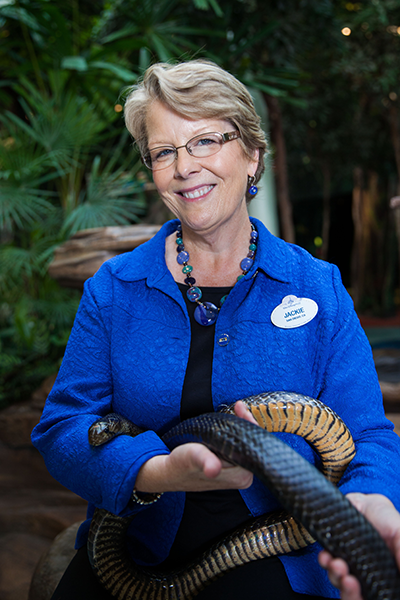
Jackie Ogden, PhD, played a key role in the development and evolution of Disney’s Animal Kingdom. Her educational background in psychology and animal behavior made her the right choice to work on this complicated new park. She joined Disney in 1997 just eight months prior to opening and became the Curator for Conservation Station. Jackie ultimately became the Vice President of Animals, Science, and Environment for Walt Disney Parks and Resorts and worked there for 19 years.
On this episode of the Tomorrow Society Podcast, Jackie is my guest to talk about her career at Disney and beyond. Before joining Disney, she was the Curator of the Children’s Zoo at the San Diego Zoo. Her background leading a team focused on animal care and conservation fit perfectly at the Animal Kingdom. Jackie talks about what it was like to be part of the opening team for that park and how the group of experts delivered a place that served both the animals and guests.
We also talk about Jackie’s work on the important efforts of the Disney Conservation Fund around the world. Looking beyond the Animal Kingdom, Jackie discusses the Seas pavilion at EPCOT and the different challenges there. In addition, she describes the work of the Association of Zoos and Aquariums (AZA) and gives advice for listeners hoping to join this field. I really enjoyed talking with Jackie and learning more about her experiences at Disney and with animal care.
Show Notes: Dr. Jackie Ogden
Learn more about Jackie Ogden’s work as the Founder and Principal at Natural Leadership, LLC.
Watch Jackie Ogden speak about environmental sustainability at the World Environmental Education Conference on September 30, 2015.
Read a Zoophoria interview with Jackie Ogden from December 17, 2017.
Support the podcast through a one-time contribution and buy me a Dole Whip!
Transcript
Jackie Ogden: I always remember when Bob Iger went to Africa for the first time, and I’m pretty sure when Bob goes to Africa, he has a pretty special experience, and so he saw a lot of the work we were doing and he called me when he got back and said, oh my God, I knew we were doing great things, but when you see it, it’s like I am so proud. So that kind of thing is kind of cool.
Dan Heaton: That is Dr. Jackie Ogden, and you’re listening to The Tomorrow Society Podcast.
(music)
Dan Heaton: Hey there. Thanks so much for joining me here on Episode 212 of the Tomorrow Society Podcast. I am your host, Dan Heaton. Really excited about this show where I talked with Dr. Jackie Ogden, who worked for more than 30 years in leadership roles in the zoological world, including 19 years with the Walt Disney Company where she was the vice president of animal science and environment for Walt Disney Parks and Resorts. Also was very closely involved in Disney’s Animal Kingdom. She joined Disney less than a year before the opening of that park, led teams at Conservation Station, and then her role expanded to cover efforts Disney was making around the world, plus at the Seas Pavilion and of course at the Animal Kingdom in Walt Disney World.
And we dive into her career at Disney. A lot of the efforts in that park, some of the challenges with something like Kilimanjaro Safaris where you want to make sure you have top-notch animal care, but also it’s a theme park with guests and entertainment and how does all that come together. Then we talk about a lot of the cool conservation efforts that Disney’s doing, like you heard in the intro work that Jackie’s done on environmental sustainability and just some of the things that interest her about what’s currently happening in the world of animal care with zoos and aquariums and a lot more. So let’s dive right into it. Here is Jackie Ogden.
(music)
Dan Heaton: Jackie, thank you so much for joining me on the podcast.
Jackie Ogden: It’s great to be here. Thanks for inviting me.
Dan Heaton: Oh, totally. You were involved in so many interesting things and I really liked talking about the Animal Kingdom, especially with it being 25 years now that it’s been open. It just seems like the right time, but I’d love to even go further back with you and just what got you interested in ultimately moving to a career where you were focusing on the animal world and zoos and everything related to that?
Jackie Ogden: I was lucky enough to grow up in San Diego, California until I was 13 years old, and when I lived there, my parents sent me to basically I think every education program that the San Diego Zoo had and I fell in love with animals. Also really realized I really liked zoos obviously, and thought, gosh, I think I could see myself in this sort of a place.
I also spent a lot of time in canyons behind my house, a lot of times in natural spaces in general. We went camping in Yosemite every summer, those sorts of things too. So I think I was destined to go in that direction, but I got really bad advice when I was in high school, which was sort of the standard thing that people tell kids, which is if you want to work with animals, you have to be a veterinarian, especially if you want to make a living working with animals.
And it’s completely not true, but they just don’t know, and so they say what they know. And so I tried. I volunteered with a local vet and went, this is not for me. I really love working, seeing really healthy animals. I’m a little too emotional to work with sick animals. You should see me while my dog is not sick or is sick. So I ended up going a different direction and studied industrial organizational psychology. I am one of the weird animal people that also likes people, and so I said, well, okay, then I’ve always been curious about people too. So I will study them and then I’ll work with them.
Dan Heaton: So that raises a really good question of if you went in that direction and then ultimately still used your psychology background, but ultimately kind of switched gears, I know went back to school and then focused more on animal behavior. So what made you decide to ultimately make that change?
Jackie Ogden: Well, I was really old when I decided to make change careers. I was 26 and it was really, it’s so funny saying that I thought I was way too old to change careers. It’s like, gosh, I’m on track and I was actually making decent money and I had a real job and my parents were so happy that I was making decent money and had having real job.
But I also realized that I was spending all of my free time volunteering for animal and conservation organizations at the age of 26. I went, okay, there’s got to be a way I can make money doing this. And so I started looking into it. I still thought it was a little late to try, but then one of my very dear friends that I was dear friends with at the time was sort of elderly. She was 36 and she was just in the middle of leaving a really great job.
She ran the MS Society in Seattle, Washington to go back to school to be a clinical psychologist because that’s what she had always wanted to do. And I went, oh my God, if somebody that old can do this, then surely I can. So I decided to do it, and this is something I actually recommend to people a lot. I tried out a bunch of different things as a volunteer, as much as you can do some of these things as a volunteer and got a real feel for what sorts of things I wanted to do and like to do, and I’ve always wanted to go to graduate school anyhow.
So I decided to go that route and my goal was to go to graduate school focusing on animal behavior and research because I really love research. I’m very curious about behavior in general, whether it’s people or human or non-human animals. But I really wanted to come out of graduate school, not moving into academia, but actually in a leadership role within the zoo and aquarium and conservation worlds. So I did. I went to graduate school at Georgia Tech in Atlanta, and I went there because my major professor, Dr. Terry Maple, was also the head of Zoo Atlanta at that time. So I was able to do my research there, which was really, really great fun.
Dan Heaton: Well, I’m curious, just to ask you too, having to do with the psychology background, I not someone who works in the world thinking in terms of, well, psychology actually fits really well with animal behavior. So I’d love to know a little bit just about how you kind of merged the two where you focused on animals but also still use your psychology background.
Jackie Ogden: So I think that psychology is a great field to focus on. I think it really grounds you in behavior. It grounds you in cognitive functioning whether you’re dealing with humans or not. And so I’ve always been interested in behavior. I mean, I could watch people for hours; I love going to airports. I always love going early and having layovers. I’m one of the only people that likes that because I know there will be great things to watch.
And of course I love animals and watching animal behavior. So when I’ve had the incredible opportunity to go to Africa a number of times and when I’m with a group of people that aren’t necessarily animal people, I have to really be careful to not overwhelm them with how long I want to stay and watch a carmine bee eater because they really don’t. And so I have to be sensitive to that.
Yes, I know we’re leaving after 20 minutes and that’s really okay, Jackie. So I just love watching behavior and it is interesting. I often had people when I was a Disney executive, I often had my peers in other areas say, so does this psychology animal behavior background help you at all in your field in your job now? And I went, oh yeah, completely. It really is all primate behavior. And so especially since I, apes and apes were a lot like apes. Apes are a lot like us. So when I would get frustrated in meetings, I would just start thinking about the behavior and thinking about what particular behaviors they were displaying and what it meant. And that was always entertaining.
Dan Heaton: Well, I know that you ultimately after school or possibly connected to that, went and worked at the San Diego Zoo before joining Disney. So I’d love to know a little bit about that because San Diego Zoo is one of the premier zoos around the world still is, and at that time especially seemed to just really stand out. So would love to hear a little bit about what you did there and how that ultimately led you on the path to where you ended up at Disney.
Jackie Ogden: Having grown up in San Diego, I always wanted to work at the San Diego Zoo, and I don’t know if you’ve ever done the exercise of writing your own obituary.
Dan Heaton: No, I have not.
Jackie Ogden: I have not. It’s a great way to get to have student age. People sort of get a feel for actually what they want their life to be like because it’s as if you were writing your life story and often things come out of it that you don’t necessarily realize you’re driven towards. And in my obituary, I was the head of human resources because I was studying industrial organizational psychology at the time. I was the head of human resources at the San Diego Zoo, so I always had wanted to work there.
And so when I was at Georgia Tech, I was planning on doing my research at the zoo on cognitive functioning cognitive behaviors in primates. One day Terry Maple, my major professor who was great and always provided me with incredible opportunities and still does, he called me and said, so if you had the opportunity to change your dissertation, do something entirely different, but go to San Diego and be able to do your dissertation there while you’re answering a different question that they have and actually get paid for that experience, would you be interested?
And I went, well, yeah, of course I would. But I also just was just about a year into my first really, really serious relationship and we were very committed to each other and I had learned that you don’t just make these decisions, you go home and you talk about it. So I said, I need to talk to him, but yes, and Terry said, well, there is this downside.
You have to be there in three weeks. Oh, okay. So bottom line is I did go. So I went into the research department, the behavioral research department, which was part of what was then called the Center for Reproduction of Endangered Species as a predoctoral fellow. And the zoo was really interested in having questions answered about their new Gorilla Tropics exhibit, which was beautiful, is beautiful. They were interested in it primarily really actually from the guest perspective and what guests were taking away from the experience.
So that was the first time I really started doing a lot of guest research, which was really, really fun. I stayed in the CRES for three years, two years in a postdoc position, and then had the opportunity to move into the Children’s Zoo as the curator there, which was my first opportunity leading a large team. I’d really just led interns and volunteers before. So the zoo really took a chance on me. I was going, really, I don’t think I can do this, but, and it was just a great experience.
I learned a ton about leadership. They were great group of people, really. I think areas that focus on kids just naturally sort of by definition focus so well on programming and interpretation, you kind of have to. So it was really great fun and I loved being there, and I really sort of saw myself retiring from the San Diego Zoo because at that point I was 31, so clearly close to retirement, but I really did see myself staying there.
My husband and I loved San Diego. We just bought a house, all of that. And one thing you probably know is the zoo and aquarium world is really small. Everybody knows everybody. And because Terry was so good at providing me with opportunities in graduate school, I’d started presenting at conferences and publishing really early. So I just knew a bunch of people already. And in fact, one of my dear friends I had worked with at Zoo Atlanta, and she was one of the first animal people Disney hired.
So when she moved I said, just don’t call me about a job. I’m happy. I’m really glad you’re there, but I don’t need to go, just let me be. And she behaved herself for a couple of years and then she finally called and said, we just can’t find somebody for this job that is curator of Conservation Station, and it’s in some ways not dissimilar from what you’re doing, and we just keep talking about you.
Would you consider coming out? And it’s like, oh. So I dutifully went home and talked to my then now husband about this opportunity and he looked pained, I kind of was, but said, well, you kind of have to try, don’t you go see it. At least it’s like, yeah, I guess I do. Once you see something like that, and once you see this giant park that is coming up from where there used to be orange groves and now it’s just sand, it was like, wow, this is pretty darn cool. Then I knew they were putting together a great animal team from all over, mostly AZA institutions, really incredible.
I knew many of them and I knew that they were really talented; I knew that because I knew something about the Disney company, I knew that it was a very ethically focused company, so I knew they would do the right stuff for animals. I knew they were very focused on inspiring people to conservation action, which is one of the things that gets me up in the morning. And I also knew from the people I had met when I was out there that there were some really great leaders there, not just within the animal team, but more broadly and that they would be great role models. So I decided to go.
Dan Heaton: Well, wow. So that covers so much just of what I was going to ask next, which is great. So what were some of your initial impressions of Disney’s Animal Kingdom, particularly of Joe Rohde, who had led the design side of it from Imagineering for such a long time, even prior to when you arrived and then the park opened?
Jackie Ogden: Animal Kingdom is a really unusual park, so it is absolutely a great zoo. It is accredited by the Association of Zoos and Aquariums. It does everything that a great zoo should do; it also is a full-fledged Disney theme park. So that means it has world-class entertainment, it has great dining opportunities, it has of course Disney characters, it has all of the things that make a Disney park, a Disney park, and the person that really deserves credit for that is Joe Rohde.
And Joe led the design of Disney’s Animal Kingdom and then stayed with it for, gosh, probably what, 15, 20 years? He just retired I think, from the company. Joe really deserves credit for first diving into this project with I think a passion for the environment, but without, he had never designed an animal-based theme park before and he did an amazing job.
So it is the park that I think has the highest integrity of how you link the attractions, the storyline, the experiences, the animal piece, and the Disney piece all into one. So as a result, the rides all have a real conservation message. And in fact, Expedition Everest when it opened, not only has a great conservation message, but there was significant funding associated with this opening that went to Conservation International and others to do conservation work in Nepal and China.
So it’s really serious, and Joe deserves a ton of credit for making that all happen and also working incredibly hard. And I know it took a lot of incredibly hard work to ensure that the product continued to have that integrity. And it’s why it’s such a great place and why it’s so wonderful and it’s why we all love it. Joe is quite a character, as you may know, and is brilliant as well.
Dan Heaton: So you ultimately make the decision, you’re like, okay, I’m going to do this. What was it like then to, well, one, you’re moving across the country, I assume, but then ultimately to join them for a project, like you said, it’s so big and you joined pretty not that long before it opened. So how chaotic and crazy and just interesting was that?
Jackie Ogden: All of those things, it was amazing and it was challenging. It was so cool to be there as it emerged. It was all the things that you would think it would be. You’re putting together a team of people that are coming from over 50 different AZA institutions, which is pretty incredible and that don’t necessarily know each other. And then you’re trying to integrate them into the Disney culture, which is really different than a zoo and aquarium culture.
You’re trying to also educate the Disney people, what you do and what it’s like to be in the animal world and the things they now need to think about. And so it was really, really great fun. It was chaotic, you’re right. I joined late because they had trouble filling the role, and I did not think until a couple of years later that I actually was only there for eight months before we opened. It was never useful for me to think about that at the time. So I had way too much to do. And it’s also creating systems, processes, bringing your animal family together too, lot of stuff.
Dan Heaton: Well, yeah, I mean, there aren’t that many brand new, I mean, I know this is a little different like a theme park and a zoo, but brand new zoos that appear in the United States or in North America. So how much was involved with that where you have this entirely, like you said, from the ground up park where habitats are being created and conservation station, but then as an attraction, but all these other places and it’s not building on something that already exists?
Jackie Ogden: So it’s fascinating. It is challenging. It’s weird for most, well, really for all of us, the design part was kind of done when we all started. There were certainly tweaks that could be made when I started, there really wasn’t even a lot of times a tweak. Things were really at that point, any tweak was scope creep and nobody likes that. So many of us were given the spaces that we didn’t really have a lot of control over. So that’s always hard. But in large measure, they were great designs.
And so it was a matter of then figuring out, okay, how are you going to use this design? And this space was actually made for golden lion tamarins, but probably not the best place for golden lion tamarins. So what else do we do instead? Those sorts of things.
Then of course, bringing in all of the animals from mostly AZA organizations then really as you’re working with the animals, getting them accustomed to being there, socializing them, starting the training programs, all the programmatic work of how, and because my role was bridged both the animal side and the education side a lot, I’ve worked with the education team a lot on what messages were we going to get across, what animal demonstrations were we going to do? How were we going to integrate our conservation stories, all of that stuff. So it was just fascinating and complicated.
Dan Heaton: I can imagine. Well also too, I mean, I’m curious to know a little bit about, I know you mentioned the design was in place, but you’re coming into something where you have experience with the San Diego Zoo, which again, kind of has themed entertainment elements and always has, but then it’s a theme park where Disney still has guests that are coming in expecting a Disney park, but then it’s also somewhere where you want to give top-notch animal care. So was that, I mean, was there a push, I mean, again, not a push and pull meeting, there’s anything, not anything a sacrifice, but I’m curious about that kind of mix when you’re working there.
Jackie Ogden: Yeah, so that’s a great question and absolutely is something that the entire zoo and aquarium world was very curious about. And as you said, San Diego also has some highly themed areas, although the Imagineers don’t love that term, and every zoo or aquarium really has goals. They have both entertaining people as well and recreation as well as educating them and inspiring them to conservation action. So everybody does that to some degree or other. Disney’s just probably on the end of the spectrum in terms of how they do it.
I think what helped was that conservation was so woven into the theme of the park. Even the rides had conservation messages woven in. Now, does everybody that rides Kali River Rapids really understand that it is about deforestation? No. No, they don’t. Probably, but some folks do get it. But I think for the people that worked there, the animal folks, that was really helpful to know that the designers cared that much, that Disney cared that much about the conservation piece, that they even integrated messages into the ride, and there was a huge focus on integrating conservation into everything.
When we opened the Mickey Bars, actually the wood stick actually had conservation messages on it. We gave them a lot of training about what it means to be an animal park and what it means to be at accredited zoo and why we care about conservation, what Disney was already doing for conservation, those sorts of things. So it was interesting.
I mentioned that the World Association of Zoos and Aquariums, the accrediting body for probably the best accrediting body in the world for its 230 some members. So everybody within that group was watching all of this very closely, and particularly people that didn’t know Disney as a company, which honestly, other than the Wide World of Disney on Sunday nights, probably most of our folks really weren’t, they certainly weren’t Disneyphiles. They might’ve gone to the park a few times, but they didn’t know a ton about the company.
So it was pretty easy to think that Disney was going to do what I fondly refer to as stupid animal stuff. There would be chimps riding on bicycles, bears on unicycles, all of that stuff. And if you knew something about the company and knew how ethically what their code of ethics is, you would know that was never going to happen. But there was that except, and so there were just a lot of myths. One was about the chimps riding on bicycles.
Another was that as soon as things get tight, the conservation support is going to go away, all of those sorts of things. And so it took time to demonstrate that none of those things were true. And so those of us that were there, we talked a lot to all of our colleagues and we took a lot of razzing. But one of the great things is that the Disney gang generally has a great sense of humor.
The company as a whole, certainly within parks and resorts, and certainly within Walt Disney World, indefinitely at Disney’s Animal Kingdom, and they generally don’t love ego when they’re hiring people. So there were a whole bunch of people at Disney’s Animal Kingdom within the zoo and aquarium world that didn’t have a lot of ego and had a good sense of humor and were able to laugh at themselves.
So we spent a lot of time laughing along with people to their jokes, cringing inside, and then taking an opportunity to tell them what it really was. And so we did that a lot. We gave a lot of presentations at conferences on what we were doing. And we also did a huge thing, which is we shared a lot of information that is of course, what any accredited zoo or aquarium would do, but everybody assumed Disney would not do that.
And we did. We openly share policies, this is still true, openly share policies, openly share SOPs, those sorts of things. And of course, getting legal to understand why that was critical was hard, but we did. So that helped a lot. And I think just the fact that we knew so many people and those people did trust us to some degree to not have gone someplace that was stupid. So I think they also felt a measure of comfort, oh, if you guys are there, then it must really be okay. And then we went through the first economic stuff and didn’t cut the conservation programs and those sorts of things, and that was hugely helpful.
Dan Heaton: Well, yeah, because there was a downturn with travel and a few years after it opened. So the fact that it hung in there, I think this is a good time to ask you about the Disney Conservation Fund and about some of the efforts there, because as I learned more about that through a few other interviews, and then also through what I’ve read, I’m impressed just by how much is done because you can go to the park and you’ll see info and stuff, but as you dig in more, there’s just so much there. So I’d love to know, you’ve referenced it a few times, but about that Disney Conservation Fund and what impact it’s made and kind of your experiences.
Jackie Ogden: I mentioned that one of the reasons I went there was that I was sure that Disney would do a lot for conservation, and that has absolutely been true. And in fact, it grows. The company was very smart and put together a group of experts from the zoological world, but also the animal welfare world, and they became the Disney’s Animal Kingdom Advisory Board.
They were very instrumental in helping the company understand what all of this meant. One of the key lessons that they provided was you have to do conservation work, you have to support conservation, and it cannot just be an afterthought. You can’t just put something, put a, what did they say? Put a Band-Aid, lipstick on a pig. You can’t put lipstick on a pig and think that you really are, have people really believe that you’re serious about this. And so that led to the development of the Disney Conservation Fund.
It was on the Disney Wildlife Conservation Fund, and a great woman and friend and friend Kim Sams, who was within the public affairs team, was the one that really guided it along. She just retired maybe this last year. And so she was really instrumental in bringing all of that to life. And of course, our team worked really closely with them. So the Disney Conservation Fund, which initially was called the Disney Wildlife Conservation Fund, started in about 1996, so before the park even opened.
And since that time, it has provided more than 125 million to organizations, conservation organizations around the world, about 25 of them, and including 400 different conservation grants that have helped more than 200 species. And of course, it’s not just the species that are important, it’s the habitat, and certainly that’s a focus. So the Conservation Fund has done just incredible things. They’ve provided huge support to the Association of Zoos and Aquariums for many years.
There was a separate, well, I guess there still is a separate pot of money that Disney would give to the AZA to use as part of their conservation granting the AZA’s conservation granting program in addition to the funds that they already had. And so huge impact that way as well. Then when I was there, I think believing that we would just be a granting organization, that we wouldn’t do a ton of our own conservation work, but over time it became clear that that was not the smartest way to do this. That, again, when you’re trying to really make a difference for conservation, it’s one thing just to write checks, but you have to really do the work.
And especially if you want to tell stories to people about what’s going on in conservation, it’s a lot more meaningful if you yourself or your teammates have been involved in monitoring sea turtles on the east coast of Florida and really, and then watching the babies, if you will, sorry, not very scientific, emerge and go into the water, and that’s a whole lot more meaningful of a story then. We wrote a check to the sea turtle.
And so we started doing more and more of that work ourselves. And that’s really grown. So one of the things I heard recently is that we’ve recorded the one and a half millionth sea turtle hatching, and we’ve counted over 20,000 nests on the eastern coast of Florida, primarily around where the disease Vero Beach Resort is. They’re involved with a whole bunch of other work, whether it is work with butterflies, whether it’s work with gorillas, whether it is working with birds that are found on the Walt Disney World property, including purple martins, really cute little song songbird that is sadly really in decline because their habitat is going away, their homes are going away.
The team has put up over 400 different nests across Walt Disney World and they’re monitoring it, which also means they can have cast members from other areas be part of the monitoring so that everybody begins to realize that this is really not just the conservation team’s work, but it’s our work and everybody supports the conservation mission. So they’ve done incredible things in that way.
Dan Heaton: Wow, that’s really impressive just to hear those numbers in terms of the sea turtles and everyone else, I think this leads well back into circling backwards to when you started at Conservation Station as a curator. So I would love to know a little bit about your work there because a really interesting place, just I’ve been there and then they’re performing, sometimes performing in operation, and then there’s just a lot of interesting elements of that place from the start and continues to be that way today.
Jackie Ogden: So I love Conservation Station, and it was great fun to help bring it to life. It’s a really interesting part of the park. It’s the part of the park where really all of the stories come together to really talk about what Disney is doing to help animals and habitats around the world, and really what’s involved with all of that.
There’s also challenges with Conservation Station in that, as you probably know, it’s a little hard to get to. And what that means in a Disney Park is if you have to go a long ways to get well, really anywhere, if you have to go a long ways to get to something, you really want to pay off for that I’m old enough. I don’t know if you are to remember Disney when we graded the rides by letters. So an E Ticket ride was the Matterhorn at Disneyland, it would be the Safari or Everest at Animal Kingdom.
And so if you go that far, if you walk that far to get to an attraction in this case Conservation station, you really think you’re going to get an E-Ticket experience. It was never designed to be an E-Ticket experience. It is really, it’s got incredibly cool things in it and fun things to do, but people have to do them. And sometimes people are less willing to do so. So that’s a shame because it really does.
It is the most interpretive part of the park, both in terms of especially what Disney is doing for animals and conservation, including the parts where you actually look into how it is that we care for animals from a research perspective, a science perspective to a veterinary perspective, to a nutrition perspective. And so being able to give windows into those things and also to show we’re proud of what we do. You can see our veterinary care right here that is really great. One of the things that’s really fun now is the number of zoos that and aquariums that have now created an opportunity for as they’re building new veterinary areas for people to see into those. So I’m pretty sure vets around the world are really annoyed with Disney. So as they didn’t all love, they don’t being on show as we say.
Dan Heaton: Yeah, I’m sure they’re like, we were doing just fine. But for me as a guest, I think it’s something that you’re like, if you go by that window and something is happening, it’s like, wow, wow, this is something really special. But you’re right, you do have to take the train and then walk. It almost feels like you’re discovering something so far away, but not everyone wants to have to do that. I understand.
Jackie Ogden: It’s an ongoing challenge. I’m sure that I think there are always people in the background at Disney that are thinking, so how could we change this in some way? So I suspect it something will change over time, but it’ll be interesting to see what that is.
Dan Heaton: Yeah. Well, you referenced the Safari, Kilimanjaro Safaris and then earlier you referenced Kali River Rapids overall, I mean, especially with the Safari, what always kind of interests me is just how complicated it was to have it where you’re riding past all these animals and then you can’t see the fact that we can see ’em so closely, but it’s hard to realize that they’re blocked in a way or there’s things put in place. But I know you came in kind of late in the game, but I’m curious just from what you saw, just how complicated it was or how can you put in systems like that where it can be effective, where guests can see the animals really well, but then it also makes sense for all those different type of species and everything else.
Jackie Ogden: So it’s hard. Yes, it really is. You use the right term. It’s really complicated. It is arguably the, I believe still the best animal experience as a whole in a zoological park or a theme park in the world. And it’s because of its nature. So it is over a hundred acres. You’re of course supposed to be in Africa. That was how it was designed.
There are a couple places in particular that they drew upon, and when you go to those places in Africa, you go, oh my God, it really does look like the Safari ride. It’s amazing how incredible, how incredibly accurate the experience of being on the Safari, aside from the fact that there are lots of other Safari vehicles, but I just realized I was just in Kenya and Tanzania this past year. There are a lot of Safari vehicles there too, so maybe that’s not so different.
But so those animals, as you said, they need to have a place to go at night, have bedrooms just like we do, and some of them stay out, but most of them go into bedrooms. And that’s because you have to keep, if you want that area to keep looking like not Africa in a severe drought, then it means you have to take care of it. You’ve got to do maintenance, you’ve got to do horticulture work and irrigation work, whatever it might be, road work.
So that means that most of the animals really can’t be out at that time. And also we need to look at the animals, and so the animals need, and we need to be able to have the animals come inside if they need to for treatment or because there’s an emergency or whatever. So that means that every animal that is on the Safari has to be trained to go in and out every day and at will.
You don’t time an emergency. So if there’s an emergency, they have to come in even at the wrong time of the day. So that is incredibly complicated and it’s all, it’s not inexpensive as you might guess. A lot of people involved in making that occur and that all work, we always call those things that Disney daily miracle, that just all comes together. So it’s even more complicated by the fact that it is such a mixed species exhibit and that it is run by both animal people and operators and right operator. Operators are not used to dealing with live animals except for people.
The Jungle Cruise maybe arguably is a little different except for those animals actually aren’t alive. Sorry, what? I know. I know; I hate to spoil the magic. And so as you can imagine early on and to this day, there’s a constant focus on training the non-animal people, training the drivers that also aren’t animal people, both in the messaging and the spiel. There is of course a spiel, but they have to understand a bit more about it so they understand sort of why the spiel is the way it is. And then they also have to really understand not only how to drive those vehicles, which is not easy in and of itself, but how to do it when they’re actually animals there. So that was really hard at the beginning, and it continues to be hard today. It’s just complicated, but the end result is phenomenal.
Dan Heaton: I almost feel like the behind the scenes is even more interesting than doing the ride itself, which is also great. So it’s kinds both ends of it. Well, I want to focus to expand a little bit to your role as it expanded, but I’d love to just ask one more question about Animal Kingdom. From your perspective, what’s an aspect or part of your work on the Animal Kingdom that you look back and you’re like, wow, that’s something that I’m proud of, or something that was a good accomplishment?
Jackie Ogden: Great question. I think probably two things. One is I was part of really building what I considered to be a healthy culture, organizational culture. I care deeply about cultures and know that really it is the leadership ultimately that creates that culture. I really felt like I created that. My team worked closely together. They were open with each other about what resources they had. They shared resources. It’s like nobody does that. And so that was one piece. I think the other piece was working to have our cast members, because of course Disney does call them cast members. Our cast members are actively involved in field conservation. So we weren’t just writing checks.
So doing that, but also having the company not only accept that we were doing it, but be proud of the fact that we were doing it. That was huge. I always remember when Bob Iger went to Africa for the first time, and I’m pretty sure when Bob goes to Africa, he has a pretty special experience, and so he saw a lot of the work we were doing and he called me when he got back and said, oh my God, I knew we were doing great things, but when you see it, it’s like I am so proud. So that kind of thing is kind of cool.
Dan Heaton: Oh yeah, yeah, to get any calls from Bob Iger, but with that kind of message, that’s pretty awesome. Well, I know your role did expand where you were going beyond Disney’s Animal Kingdom, and then you were kind of working with efforts across all parks and resorts. So I’m curious to learn a little bit about how your role changed and some of the things you were doing as you moved further in your career at Disney.
Jackie Ogden: So at Walt Disney World, there is the operating teams at all of the parks and all the areas, but then there also is a group that is called the Line of Business Organization, or at least that’s what it was called. I’m sure it’s changed names now. But in that Line of Business Organization included leaders from food and beverage, from merchandise, from operations, well from animal science and environment and a number of others, entertainment and so on.
So we were responsible for working with all of the operations to ensure that people were following the same standards, that we had consistent standards, that we knew how to make their lives easier from an operational perspective, that sort of thing. I was, I think, the only person on that team that led not only the line of business piece, but also the operational piece because they realized animals were a bit different and that it was going to make sense to do that.
So at one point, the Line of Business Organization shifted from being just at Walt Disney World to around the world. And so all of a sudden the Line of Business Organization served all of the theme parks, whether it was in Hong Kong or whether it was in California and Paris and Florida, et cetera. And I think that’s changed now. I think it’s gone back a bit the other direction. Pendulums always swing back and forth, but that’s how that shift the animal part of that shift was made from a parks and resorts perspective.
What really changed within my role over time, first at Walt Disney World and then across parks and Resorts, is the company got really serious about the environment and about environmental sustainability. And we’d always had a focus on it. I mean, Walt was very passionate about animals and conservation. So there were green teams everywhere, and there was a tiny little group of people that did an amazing job helping to support these gazillions of green teams that were everywhere.
But it was really a grassroots operation. And all of a sudden Bob said, if we’re going to be the most admired company in the world, we’d better be serious about what we do from an environmental perspective. And the environmental perspective world was starting. I think people are starting to realize how incredibly complicated it is and that there’s no easy answer, and you really have to do a lot of work to figure out what the right thing is to do. And it varies.
The right thing to do varies between where I now live, which is Bellingham, Washington; to really different when you were talking about Hong Kong or Shanghai and so complicated. So they decided to put in a person within Walt Disney World that was at a higher level on the environment. So I then had that added to my scope. And then when we went global, that scope went global.
And so each park had a small group of people that were focused on it. I mean, these are really pretty small teams. They do an incredible amount of work and they’re amazing people. So small groups that did that work. But then I was responsible really kind of at some level for making sure that they did do the environmental work that we were supposed to. And when the company got serious about that, about the environment, they also put in place, and Dr. Beth Stevens, who had been running Disney’s Animal Kingdom, then moved into leading that for the company.
So she led the effort to develop company-wide environmental goals and company-wide targets. And because of the fact that while Disney World alone is a huge part of the footprint, and then Walt Disney Parks and Resorts is a giant part of the footprint, I also help develop targets, develop the company-wide targets because we were so much of a part of that, such a big part of that footprint.
So that’s really how that changed and how my role became global. And it was great fun. The environmental work was fascinating and hard and complicated because inarguably, the operational leaders within parks and resorts have a lot of priorities, and they may love the planet and they may love the environment and they may love animals, but they have a bunch of other things that they really have to love more. And not all of them really are huge lovers of animals, and that’s probably maybe not going to change.
So getting them to focus on this work and do this work, it was really all about making it as easy as we possibly could and also really showing them demonstrating over and over again what the business case was for doing this work, and then also what metrics we were looking at to help them do this work, understand how they were doing, getting reports on it, yada, yada, yada, all that stuff.
Dan Heaton: It sounds like a very big job. That’s what I’ll say, especially given just sustainability for Walt Disney World, like you mentioned. I know they added that very large renewable energy, solar panels that they’ve been adding, but I’m sure there’s so many efforts like that in every corner of the resort. I want to ask you about one particular corner a little bit more relating to that, because I know that the Seas Pavilion is kind of the other big, when you think about areas that have a lot of animal care or animal behavior in Walt Disney World, that’s the other big one.
And going back to the late ‘80s, I remember going there as a kid when it first opened in 1986, that was like, whoa, this is something. But I’d love to know a little bit just, I mean, I know that you were in charge of a lot of things, but just from your perspective, what kind of stands out to you from that pavilion or just maybe even challenges about how to keep it running well?
Jackie Ogden: So I love what was then The Living Seas and is now the Seas with Nemo and Friends. And so when that was added to my portfolio, it was like, oh my God, this is so exciting. And oh dear, I know nothing about the aquatic world. I quickly learned that the aquatic world is arguably inarguably more complicated than the terrestrial world. And certainly it was very clear. I do very little.
So the really great thing was that there was and is an amazing team at the Seas that helped educate me, and I really began to understand how the different elements that made all of that work, and one that people really know very little about is the life support team. What they do is they ensure that the environment is safe for the animals, is right for the animals, is what it needs to be.
And at the Seas, they make their own salt water. So there is an incredibly complex process to get that recipe, if you will. These aren’t folks that just turn screws or fix pumps. These are experts in chemistry. So I remember attending meetings and seeing all of the calculations up on a board kind of as if you were in NASA and knowing that they were using calculus and that there was a small part of my brain that should remember that, that really didn’t.
So I’m sure that they clearly got that. I had not a clue what they were talking about, but I knew they were brilliant and they were doing all of the things that they should do. They were also quite good at answering my stupid questions. So that’s just one example, and then just how it is that you care for and feed animals that are in the water a whole different thing.
And then the other thing that I certainly didn’t realize, and I think a lot of people, sadly, people still don’t always think that fish are animals, which is just wrong, is fish are animals. They certainly don’t know much about them. And first, actually while I was there, I got certified in scuba diving. It just sucks you in, right? That whole world. And as I’m trying to learn how to identify fish. So did you know that many species of fish are one shape when they’re kids and one color when they’re kids, and then that changes as they get older?
Dan Heaton: I did not know that.
Jackie Ogden: And so nor did I, and so at first I was diving and first snorkeling and then diving and going, oh, okay, so got it. You need to understand, it’s like birdwatching, right? It’s much harder than birdwatching because they change as they get older. So it’s really tough. When I started there, there also was an increasing focus on aquariums and on aquatic animal welfare because of the fact that broadly fish were not considered as much animals, they didn’t get as much attention, and that was really wrong.
So as I was there, it was clear that there was a sea change, if you will, where that was really changing and people started demonstrating that you can actually train these aquatic creatures, whether they’re invertebrates, whether they’re turtles, whether they are a fish. The Seas started doing that, and so they started training individual animals and demonstrating that, in fact, fish aquatic creatures really could do this.
So that’s really cool. And then also from what we call environmental enrichment, which is really just about making the habitat you’re providing for the animal as much like their natural environment as it can be from a behavioral perspective. So not just how it looks, but how it actually functions for the animal and how it makes their life interesting. And so that other than aquariums have really been about how they looked and not so much about the, is it actually enriching the life of an animal?
That has really changed. So all of those things that zoos have been doing for a while started being applied to the aquatic world. Now, there were many things that the aquatic world was much more sophisticated in than the terrestrial world, but they sort of all came together and they already were very sophisticated on the veterinary side of things because they had to be. And so that really, really fascinating. I loved that work.
Dan Heaton: Oh yeah. It’s so interesting. Again, the behind the scenes just being so interesting for that pavilion. I mean, I have not done it, but I would love to; I know they offer where you can kind of go diving. I mean, I’m not a scuba diver, but just see that behind the scenes it looks incredible. Well, I have a few more overall questions to ask you before we finish. So I know you’ve referenced it a bunch of times, but you worked closely with the Association of Zoos and Aquariums throughout your career with the AZA. What’s it been like for you to be a part of that organization? What’s your experience been like there?
Jackie Ogden: I am a huge proponent and supporter of the Association of Zoos and Aquariums, and I always have been. I think it kind of goes back to the fact that I actually like people and how people work together. And I’ve also, it’s always been really clear to me that the Association of Zoos and Aquariums, which is, it’s really the accrediting body for primarily North American zoos and aquariums, but many others scattered around the world.
It has so much potential to impact the animal and conservation world because every accredited zoo or zoo aquarium has guests. So I’ve always seen that potential a bit, but we need to do it better. And really every conservation organization that we work with would kill to have those people coming to their place. I don’t think they want to do all the work that it takes, but they would kill to have that opportunity.
So I’ve always loved that. And I worked with AZA starting from the very beginning. On the very beginning, I worked on the AZA has and the other regional zoo and aquarium organizations all manage many species cooperatively. So you can think of it as, and I’m sure you know about this, but you can think about it as a dating game that if you’re thinking about gorillas as an example, which I generally do.
There is a group of people that makes decisions about gorillas based on in terms of who they should be living with, who they should be, having babies with, all of that based on a whole lot of genetic information so that we have the most genetically diverse population that we can because that’s good from a gazillion, gazillion reasons. And also from a behavioral perspective, is this actually going to work? And from an expertise perspective.
So as an example, if you were moving a female that has a long history of having babies and they’re hoping that that’s going to continue, then it’s good to have a group of people that has dealt with youngsters before, especially if there’s a problem with maternal care. So they have all of that, and I love that. I also love the work that they do from a training perspective.
I was on the board of AZA, was the chair of the board for a year, and when I was a chair of the board, we put in place a leadership program to train people that were on the executive leadership track and were really thought to be ready within five years to run a zoo or aquarium. So we put a program in place to help them and nothing like that existed before. So I love all of that stuff.
And then of course, the education piece and inspirational piece, we’re really starting to use more terms like engagement rather than either. And learning and engagement instead of education just sounds so boring to people, which is a shame. I bet you don’t find education boring. I don’t. But a lot of people don’t.
Watching the education departments move into being operations that really focus on engaging people in a serious way and do it very thoughtfully and very professionally, and to also then realizing that they need to be thinking not just about what they’re teaching people about animal facts, but that they’re really reaching them emotionally and that they’re really creating empathy in that person for the animals and that they’re also, they’re really beginning now to think of actually they’re past beginning to, they are thinking about what behaviors they really change and the people that visit Susan Aquariums, and I love that part. And then finally, I really could go on about AZA, I’m so sorry.
Dan Heaton: That’s okay.
Jackie Ogden: Again, when I was on the board, we put in place a program called SAFE, which is Saving Animals from Extinction. And that program is really about, we have some members within AZA that do incredible conservation work. So all the New York zoos are part like the Bronx Zoo, they’re all part in the New York Aquarium. They’re all part of the Wildlife Conservation Society. That is one of the largest conservation organizations in the world. So we have some members that are doing phenomenal work, others that are doing a lot of work, and then we have a bunch that are doing stuff, but they’re just starting out and many of them are really small.
So SAFE is about helping the members of AZA really do more and better conservation. And so it’s about working within the community to establish safe programs that then can actually be things that zoos and aquariums can sign up for. And generally, if they have that species, I don’t think they have to, but have they have that species and then be part of conservation in a meaningful way where their teams can get directly involved, that sort of thing, but without having to have the infrastructure of a whole conservation department. So those are just some of the things that I really love about the ac.
Dan Heaton: Well, excellent. Well, that leads well into a question I have, which this is such a giant question. I don’t expect you to give me a large long-term monologue, but what’s a big change you’ve seen with animal care or with conservation, you think whether it’s in recent years or something that might be going on now, that’s going to happen? That is a really positive thing in terms of how with the zoo or aquarium or somewhere where animal care or even conservation’s really improving.
Jackie Ogden: So I think that the zoological world in general, and this is international, not just within the AZA, is focused more on animal welfare than I’ve ever seen. I think that’s really important. People have always cared deeply about the animals under their care, but the focus on really thinking about every aspect of their being is a little new. So that is really exciting to see how people aren’t just embracing that they’re doing it, and every organization now has to measure the welfare of their animals. It’s pretty cool.
So that’s one thing. From a conservation side, I think the biggest thing is not only the safe program, but it is, we have realized that it is one thing to develop a protected area, what a national park in another country is, if you will. But if you’re really focused on the conservation of that land and the animals on that land, just calling it a park is not very meaningful.
And often around the world, there are a lot of what are fondly referred to now as paper perks. And even if it’s a good park and they’re really doing everything they can, it is not easy to do and it doesn’t always work because of things like poaching and such. So what people are now realizing is that, and this is actually true not just for conservation, and zoos and aquariums are really realizing this in a very broad way. I think people are, that it conservation has to be based, it cannot be.
So historically zoos and aquariums have sadly been quite colonial just as people in the United States have been quite colonial. So we have a history of going into other countries and telling them how to do and what they need to do and how to do it according to the way that we would do it, but without really engaging them in the effort.
And lo and behold, that doesn’t work so well. Isn’t that shocking? And I know it’s like how did we ever think that would, but there you go, and it doesn’t. So now the really effective conservation work is being done in a community-based way. And so one of my favorite examples, and it’s a local northwest example, is out of the Woodland Park Zoo, a woman named Dr. Lisa Dabek has been working with tree kangaroos for decades in Papua New Guinea. So she started out really focused on the tree kangaroo. And so she went over to do research on them.
That grew to her realization that in order to be effective, she actually needed to work with the community. And now she’s so well established in these communities that they actually have set up protected areas and they’re now their protected areas and they’re the communities. You see examples of that all over the world. So I’m really excited about that part and I’m also just excited about just anti-colonialism in general and how more effective that makes us at everything. It’s just hard.
Dan Heaton: Oh, definitely. Yeah. I mean, I’m glad to see all the progress we’ve seen on that front. Around the world for sure. One last question. So I know there are listeners who are interested, whether it’s at Disney or San Diego Zoo or aquariums, zoos, wherever in getting involved in this field in some way. So I’d love to know if you have any advice or any wisdom to a part that might somewhat something people should look into or consider or just the type of work they might want to do.
Jackie Ogden: So I talked about how I tried what I was in high school to figure out how to get into this field and was other than being a veterinarian was unsuccessful. I then learned in college and particularly after college as I was looking at graduate schools and such, how many varied careers there were. You can be a park ranger and be actively involved with animals and conservation; you can be a wildlife biologist that works either in a nature center down the road or for the 70 national parks, for my Alaska area where grizzly bears congregate together every year. You can do wildlife biology and all of these species and usually as part of the local, state, regional, national governments.
So there are all those opportunities. And then the other piece that I think is really important, especially if people, so I thought I was old at 26 and I wasn’t actually, but there are a lot of people that have been in a career for a long time and 20, 30 years and all of a sudden realize that they really want to work for a conservation organization.
Then I meet with them and tell them kind of what it means and that if they’re going to do that, they’re going to make a lot less money to begin unless they’re at the executive director level. But what does work is the idea of doing the profession that you love to do and have expertise in within the environment of a zoo or aquarium or conservation organization. So I saw as an example, a woman that was in finance within Disney that loved the animal piece and really thought hard about if she could start over and decided that instead just to focus on being in finance within the conservation world.
And I think that’s a great thing to do, but there are, for people that are just starting out, one thing that they can do is the AZA now has a student membership, so that’s a great way of beginning to learn about it. You can also go to conferences on a reduced rate if people are interested in animal care. There is an association of Zookeepers, AAZK, AA, and so they also have student rates. A number of students do join them. So that’s one thing. The other thing that they can do is to just go in now and search for careers in animal conservation and they will be shocked and amazed by what comes out.
So there’s so many things. If you want to study endocrinology, you can work in a zoo because zoos do endocrinology on a daily basis and certainly conservationists do as well. So it’s just amazing what opportunities are out there and so people should not feel hindered.
Dan Heaton: There’s just so many good options out there like you said, and it’s great to hear that a lot of different things someone could do. Well, Jackie, this has been so great. I really appreciate the time and it’s been great to hear. Thank you so much for being on the podcast and talking about your career at Disney and then the world of conservation and what’s going on with animal behavior.
Jackie Ogden: It was so much fun and thank you so much for having me. Really great conversation and I would love to talk with you more about this. So really cool. Thank you for having me.
Dan Heaton: Well, that was great. I should add one more tidbit. If you’re a big fan of Flight of Passage and in the pre-show we meet Dr. Jackie Ogden from the Pandora Conservation Initiative, it is not a coincidence that my guest of this show has the same name because that fictional Dr. Ogden is a tribute. This came from D23, to the real life Dr. Jackie Ogden, who played such a big role in so many efforts at Disney’s Animal Kingdom and beyond. So a fun tidbit about this episode’s guest to show the impact that she’s had on the parks.


Leave a Reply