Podcast: Play in new window | Download | Embed
It’s easy to forget how much goes into every aspect of theme parks. The work involved moves well beyond concept art. The design and construction require intricate planning including the restrooms, trash cans, and building layouts. Kevin Sherbrooke has worked closely on a wide range of theme park projects for Walt Disney Imagineering, Universal Creative, and more. As an architect and show set designer, his role is crucial to ensure attractions come together effectively. Kevin is my guest on this episode of the Tomorrow Society Podcast to talk about his career and projects.

We discuss how Kevin got interested in working in themed entertainment and ultimately joined Disney. He started on EPCOT Center updates like Innoventions and the Electric Umbrella restaurant plus Honey, I Shrunk the Audience! at the Imagination pavilion. Kevin describes those experiences and visiting Walt Disney World for the first time along with that work. Next up was DinoLand at Disney’s Animal Kingdom during its development and the now defunct StormRider and Aquatopia for Tokyo DisneySea. Kevin describes his role in two of Disney’s most attractive theme parks in the late ’90s.
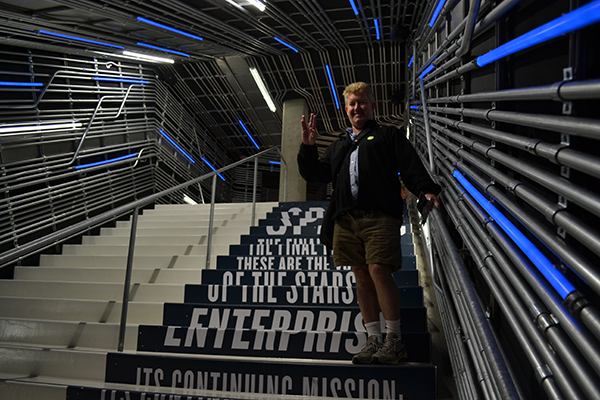
Beyond Disney, Kevin also worked closely on attractions for Marvel Super Hero Island at Universal’s Islands of Adventure. We talk about the differences between working at those two companies with Universal just getting moving at the time. Kevin also describes several projects that never came to fruition, including the very ambitious Star Trek attractions for the Red Sea Astrarium in Jordan. We conclude the podcast with some advice from Kevin to designers aspiring to join the industry.

Show Notes: Kevin Sherbrooke
Listen to the Themed Attraction Podcast interview with Kevin Sherbrooke from October 17, 2019.
Learn more about the unbuilt Red Sea Astrarium and the planned Star Trek attraction in Jordan on this page from themeparx.
Support the Tomorrow Society with a one-time contribution and buy me a Dole Whip!
Transcript
Kevin Sherbrooke: I would say I have multiple hats. I’ve gone from architecture to show sets to really almost construction management, to understanding the operations. Operations is a very huge and part of theme park design. I didn’t understand that in the beginning, but think about it. I mean, you build all these buildings, but if the people don’t flow into it, if they don’t queue properly, if they don’t go through the ride fast enough, you get huge bottlenecks and people get frustrated and hot waiting in lines. The pre-show and the line experience, how do you create story beats and keep people engaged?
Dan Heaton: That is Kevin Sherbrooke, who’s here to talk about more than 25 years working for Walt Disney Imagineering, Universal Creative, and a lot more. You’re listening to The Tomorrow Society Podcast.
(Music)
Dan Heaton: Hey there, thanks for joining me here on Episode 204 of the Tomorrow Society Podcast. I am your host, Dan Heaton. My guest today is Kevin Sherbrooke; his career has included so many cool attractions including work for Innoventions and the Imagination Pavilion at Epcot in the 1990s, Tokyo DisneySea, Storm Rider and Aquatopia, Universal’s Islands of Adventure, Marvel Superhero Island, the Hulk Coaster, Spider-man, the entryway of Islands Adventure, which is very cool with the big castle spire, and work for Disney’s Animal Kingdom.
But the thing that’s really sticking with me is part near the end where he talks about a Star Trek attraction that actually never opened in Jordan, which sounds like basically the coolest thing I’ve ever heard. I’ve definitely fallen down an Internet rabbit hole based on everything he describes about that. Kevin is an architect, he’s a show set designer. He’s done so many interesting things in his career, so it was really cool to talk with him and learn a lot about these cool projects and the work Kevin did in them. So let’s get right to it. Here is Kevin Sherbrooke.
(music)
Dan Heaton: Kevin, thank you so much for talking with me on the podcast.
Kevin Sherbrooke: Hey Dan, nice to meet you. Thank you so much for the nice introduction. Looking forward to talking to you and your fans about all my adventures with theme parks and theme park design and fun stuff. I hope I can share and glean some good knowledge for all of you up and coming students and aficionados that enjoy to go to the parks and get away and escape from the reality of our everyday lives into some world of fantasy and imagination.
Dan Heaton: Oh, definitely. You’ve worked on so many interesting projects and I’m really curious to learn more about your career and I’d love to start pretty much near the beginning where, how did you get interested even in this line of work and becoming an architect or designer kind of as you were growing up and ultimately end up in the themed entertainment industry?
Kevin Sherbrooke: Sure, Dan. I mean I grew up in Santa Monica, California, which is about 10 blocks away from the pier, and as a little child, my mom would take us down to the pier where you could see the roller coaster and some of the basic theme park rides. It was a little scary as a kid, but after getting used to it for a while, my uncle would come over and we would go down to the Long Beach Pier even before it closed and there was also the Beverly Park in Beverly Hills where now is the Beverly Center where I just had vivid memories growing up, like pre-teen, teen years of some of those adventuresome things.
We moved to the Valley, San Fernando Valley when I was about 12 and I was close to Magic Mountain and we started going to Disneyland, my dad and I, and we really got into going there during the summer and enjoying ourselves and understanding the story line behind a dark ride or a rollercoaster or Magic Mountain with all of those adventures.
And I never thought I was going to become a theme park designer growing up, but I did always aspire to draw. My dad is a mechanical engineer, electronics as well, and he would come home from work, he’d be working at various projects. I’m a NASA baby, he worked on the Apollo program down in Orlando and he would always bring these mechanical pencils home and really beautiful drawing instruments that he would draft for work and he would let me when he came home at dinnertime, use his tools, mechanical pencils that were very fine to do drafting and drawing and I’d sit with him for hours.
He being a very technical person and I kind of gleaned that off of him in starting to draw coasters or I’ll call them master plans, but little diagrams of what a theme park could be. My first inclination after I got through high school was to go to college and it’s very important to find a major that you like. I didn’t know what I wanted to do, but I got into UCLA, which was a big amazing achievement for me and got really serious about studying and I was always been into music, I played accordion and I learned trumpet in high school, was in the jazz band there.
So I definitely think there’s an interconnection between creativity, whether it’s drawing music or design. I started at UCLA in the psychology program; I think that that’s important to understand people’s thoughts and what they look for in escaping the reality that we, the daily drive to downtown la, the commute, all of that to imagine things. I didn’t think I could survive as an artist or architect per se when I started. So I went in a more technical side, but then about three years into UCLA, I decided to switch majors into the design school into architecture because I really loved doing that.
After another couple of years studying at to graduate school UCLA, you start off with doing basic house design, apartment design, understanding how buildings go together, the structure, the mechanics of HVAC systems of the way glass works, you understand solar glazing and the way heats up buildings, the electronics of a building, the electricity, all of that. I got my first job as an interior designer.
Funny story, Nick Berman was my first hand drafting, this is pre AutoCAD, pre Revit over on the west side and I went to the office for the interview and he says, I love your skills. Your portfolio was really important for me to get from college up to speed so someone would hire me. But my first drafting job was actually at Pierce College learning how to draft with rulers and the T Square and everything like that. And an architect walked in and he says, is there anyone here who wants an internship this summer?
Very nice guy, Wayne Moore. And I raised my hand. I went to go see him, five bucks an hour and I drafted my heart’s content for that summer. That was prior to UCLA. And then after UCLA, I got the Nick Berman job, which was really a higher level of interior of home design, learning how to draw cabinetry, learning how to detail all of these things. And we did the Irwin Winkler house in Malibu and I got to work with him later with Berman Rosetti furniture, understanding how things go together, things are purchased, the extreme prices of things for high-end customers.
Then I was working downtown at RNL interplan, my next job, and I got the call from Disney, which was, it was to work on Epcot Center, so it was on Epcot’s entry. They were redoing the whole World Showcase entry with all the parasails and restaurants and everything. It was kind of a refurbished graphic look at how to re-skin the old 1970s buildings that were looking a little bit drab.
Dan Heaton: Oh yeah, I would love to learn about that because I mean, I am a big fan of Epcot going back to the early ‘80s and everything else, but then for you to come in one as such an early job for Disney, but to come in when they were 10 years plus in deciding, okay, we’re going to make some changes to it, I find really interesting. So yeah, I know you worked on Innoventions and some of the other central spine area, which now they have completely removed and are changing again. They’re mostly done, but they’re still doing. But I’d love to hear one, just as you started Imagineering, but also just what that project was like getting involved on Epcot as the park started to change.
Kevin Sherbrooke: Yeah, so it was really exciting getting the call from Disney. So I went there, I interviewed, I got the job and jumped already in pay a lot was really good. It was a little bit shocking that they isolated me in what’s known as the Chastain building. So 1400 is the main Disney campus building where Walt Disney was and all of the main people are. I was in a remote building, I could go there no problem for lunch or whatnot, but still what you learn about working in a Disney is that a lot of things are segregated and a lot of things are confidential, so you have to sign an NDA agreement.
These have been built and already getting torn down already, but some of the projects going on behind black curtains, you don’t even know, even though you’re working for the company, it’s top secret because it’s an IP and they don’t want it to get out in the press and whatnot. So what I’m talking about here today is long since passed and there’s some things that I can’t talk about, but my first one, I was young, I was probably 20-22, was this umbrella, the Electric Umbrella restaurant, and it was a very complex tinsel fabric, I’ll call it bird air structure.
We ended up starting with this one and then going with the show producers and art directors to put a skin on the old buildings, if you will, of this modernistic, kind of a credence to the original dome at the entry there. But this was being done out of fabric. Fabric and it created, Florida has got tremendous heat and humidity, and so this provided a structure that you could go to the outdoor terrace, we’d have misters and I worked with a structure here. I’ve got a good story about him, Mohammed, who helped me develop all these poles.
We had to be mounted and we had to dig very deep foundations to take on the cable tension between them. And this grew into overall of other types of fabric structures and that other types of entry points into the various portions of the CommuniCore center. So here you can see the overall master plan with sphere and then CommuniCore West and East that kind of create the initial entry courtyard, if you will. So all of these elements around the facades, including the stores and restaurants, got this new treatment.
We also did a graphic treatment for the entry points. We carved out the corners of the buildings. We’ve demolished what was a rounded corner here and put in place kind of a steel mega structure with a graphic sign, a multilayered graphic sign for the entry that was tilted and it was all special effects illuminated and was meant to look really modern. One of the key things I learned from Disney was you don’t try to design something that looks futuristic.
You try to design something that looks retro futuristic. So it would be the future vision from the past like Jules Verne did with the Tokyo project, DisneySea. They didn’t want to have it because it will be dated in 10 years. Technology and futurism constantly changes. Today’s futurists, SpaceX and Tesla, will look so passe in 20 years from now looking back. So that was an interesting knowledge thing that I learned there. It also involved a lot of these interactive Imagination was supposed to showcase all of the newest technology that was coming out to the world. This since has been getting overlaid now with more of the movie IP themes with Guardians of the Galaxy and with the Moana coming.
Dan Heaton: Soon, I think.
Kevin Sherbrooke: Yes, very soon that would go in this garden here where we were doing just simplistic, it’s almost like children’s toys that you build with the sticks and whatnot. So anyway, that was Innoventions and that grew after I worked on that to looking at some of the pavilions we worked on, Honey, I Shrunk the Audience, which Mo and I put together a package where the entire theater would be gutted and we would put innovative airbags underneath the audience so that when you were shrunk, remember in Honey, I Shrunk the Audience.
The machine shrinks the audience, and so then all of a sudden the entire platform is airbags and could be adjusted just a few inches here and there. But when he held you in his hand, he looked at the theater, the kid in the movie, it felt like he was holding you and moving the entire theater.
It was a great little practical effect. And so there was that. And then I also got involved before Nemo, we did a look at renovating the Seas world. I went to Florida, they sent me down there and got to go through those two pavilions and log everything that’s there and what we were doing for Nemo. That eventually became, they got rid of a lot of the fish and we ended up things that didn’t work turned into projection and the IP of Nemo was stronger than actually the kids wanting to see fish and real things.
There’s still a component of that in the back side of the story, but that was that project. And then this was the Imagination pavilion where we didn’t have a huge budget and I actually honestly liked the previous ride better than what was done because of the budgetary constraints. But some of the special effects were to create auditory sound and smells and try to create Imagination with Figment. They brought Figment back to a new kind of setting, if you will, of a project.
Dan Heaton: You mentioned that you were able to visit Florida and do some things on site. I’m curious for you as someone who’d mostly grown up with Disneyland, getting to go down there and actually work there, what that was like for you, if you could talk about that a bit.
Kevin Sherbrooke: Yeah, I mean, I didn’t work for Disney in Florida. I only would go there for business trips, so get this. So the first, I was working there and the show producers came and they said, well, we’re going to go down to Disney World this weekend. This was for this project, the Epcot Innoventions. I had never been to Epcot. I’ve seen some photos of it.
I was very intrigued with Disney World, but I said, well, what about me? I’ve been working on this project for six months and it wasn’t in the budget for me to go with the team to do that. I was kind of higher level executives. You work with people like this. So I bought my own airline ticket, stayed in not a Motel 6, but something equivalent right there on International Drive and went down for the week myself and went to all the parks and went to Epcot and Disney World.
And it was really a mind blowing experience all by myself just to really get immersed into the company I was working for overall and Disney World, unlike Disneyland, which is this little five square mile thing in the middle of Anaheim, Disney World is like 50 square miles of multiple theme parks of vast wilderness areas and interconnected and separate from Orlando. So that was a real eye-opening experience.
I went on all their buses and tram tours and they didn’t have Uber back then, but I would just find my way around and I was just blown away and I came back from the trip, went to Epcot, went to all the rides that are, some of ’em are now closed, and I relish those times that I got to visit those before they shut down where the GM building was. They had that walkthrough and they had some of the other ones that they refurbished these things.
So it’s really good to keep going back and experiencing the shows as things evolve. I’ve yet to go back, but yeah, it was just great and I went back to work the next Monday and my bosses were back and they said, how was your week? I said, great. I was in Orlando the whole time and they were really impressed with that and that led to me getting the next Animal Kingdom gig.
As I tell a lot of up and coming people, you really have to work it with going, introducing yourself to show producers, showing them your experience because they’re on a 30-year track and sometimes we come in as show set designers or architects and it’s a gig, it’s a project, and then after the project is done, they downsize and everyone’s laid off and you may not have that opportunity to come back. So you really have to impress them and be looking for your next gig while you’re there. So it’s very challenging.
Dan Heaton: Sure, yeah. And I would love to hear more about Disney’s Animal Kingdom. I know you were involved in before the park opened, even in the DinoLand area and Restaurantasaurus and the attraction called Countdown to Extinction then now called Dinosaur, but I’d love to hear how you got involved in that and just your overall experience working on what for Disney was a really ambitious park.
Kevin Sherbrooke: So after doing that for the architecture division, I switched over to Show Set a little bit later, but prior to switching over, they asked me to work on Animal Kingdom. So interestingly, right at the time, Animal Kingdom was starting up as a fourth gate. Disney World has got Epcot, it had MGM Studios and obviously the Magic Kingdom over there.
So this was going to be a fourth theme park was going to be meant under the leadership of Joe Rohde, who was a real big advocate. He did Avatar and everything. He was really into the Safari and creating a zoo, if you will, an interactive zoo that you could go to with live animals and also some of the show component elements, but it was mainly more about the Safari tour.
The executives were doing a lot of research when I was there, going to Africa, going to different continents of the world and gathering very detailed, beautiful exhibitory to show it’s always a journey when you go to Disney park, it’s almost like you’re getting a little piece of like you’re going on a world tour, if you will. So this was even more exotic and so I was called into work on DinoLand, which and also the Safari open air shops. I was part of that. I did not work on any of the Tree of Life or on the what’s the mountain, the coaster?
Dan Heaton: Oh, Expedition Everest, that came later.
Kevin Sherbrooke: Everest, which is actually my favorite ride at the park. But I was working around, so you work in different teams, if you will, of maybe five to 10 people on a land. And so I was with Gary Williams and Peter Rummel at the time was DDC. They were taking over a big chunk of the work that the Imagineers had done prior, doing hotel work and there was a big money grab, if you will, of all his creatives to his camps and to outsourcing a lot of the hotels to other people.
So Imagineering cleverly needed engineering on this park and they hired Parsons engineers out of Pasadena to do the engineering in a horse trade in Pasadena on the second floor. And all of the designs for this were being done over there, kind of hush hush. Corporate Disney paid Imagineering back then and we had to keep our budget very limited on this park so we wouldn’t go overboard.
But DinoLand was a great experience. My first project on that as a project architect was the restaurant, which was a large restaurant building, which was a collage based on an actual dinosaur dig site where they use these army barracks kind of structures that were used for collecting dinosaur bones and whatnot as if you were a actual dinosaur collector living in a mobile home. We created portions of the building that it was a dining room, but it was meant to look like a mobile home and it was a collage of that, but it was a very detailed package that I was involved in there.
Then we had the Dino ride, which we all collaborated on that, which was going back in time 65 million years to reenact the ride, the Jurassic Park ride at Universal was so hot, they wanted to create an offshoot of that. It is a pretty good close example of that. Not quite as grandeur as what the one in Hollywood is, but it was a drive-through with a similar in the Indiana Jones vehicle multi-axis vehicle that simulated going back in time and interacting with dinosaurs and coming back in theme park, there’s always the pirates ride, there’s the haunted house ride, there’s a dinosaur ride and then there’s a coaster ride in a mountain, which you know it’s going to be a hit.
It’s the top 10 and you always got a winner. So they wanted a winner here. They wanted a coaster, they wanted a dark ride, they wanted a river ride and they wanted the Kilimanjaro Safari ride. Those were the key. And then of course, I was working with Michael Brown on the Tree of Life. That was his big, he’s one of the executive architects over there now on the Tree of Life, and he was coming over with big green leaves and trying to fabricate components. It was an oil rig.
The Tree of Life was actually oil rig that they then decorated out to be the Bug’s Life attraction underneath there if you haven’t been to that. But yeah, that was in a nutshell. I worked on some of the animal attractions for the hippopotamus where you go under the ground so you can see the hippos floating around. And then with Joan, who passed, I believe I heard recently, unfortunately on all of the interiors of the Safari Open air, these shops didn’t even have air conditioning.
The budget was so tight, but a lot of show sets and propping of those stores. Entry signage, when you’re working for Disney, you’re always working with great graphics people. You’re working with colorists, you do beautiful layering and you learn so much about that. And then you go over to the special effects people who are doing show lighting and sound control.
You start to learn about all of these magical overlays. So when you come into a space, it’s already kind of a magical experience beyond your normal reality. But a lot of the projects are very glum and boring. I mean little snack shops, this is a library bakery I did down here at Disneyland. One of my first assignments actually for WDI was doing the area development restrooms and you laugh, you think, wow, I’m working for Imagineering.
They go, okay, hey Kevin, good morning. Your first project will be area development restrooms. And I mean there’s probably 50 urinals and 50 stalls and 25 sinks, and they all have to be code. Obviously Disney’s a high profile company and they don’t want any slip and fall injuries or any a lawsuits or anything, so it has to be by the book. So you really are under the gauntlet of getting it right.
I worked on the Paris entry gate, which was another pretty, this is a period at Disney where it was a very limited budget for a lot of parks and a lot of people complain about it now and they had to go back like California and retrofit to put another billion in to make them now world-class places. But I was asked to work on the entry gate and the entry plaza for this MGM park, the Disney Studios Park in Paris. So I was doing 3D modeling, simplistic AutoCAD 3D modeling for the entry where we buy the tickets with fans and covers and things.
The entry stylings were typically done by an art director, and then we’d translate some of those sketches into constructable themed facades, which I’ve become an expert at. You work a lot with Hollywood art directors that do a lot of the movie sets like you’d see in the drive-through when you go to Universal Studios, you see all of those fake facades that are built on a skeleton, if you will, that look like New York Street or whatnot.
It’s a big part of what I do. And so yeah, the Disney Paris park had a few components that were pretty good. It was a shorter stint on that. Later on I went, transitioned from Disney. I started working both at Universal Studios Islands of Adventure in conjunction with my time at WDI.
I was working in the day at WDI and at night at Universal Studios, and I was reluctant to do that; I had NDAs for both, but ironically I worked out and I transitioned to Universal for a couple of years while prior to doing the Storm Rider, when I went back to Disney. So Islands of Adventure was work on Hulk and Spider-Man and some of the facades, they liked my ability to work on theme facades and the idea there was to be taking actual Marvel comic books and translating them into real buildings that were like Disneyland.
When you walk in each level as you go down the street, each floor of the building is two thirds the size of the last. So it gives you the illusion of a much larger, much larger building going up so that you’re creating this artificial sense of perspective. The same idea was true here with the main street of the Islands of Adventure Superhero Island.
So you can see here on this facade where we’re trying to do a tall skyscraper taken from a comic book, but each floor, each layer of that cake got slowly smaller and smaller. When you’re looking up at it, it looks like the building is a hundred stories when it actually, it’s only 40 feet tall. So that was pretty effective and I’ve got to work with Gene on that one and also Jerry Parra, who I would highly recommend for any project, a great friend of mine and we go cycling together from time to time.
He taught me a lot about theme facades. He’s a well known Imagineer from a lot of projects, but I worked with them hand in hand putting these sets together, creating these 3D models, crude if you will, 3D Studio Max beginning models back in the day. This is going back to the eighties, I think, eighties and nineties, but you can see how dailies you would get some sense.
Mark Woodbury was the overall CEO on this project and well known, this is the first project, but a lot of very creative people worked on this, including myself. So this was the S Island restaurant, which I created this effect of doing multi-layers with cartoon image cutouts of what you’d see in a comic book and try to make them on different layers, backlit trying to create a little bit of a dynamic there when you’re having your hamburger.
And then I got to work with Gene. He was very adamant about the Hulk rollercoaster; working with him to 3D model, the gun, the big ray gun that this was one of the first rollercoasters where was truly immersive. You were going to meet the Hulk, you were going to be going into the lab. The people that run the ride were actually going to be dressed up and costumed and really engaging the person. They’ve redone this in the past about six years ago.
It’s even better now with the special effects and the launch sequence and then the gamma gun and shooting it out. So it was a very innovative, one of the ideas that I had on this to bring, I talked to Mark Woodbury about it, but I said, why don’t we bring the coaster down and underneath the walkway that the guests are coming to the ride?
They liked the idea so much that we called, I think it was a Vekoma coaster, that we re-engineered the double barrel roll loop to be able to, on the outer part of it, to go underneath that main walkway where you walk under it, and we created a trench that it ended up being a really great entry point to the land. This was the first big attraction that had them asking me to design the ride station.
This is the old design, which was more of an exoskeletal structure with kind of perforated metals and things like this that led you up to the powerful gamma ray rings that launched you off the coast or that was going to be the big entry launch and that they’ve updated since too. So that was great. And then Mark Woodbury asked me one day to help him come up with the idea for the main entry Tower of Babel weenie, if you will, of the park.
Every team park has got the castle, right? We call it the weenie of the park. It’s the thing that when you come through the gates, you’re focused on, you see it in the distance. You want to go there, you want to get there. So this is more of an entry point statement. So I did a few different versions of this Tower with him. We talked about doing the signage and creating the lighthouse, which would’ve a million watt light that would guide people to the entry point to islands of adventure. Here we’re seeing some of the crude models of the Dr. Doom alley, which was a lot of cladding and deeming to make leading you up to the fear rollercoaster. This is a basic launch tower.
I think it was about a hundred meter tower. They’ve got two towers, but it was a haunted house version of Dr. Doom. You’re Going to Die. The trick to theme parks is they take you to the edge of where you think you’re going to die, but you don’t die. You survive, and that’s the thrill. I mean, that’s a well-known idea behind these things. So the Fearful Fall turned out good. It turned out the coloration was a little bit different than we were going forward, but all was going for that Backlit Green, Dr. Doom coloration. So that was some of the stuff I worked on at Islands of Adventure.
Dan Heaton: You said you were working for both companies at the same time. I mean, how different was it you’re going from one to the other in terms of just style of work or how things worked or how tricky was that for you to balance doing one and then the other and the approach, I guess?
Kevin Sherbrooke: I mean, I was working probably 12-hour days back then, maybe 14-hour days. I was hired a Universal, Universal Creative was kind of a relatively new company that they threw together a lot of people to do this Islands of Adventure to compete with Disney World, right? So they had the Universal Studios down there in Orlando, which was doing okay, but they didn’t really have a resort destination, so this was the big first foray for them to spend a billion dollars on a new, highly developed, high level theme park. So at Walt Disney Imagineering, it was an established company that had done tons of stuff. There was a lot of warehouses, a lot of model building.
There was probably 25 buildings that you would go through seeing different projects in their works. Universal was more, we actually were working out of a parking structure that the upper level of it was converted to offices, so you would park in your parking structure, you’d go up to the office, which was not a low-grade thing, it was a nice office, but it felt more corporate like you were in a, what’s that TV show called with The Office?
It felt a little bit like that with cubicles, and it didn’t feel like you were really in a designy theme park type of thing. It was great because the enthusiasm there was so high, and Mark Woodbury, who hired some really great talent from different companies around, Larry Wyatt and some of the other names that will come to my mind, they would come in to oversee and say, hey, yeah, this is what a theme park should be. You’re on the right track. It was a lot of that kind of guidance from old guru theme park designers coming and going with us, kind of a new generation of Universal creatives.
Then they hired Phil Bloom when we got to the work on the Spider-Man attraction, who I didn’t know, and I got to work with Phil on the show set, and he asked me to do an animatic, a walkthrough in 3D of what the Spider-Man ride would be doing, and Thierry Coup, who now I think just retired, but he became the Vice President of Universal Creative, was heading up the creative side of all of the show sets, and we built a big model.
It was probably the size of a conference room at half-inch scale really looking. You’d build the model and then you’d build a test track and we’d actually sit in a chair, like an office chair, and you could roll your head in between the different scenes as if you were actually on the right, but it was all foam core and whatnot. You’d work it up and work the different scenic elements from there, but it is an attraction that holds up today.
They remodeled it, they did laser projection, and they used my 3D model and an out of Montreal company in Canada to develop all the latest CGI for Spider-Man and interacting the 3D component of that with the ride vehicle, which was kind of like an Indiana Jones. They’d never done one before Universal. So it’s a big first for them, this project, and it was gotten a lot of attention from a lot of people and it turned out to be a really good, I think what holds up about it is the story beats.
You can design a billion-dollar ride, but if it doesn’t have a great story with scenic elements, I reiterate this. Scene one is telling you a little intro story. You’re coming into the city, scene two, Spider-Man is introducing you as a friendly character. I mean, I grew up with Spider-Man, so this project was really to my heart. As a kid, I would wake up at 6:00 AM in the morning before school to watch Spider-Man kind of half awake because it was that important to me.
So I put my heart and soul into everything in this land, in this ride, and then it got into the character building of the different villains you get to meet during the ride, and then one throws a fireball, one shoots an electric thing. The vehicle zaps. Each of those moments has its own little, and it goes by so quick.
You have to edit, edit, edit everything down to five, 10 seconds that you’ve got that room that the vehicle’s going through. And each of the rooms has to be, has its own projection system. It has its own speakers, it’s lighting, it’s special effects, and as an architect, I have to design in all of that. If we have a vapor blast of smoke, I have to have an emergency evacuation air handler unit that sucks that smoke out so that the next scene doesn’t see it. There’s a lot of little magic tricks in there.
We did some attractions at Warner Brother Abu Dhabi where you’re in a theater and you see a light flash and the entire theater lifts up with cables and cranes, and when your vision comes back, you’re in a completely other environment. You’re like, what the hell that just happened? That wasn’t projection.
That was really, and it kind of blows your mind a little bit. We’ve done that gag on a few different projects. So Spider-Man was a really great introduction to dark rides for me in my career. You’ve got all kinds of things, but as an architect, I have to deal with overall in a theme park and master planning. I have to deal with the entry gates, the guest services building, the security offices and stroller parking. Then you get into the exit retail stores.
There’s probably 20 retail stores in the theme park. I worked with Richard Print at Universal Islands of Adventure on all the different retail stores putting together those packages, and now I’m working with consultants outside of the firm. So you’re now the mothership company that’s providing services to outside vendors, outside consultants, managing all their work, making sure that they’re following their budget, following their contract, you’re reviewing things, making sure they’re hitting their schematic, design development, construction, document deadlines.
And then you get into construction, which is a whole other world of my first onsite work working in a trailer was for Islands of Adventure. They asked me to go down there, they got me an apartment, I lived there. I brought my girlfriend then to become a wife living right there on Kirkman Avenue where they’re building the new Epic Universe, and we were there on the trailers where they’re getting out all those beautiful trenches for the rivers to go to the hotels and building the foundations for the coasters. All of that kind of experience is totally different than the design world.
That’s the construction management side of things. So if you want to get into theme parks, figure out if you want to be on the design side or do you want to be on the construction side because they’re two totally different things. You’re dealing with getting up really early in the morning on construction, dealing with all the noise, the dust, the dirt walking around. Some people love that. I’ve done both. I’ve tended to glean more towards the design side, but I’m doing a project right now for Thinkwell Group doing construction management in Burbank at their new headquarters and working with the COO on that. That’s very gratifying in and of itself because you’re putting into the industry into the people that will be designing the next generation and creating an inspiring office for them.
Dan Heaton: Well, I mean, I would love to ask you a little bit about your work in Tokyo if you can. Because you referenced that with Storm Rider and Aquatopia, but for DisneySea and just some of the work there, because I know we’re kind of building up to what you’ve done, but also it’s a really cool park and resort.
Kevin Sherbrooke: So after Islands of Adventure, I think I had a hiatus from Universal. You get laid off, the world comes to an end, you regroup and then you start marketing and showing what you can portfolio wise. These are some of the images from Islands of Adventure, some of the sketches, and that’s some of the finished product. I went back to Disney; I got hired in the show set department this time to work on TokyoDisney Sea, which in my mind is probably the best theme park in the world.
I mean, there’s a lot of great theme parks; I was hired to work on Tokyo DisneySea, and this was what is now the Nemo attraction, and it was the Storm Rider attraction when I was there. So I helped with developing all the interiors, and this was a whole other level of complexity because you’re dealing with a large motion-based theater, which was four times bigger than the attraction at Disneyland, Star Tours, this was similar to Star Tours, but much, much bigger.
So I got to go to some of these meetings with the ride mechanical and special effects projection divisions. It was a guy named Tom Brentnall, who did a 360-degree view of the screen. We had to create a double mirror bounce. He created it. I didn’t, but I coordinated some of how he connected to the vehicle, how we shroud the projector, where the actual film was located on reels underneath the vehicle was a very complex endeavor. And the idea, again, with the story behind this was we’re at a research center in Tokyo. It’s on YouTube.
You can watch some of the old video and we’re having the storm of the century like hurricane, what was the big one in Houston, the big hurricane that wiped out that, and we’re going to go and we’re going to save the world. We’re going up in this space vehicle, we’ve got a giant missile attached to it, and we’re going to blast the heck out of the hurricane and it’s going to dissipate the hurricane and we’re going to save the world.
But as you know, if you watch the story before we get into the story, they had a pre-show. One of the important aspects about being a theme park designer is understanding your queues. And it’s gotten ever more complex now with general queue, FastPass queue, and if you want to have a magic ring or bracelet or pay extra money, you can go to the VIP queue and go straight on the ride. But this one had a couple of queues, and what we did was we created a pre-show where you would have a host come out on a walkway here and she would have a background explanation that the storm is coming.
It’s your mission to go out and to try to save the world. We had a special effects this churning water tube. It had water in it, glycerine I think it was, and it had bubbles that would come into it, and it created kind of a magical, magical special effects.
And the reason being is there’s a show going on right now, right? The last 10, 15 minutes we’re holding you here in an air conditioned space, getting you ready, building up your enthusiasm for the ride and then loading you into these pre-queue. It’s very similar to the way they did the flying over California kind of queue where then you see above the doors, you have the pre-show, get ready, this is where we’re going to get on the ride. And then you’ve got a double set of doors you come through for sound.
You want to keep it quiet, and you get on your seats, you buckle up, and then we fly up into the clouds. And this was the model of the ride vehicle here and built into the ride vehicle was all kinds of special effects. We worked with a guy named Scott who was doing the production design, reverse engineering some of the 3D models into 2D shows, set components.
They show you an example of the missile that you’re going to launch, which actually crashes into the ceiling of the vehicle. Lo and behold, you have an accident, we’re ready to blow up the storm and the missile malfunctions turns around, comes back and lands right over your head in the cabin where you’re sitting doesn’t explode.
We get it out of there, it explodes. We save the day and we come back and land. So it wasn’t the most popular ride, but I still think the original is better than the current Nemo ride, which didn’t have that really great story. Now it’s more of a kids, you’re looking at Nemo and where we’re going, you’re looking at bubbles and whatnot underwater. But that was a really good thing. And then other parts of the land were Aquatopia. It was really a sheet of water. It’s not that deep.
It’s like three, four inches deep, and they’re ride vehicles with wheels that it looks like they’re floating, but they’re actually not. They’re actually just kind of rolling around and they’re programed so that they wouldn’t bounce into each other. It’s based on an early concept of Disneyland where they had air that would lift vehicles up, and it was a failure of an attraction because it kept malfunctioning and the air wasn’t working properly. So this was kind of a rehash of that, and it turned out to be great.
We would create special whirlpool effects across the street from where I was working. It’d create water pools in the parking lot, and they were able to generate it looked like you were going to get sucked into a whirlpool. Little splashes here and there and going around. It’s a fun attraction. I would love to get over. I’ve never been to Tokyo DisneySea as of yet.
I had my tickets booked last couple of years ago before the pandemic, and I had to cancel, but I am planning to go. But yeah, working with some of the great people, Catherine Ritenour, who now is a creative director over there, was working on the Little Mermaid attraction. I was working on this with some art directors, then Mike Brown and some of the other people working on the Indiana Jones coaster over there. Then from that, Disney’s California was underway, and Joan Ellis, who knew of me, brought me over to do the show set work on the big river ride, which is at Disney California, the river raft ride.
So here we had recreation, the California mountains, and we created a big bear head out of the mountain to be reminiscent of California, and then creating all the props and everything. As you’re going up in the round blow-up type tube going down the rapids, you’d go, come up this kind of, I’ll call it a southern style wooden rickety looking building with the water wheel that’s bringing you up the hill incline up to before you drop into the mountain and go through the mountains.
But it had a lot of props that were gears and knobs. It’s a little bit like the Big Thunder Mountain kind of experience, same type of thing where you’re seeing all of these props moving and you think you’re in a world from the 1920s back in the old West was the idea. And these are some of the different beats, even on a water ride. We break it down into different scenes and different gags, if you will, whether it be seeing a goat on a mountaintop talking to you, or if it’s a fireworks going off in a cave, you think the cave’s going to explode to then going down the actual river.
You have the water effects squirting at you and whatnot. So that was a great little project to work on with her. I didn’t get to work on a lot of California’s Adventure. Disney was downsizing at that point, running out of budget, and that kind of is the essence of that park. I switched out of doing theme parks for a while there after California, after California, I worked on a lot of restaurants at, oh, I worked for John Farm Studio doing some of the retail stores for Nike and for the California Academy of Science Planet Hollywood, Discovery Channel stores in Santa Monica, lots of retail.
And I worked a bit for Nadell. Nadell was doing some of the China work for the Olympics in 2000. And so I worked on some big projects. They saw that I had done big projects for Disney and they liked me to be involved in. They were doing a hotel with the sports centers. All the cities were getting their own sports centers, so I worked on some of those. I worked for design build architects, C2G architects, doing tilt up construction, and that was so close to home. It was great.
And then Luckman Partnerships, LAUSD projects. I worked on design development. I worked for probably six, seven years doing retail restaurants, everything from elephant bars to Sizzler to Brent Stellis, Gladstones, doing complete permit sets with the city of Los Angeles or other cities. Working with engineering on that. I’m becoming now more a senior level architect, working with construction managers in the field, seeing how things are being bought and put together.
Got into kitchen design, actual equipment of kitchens. I’ve done a lot of that. And then I came back with call and architects. I was asked to do a special project and he wouldn’t tell me what it was. So a lot of people interviewed for this project. And Bill Lacey was the guy’s name. He since changed. He was the president of Callison Architects who are very big international firm. Recently merged with another RTKL firm.
He asked me to work on the theme park that was under development in Jordan. It was the Star Trek project, and that was a really fascinating one to work on. The Star Trek project in Jordan was to be an equivalent of what now is the Star Wars land at Disneyland and in Orlando. So it was very ambitious and very futuristic. It involved your experience as becoming a Starfleet Cadet.
You’d get an RFIDA radio frequency badge. It would know who you are when you walk through the attraction, and it would take you on a journey on the Enterprise. So this is an exterior of the building I’m showing you now, very futuristic. It was metal clad. I was asked to do the architecture on this in conjunction with Hetzel Design, who is a brilliant designer out of Sherman Oaks here at California. Looked him up. Hetezel, H-E-T-E-Z-E-L, Hetezel, good friend of mine, was just very, very inspirational to the next level of my thinking about theme park architecture and working with him.
I would go to Paramount Studios and a guy named James Miller was my project manager at Callison, and we worked with some of the old folks who worked on the original Star Trek series over there, presenting to them some concepts. So as you come into the hub, it was kind of like an orientation hub of the Starship Center. If you ever noticed on the movies, they always come back to the home base port and they meet the admiral and all of that. So this was your orientation, and then you could do a photo. You could come down these corridors to go to the bridge of Star Trek and do a photo sitting on the bridge.
This was all decked out to look like you were on the Enterprise. If you wanted to go have a meal, you could go through this tunnel here, which would bring you to a portal, and they would do a special effect, like a wormhole thing, and the whole room would spin and lighting effect. And then it was basically you weren’t going anywhere. The floor would vibrate and they would teleport you to the restaurant, which was here. You’d come into the restaurant very, very similar to what they did just recently at Epcot, where you go down the restaurant, supposedly an outer space to an elevator.
Dan Heaton: Yeah, Space 220.
Kevin Sherbrooke: Yeah, Space 220. So this was prior to that, probably eight years, 10 years before. But the idea just like that one was the entire wall was a projection screen with some, a show set. And it would create the effect that you were in outer space while you were having dinner. Then when you were ready, you could go down the main corridor, do the pre-show here where you get debriefed.
You always have a pre-show. They’re stalling you because the main show is going on, right? You have to pump people in, pump people in. It’s all about THRC, which is the theoretical hourly capacity, not THRC, but THC. Anyway, the hourly capacity of guests. Pirates of the Caribbean is still one of the highest capacities at whatever it is, 5,000 guests a minute or whatever.
This was a little bit lower. And you come into the bay, the bay doors would open the doors everywhere, and you would see the three shuttle craft in there. Only one of ’em was functional, but it looked like it’s a big room. We had a mirror to make it look like there were six of them, and you’d get on that it would take you for a ride. These were similar to Star Tours where you would have a screen in front, similar to Star Tours at Disneyland where they take you to the other world.
And then what happens though, we get crash landed on a Vulcan planet, and you come out of the vehicle and you see your broken vehicle and you’re in a tunnel that’s steamed, totally differently to Vulcan land. And you’re battling with live characters with the laser blasters in here. You’re trying to make your way with your lead captain into these different rooms where you’re trying to escape out of Vulcan land and get beamed back to your shuttle crop.
So the final effect when you get through here, you’re crossing bridges and whatnot, and there’s fire and whatnot. It would be to get that room that I was talking about where the Captain, we have you on laser transmitter, we’re going to beam you out now. Are you ready? And we’re ready to be beamed out. The lights flash and the set work comes up. And now you’re back on the Enterprise bridge or Enterprise hallway B, coming back to the main show.
This area over here was we had KUKA Arms, which are those big robot arms that we were going to have Starfleet training where you’d get on a KUKA and it would do four or five degrees of rotation, and you could be flying around and outer space with lasers shooting at things. So yeah, unfortunately the project was not realized. We had the rights to it, but there was a war, as you recall, next door to Jordan, and they had thousands of refugees coming in, and a lot of the funding it was going towards, this went towards the refugees.
It may get realized the future, I hardly doubt it, but this was just one component of the park, which we had a future land here that was the Star Trek. And then this was more of an indoor restaurants and hands-on Tower of Babel kind of concept was the Gardens of Babel entryway, and this was the Future Land, which I worked on primarily. There were other lands that were associated with Cirque du Soleil and with other things. But one thing I wanted to reiterate is that as a theme park designer, you’re going to work on a lot of parks, a lot of attractions that never get realized.
Maybe one out of 10 actually get the hundred million dollars or whatever it is to build such a thing. So you have to kind of stay persistent and not get your hopes down if you want to survive. So jumping from that, I’m going to foray into this is just showing you some of the overly complex overlays of show lighting and whatnot.
I’m going to jump to Motiongate or I’d worked. Then also with Paramount on the Paramount Park Murcia, which involved themed space and involved also some other companies over here in Pasadena. Pasadena is a hub in California where a lot of design companies, are Phil Bloom and some Wyatt design companies. And Reva Creative. I eventually got onto working for them, but that’s another part we never realize development, and he’s going to bring us our first a theme park, I’m hoping for Paramount.
But after that Callison run, this is some of the Star Trek land I worked on the Riva Creative Motiongate bars in Dubai. Dubai, as you recall, tried to do in 2000 a mega resort with like seven theme parks, and it all got stopped because of the economy theme parks come about when the economy is just perfect, otherwise they can die in the water very quickly, die in the vine.
With Motiongate, they tried to create a theme park that would combine the notion of all the movie theaters in the world. So we had every theme park from Sony Studios to Dreamworks. We had Fox Studios, we had some other ones. But the entry point here was a really nice feature. Again, with Jerry Parra and some of the creative, we created this big film reel, and I stress for you to go look on the 4K version on YouTube.
It was a beautiful entry and it was all a memory of how movies came about and the story of the different parts of movie making. So all the facades were, one was for storytelling, one was for film, one was, I’m trying to remember the other ones, but it was for all the different components, live action movies. And as you come into the theme park, you’d come through the main gateway and you’d be in Studio Central.
It’s a little bit like Universal Studios, but with the guest services and the VIP and different retail stores there, creating a nice fountain. Then you go, immediately you create a main street like Disneyland. And it was based on the Hollywood. I was working with Dennis Kraft, who’s passed, and some of the other people that Steve, who created a lot of the old, they brought some of the books from old Warner Brothers movies that had the doorknobs and had all the actual doors from the movie sets, and we recreated those.
We redrew them into packages that we then shipped overseas to. There’s what’s called scenic fabrication houses that will build all, you build a building. The base shell of the building is basic. It can be just a concrete in the Middle East, a concrete with infill block, and then you put a themed facade on that and then a themed interior on that.
It’s a little bit different over there, but that was very interesting. It’s one building, but it’s meant to look like 10 different facades. So that was a real good learning lesson. I was in charge of Sony Land and Smurfs Land, which had the Smurfs characters. We got licensing rights out of, I think it was Copenhagen or something, and then I worked a bit on the Dreamworks Indoor. This was a massive indoor theme park in a box, if you will.
So you’re talking about 80 foot to a hundred foot roofs, which have all air conditioned because it’s 120, 125 over there, temperature in the daytime, and nobody wants to go to a theme park in that temperature. But everyone likes to go to this one because it’s cooled down at like 75 degrees. And this park indoor had the Kung Fu theater, like a 4D attraction, had the Madagascar roller rollercoaster indoor, it had the Shrek ride.
You go through the Shrek storybook, and again, this is more of a B level. It’s not quite an E ticket. It’s probably like a D level ticket I call it. Didn’t have quite the budget, but still for the Middle East, it’s probably the best of the Middle East on that. The Bollywood Park here, you can see was unbeknownst to me. A lot of Indians go to Dubai. There’s a lot of people that it’s not so far from India that they can go there. So they created a whole theme park.
It was actually very successful for the first five years, but it’s since closed. But it had a big theater for Indian shows and it had a lot of the characters from their movies like Hollywood. There’s a place called Bollywood, which it’s all movie sets and they create movies, and the movie industry is very big in India, so this was an epitaph to that land, that part of the world’s culture.
But I was primarily on Motiongate and all of its attraction. This is the overall development showing you the morass where they wanted to put Motiongate was here, number five, and Bollywood, I believe was right next to it. One of these, and then they were going to have Six Flags over there, Legoland, and it was all going to be based on this river out in the middle of the desert with hotels. Some of this got realized. I don’t think all of it got built, but pretty successful project. I was on that for two years. So I wanted to mention that one to you.
Dan Heaton: I know that you’ve referenced throughout the podcast a lot of advice and things you might tell people that are looking to get into the industry, just things you’ve learned on an overall scale. There’s a few things that might be helpful for someone who’s aspiring to get into the industry or just a similar type field where in themed entertainment.
Kevin Sherbrooke: Yeah, I mean, I think a lot of the people that I work with come from theater backgrounds. Number one, I don’t have a theater background. I came up from architecture and getting into show set design, but theatrics, having an understanding of theater and appreciation of theater because you are creating live shows; I mean, that’s what it really comes down to.
I don’t go to a lot of theater shows, but a lot of the people that I work with, Annie just came out, we got to go see it or the Harry Potter theater show, and they go run to that; I think that’s a really good thing to learn. And I think also going to the parks, an understanding as I get older, have been getting more into doing master planning and understanding, walking around, knowing the distance to area development restrooms or knowing where there’s a drink station or drinking fountain.
Knowing the mix of components that go into each land, you only get that through really going to parks. I mentioned to you the website Theme Park X is a great one to follow. It shows you everything that’s been built, photographs of things, and everything’s under development and everything that’s failed. So you get a good understanding of what works and what doesn’t. I wouldn’t get your hopes too, too high as to working just for a Disney or Universal.
There are many other companies out there that I’ve worked for that you can look up that do theme park design and maybe it’ll be one attraction or one component of attraction under the umbrella of a Universal or Disney. So if you really want to get into theme parks, Orlando’s a place to live. I mean, all the major theme park designers are there. Disney was just recently going to move their headquarters there, but because of the Hovernor DeSantis foray, they’ve decided to stay here, thank God.
But there’s a lot of companies in Pasadena that you can look up. I can maybe share with you, Dan, some of those names after. I won’t go into all the detail there, but yeah, I mean, get to know people. There’s events, TEA. There’s theme park groups that you can join and get your name out there. I interview just on a trial basis. I do kind of pro bono interviews with students that show me their portfolios and I tell them what to show and what not to show.
Have a good understanding why you want to get into it. Don’t be married to just doing theme parks. I would say have multiple hats. I’ve gone from architecture to show sets to really almost construction management, to understanding the operations. Operations is a very huge and part of theme park design. I didn’t understand that in the beginning, but think about it.
I mean, you build all these buildings, but if the people don’t flow into it, if they don’t queue properly, if they don’t go through the ride fast enough, you get huge bottlenecks and people get frustrated and hot waiting in lines for the pre-show and the line experience. How do you create story beats and keep people engaged? I think they’re doing it stronger now with Star Wars where you’re from the very beginning, you’ve got a short queue, but the pre-show queue is so interesting. You don’t realize you’re in there for 20 minutes, 30 minutes, an hour.
Some of the lines where you’re seeing props, you’re seeing a robot move its head. You’ve got gags that make you want to go through the pre-show because it’s a show by itself. Some of the cheaper theme parks, if you will, will just have a big queue line outside with maybe some umbrellas and a fan, and it’s a miserable experience until you get on the ride and the ride is only five minutes.
So having that knowledge of Operations is critical. Operations controls the budget of the park. It controls how much the park will make and make it financially viable. So a lot of times whenever I get hired on, I ask, the first question is, who’s the operations company? They’re a specialty company. Usually attraction services is one of them, and they understand you’ll get a program and it’ll say, okay, this is the ride matrix. This is how long the ride is. This is how many people will go through the ride.
You have to design around those parameters as more importantly as, oh, I’m working on the Smurfs ride or the Minions ride and this is what we’re going to do. You have to understand it operationally to work and some of the work, and some of ’em don’t. So you have to be very careful. Universal is very careful. Their operations manual is like an inch thick, and it just covers everything from where the trash cans are located, drinking fountains, how does the emergency crew get in there to if someone has a heart attack on the ride, how the ride shuts down, how you exit the ride. All of that kind of stuff is highly important.
Dan Heaton: Well, excellent. Last question. I mean, what excites you right now? It can be a project if you can mention it, or even just technology or some trend. What are you interested in right now? Just the themed entertainment that you find interesting?
Kevin Sherbrooke: Yeah, I mean, I am always intrigued by new technology. As you say, the lighting component is very intriguing lately. The way they’ve created all this LED lighting with you can create all these special effects. Recently I did a project with Universal and theme space projection mapping. Eric Neergaard, a good friend of mine, is now with a company called Hettema Group. Phil Hettema is one of the old gurus of the business. I got to work with him a little bit.
We did the Dreamworks Theater where we do projection mapping where the wall looks like drywall at different angles, but then when the show starts, you project architecture onto the wall, or you can do it with little screens like square screen TVs that interlock together. So above the pre-show area, it looked like it’s just arches or some part of the building team facade. But when the show starts, Kung Fu Panda comes out and he’s in the architecture, this kind of optical that’s always intrigued me a lot.
One of the more recent projects, one of the things I wanted to stress, I come from an AutoCAD background, 3D Studio Max. Everything is turning now into Revit BIM modeling, Navisworks, and it’s very challenging programs to work on. But Disney learned those programs, Revit, and you can get student licenses for it. And also the Rhino helps you to do Revit’s, not real good at doing these kind of complex compound curves and whatnot. So they use other to create family components.
You bring into the model. So I’m showing you right now that I worked on Universal Beijing. This is through an architecture company, so you can get involved in, if you want to be an architect, you can work for companies like BRPH or Cowan or some of the other ones to do the behind the scenes architecture and engineering of these buildings. So that’s kind of where I’m at right now.
But if you want to be more of a creative, you can work internally to Universal Creative, doing sketching and doing themed development, becoming an art director. So there’s different sides of it, but then just holistically saying if there’s not a theme park gig, you can also go out to the real world and apply that to a themed restaurant, or it can be a hotel or something of that nature. To survive, you have to have multi hats.
You have to be able to jump different types of jobs. I’m working for a developer right now on the side in Beverly Hills where I’m doing residential houses and I’m doing, I did a chicken processing plant for USDA, which I never thought I’d ever work on that kind of project, but it pays the bills and it helps you get by until the next creative project comes along.
Dan Heaton: Well, excellent. Kevin, this has been awesome. Thanks for all the insight and all the projects you worked on. Very cool. I really appreciate it. Thank you. Thanks for talking with me.
Kevin Sherbrooke: No problem, Dan. We’ll talk again soon. Hope everyone enjoys like this podcast as they say. Alright, man, have a wonderful day. We’ll talk to you soon. Thank you Dan.


Leave a Reply