Podcast: Play in new window | Download | Embed
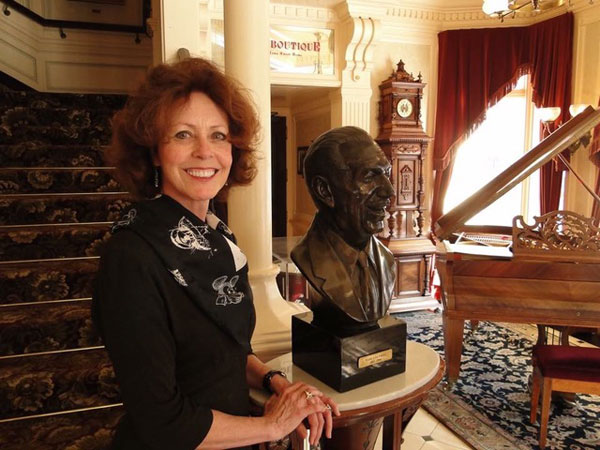
I’m regularly amazed by the random chance that goes into the careers of even the biggest names in theme parks. Few had grand plans to become Imagineers or even work in the industry. The right personal connection or small choice prepared a trajectory into a specific role. Peggie Fariss has a similar backstory and did not plan to work for Disney. A part-time job on the Storybook Land Canal Boats in 1966 began a journey that led to a remarkable 50-year career. Fariss aptly calls it an “accidental career”, and I can’t think of a better way to describe her experience.
Fariss is my guest on this episode of The Tomorrow Society Podcast to discuss her 50 years at Disney. She retired in 2016 and has so many interesting stories from a diverse career. After working on the Canal Boats and at the Matterhorn, Fariss moved to Orlando for the opening of Walt Disney World. She also served as a show producer on the original Spaceship Earth, produced the Disney Galleries, helped secure attraction sponsorships, and managed Imagineering at Disneyland Paris. There is far too much to cover in a single podcast episode.
A Remarkable Disney Career
During this extensive conversation on Fariss’ Disney career, I spoke with her on the following topics:
- How did she initially get started at Disneyland in 1966?
- Why was Fariss so interested in working at Walt Disney World during its early days in the 1970s?
- How was the research put together to develop the story for Spaceship Earth?
- What were some of the details that advisors helped to place into that attraction?
- Why was the narration for Spaceship Earth changed to include Walter Cronkite?
- What was it like to work in such a different environment at Disneyland Paris?
I loved having the chance to speak with Fariss about her diverse time working at Disney. Her stories were much different from the typical history that I know about the parks. It was also fascinating to hear about how Fariss learned new skills and moved into a leadership role.
Show Notes: Peggie Fariss
Orange County Register Article, “From Anaheim High School to Disneyland: Looking Back at Her 50-Year Disney Career” (May 20, 2016)
Tiara Talk Podcast Interview with Peggie Fariss (May 31, 2017)
Transcript
Dan Heaton: Hey there. Today’s podcast looks back at a career of 50 years working at Disney, which includes the development of Spaceship Earth at Epcot Center with my guest, Peggie Fariss. You’re listening to the Tomorrow Society Podcast.
(music)
Dan Heaton: Thanks for joining me here on Episode 64 of The Tomorrow Society Podcast. I am your host, Dan Heaton. I’ve read and heard so many stories about key figures in theme parks, and few of them seem to take a direct road to get there. The combination of skills and being in the right place at the right time, and most importantly, a willingness to try something new seem to make the difference. But every story is a bit different. A perfect example of this is my guest, Peggie Fariss, who started out at Disneyland in 1966 with a part-time job as a hostess on the Storybook Land Canal Boats. She calls it an accidental career, which ended up lasting 50 years.
It included work as a show producer on Spaceship Earth and managing Imagineering at Disneyland Paris. Peggie reinvented herself multiple times at Disney and accomplished so much, including being directly involved with the Disney galleries and working with corporate sponsors and so much more. She has some really great stories from her career, especially about Spaceship Earth, which is close to my heart.
So I really appreciate getting the chance to talk to Peggie. It was a lot of fun to hear her stories and she was so generous with her time to give such detailed information about her background. I think you’re going to really enjoy this. So let’s get to the conversation. Here is Peggie Fariss.
(music)
Dan Heaton: There’s so much good stuff to talk about, and I’m really excited to hear some of your stories. So I want to go back to the beginning, though. Back when you got started, what got you interested in working for Disney back in the 1960s?
Peggie Fariss: I think it started because we lived in Anaheim and, you know, home of Disneyland. My mother would take my brother and me out of school on our birthdays to visit the park for the day. And so I had a really warm feeling about Disneyland. It was always fun to go to. We looked forward to it every year. But honestly, I never thought about working there. To me, it wasn’t a place people worked. It was just a place where everybody had fun.
As I approached my high school graduation, I applied to one school. I thought UC Santa Barbara was just the most beautiful campus, and it wasn’t too far away. And some of my friends were going, so it was the only school I applied to. Somewhere along in July, I got a letter saying, “Thank you very much, but you’re short a credit.” I hadn’t taken Spanish 4 because I hadn’t really shown any particular flair for language.
I had taken a new science class, a physiology class that I thought was fascinating, but it was not accredited. If that had happened to me today, I probably would have appealed and sought some guidance. But at the time I thought, well, okay, I’ll go to a local school and then I’ll transfer to Santa Barbara.
When a good friend of mine heard I was going to be local for the fall, she said she’d been working at Disneyland all summer, and it was so much fun, and I should get down there and apply. So I did. I had an interview with a young fellow named Fritz Opel. He handed me a script for Storybook Land and asked me to read it to him. And he said, okay, you’re hired. Report tomorrow; that began my Disneyland career.
I worked Friday night, Saturday night, and Sunday from noon to four. So I was working about 12 hours a week. But it didn’t feel like work. It was just so much fun to be able to spend time in the park in costume. Storybook Land was a wonderful place for me to start because I got to meet guests in very small groups and spend about 10 minutes with them. I just thought it was magical.
Dan Heaton: That’s interesting how you had a roundabout way to end up working there. So when you started doing that and working part time, when did it shift to where, I know you had to take this class and I assume finished it, but when did it shift where you started to think this is something that might be more than just a part-time job on the side?
Peggie Fariss: Oh, that came much later. I’ll tell you a little bit about my early Disneyland days. I was working on Storybook Land, as I mentioned, Friday and Saturday nights. There was a young fella named Rich Battaglia; he was an assistant supervisor in the area. Like many companies, Disneyland had rules against dating the people you supervise. So this young supervisor arranged to transfer me from Storybook Land to the Matterhorn.
I was terrified because Storybook Land was a tranquil attraction. There, I would be in my little canal boat floating downstream, pointing out the beautiful little topiaries and the character architecture. And it was beautiful. The Matterhorn was much faster-paced: 17-second dispatches and a rotation that included being in the tower, actually pressing the button to dispatch the sleds.
I was so afraid that I might mistakenly dispatch a sled that would get too close to the sled in front. You see, if there were Cub Scouts in the first sled and linebackers in the second, the weight of the second sled would encroach on the first sled’s safety zone. All the brakes in the Matterhorn would set up, and the attraction would come to a complete stop.
Then a crew would have to go up and release each sled one by one. I was terrified. I thought, I’m going to shut this attraction down, and it’ll be all my fault. And honestly, there were gals on Storybook Land who were eager to go to a coed attraction that was fast-paced. I sort of went to the Matterhorn under duress. But I was really interested in getting to know that young supervisor better. So I took the transfer. (And we’re still dating more than 60 years later.)
I’d been working on the Matterhorn for about six months when the foreman, a fella named Chuck Abbott, who was adored by everyone who worked for him, suggested I might be interested in a program called Disneyland Ambassador. This would have been 1966. Julie Reihm was the first Ambassador, and Connie Swanson was the second. This program was still new, but if you were a young, single woman and interested, you could attend a tea, and they would tell you more about the program.
The selection process involved a series of interviews with Disneyland executives, who would select five finalists for the Ambassador role — to represent Disneyland, travel to foreign countries, host visiting dignitaries, and visit children’s hospitals. I thought, wow, that sounds like a wonderful way to represent Disneyland. So I applied. I found myself among the top five finalists. The final interview was at The Walt Disney Studios with the Chief Marketing Officer, Card Walker.
I don’t think my interview with Card went well because he asked me something about motion pictures, and I thought, well, hey, I work at the park. I don’t know about movies and motion pictures and what they should be titled. But it was an interesting experience. Then they took us to the executive dining room, and Walt Disney was having lunch there. That was a really special experience because I’d grown up watching Walt Disney on television.
I thought of him in the same way I thought about my grandfather. He was so familiar and so beloved. And there he was at the neighboring table. I think had he not been so sick at the time, I’m sure we would have been introduced to him. In that case, that was kind of as close as we got. He passed away shortly after that, I think within the next month.
Anyway, they chose someone else to be the Disneyland Ambassador that year. She was a very poised VIP hostess, and she spoke Spanish. But I thought, I got into the finals with no preparation at all. So maybe if I really applied myself, maybe that’s the trick. So I spent the next year studying the annual report backward and forwards. I knew all the subsidiaries; I knew the leaders of all the subsidiaries. I knew what ASCAP and BMI stood for. I would fish memos out of trash cans to read up on Mineral King.
I also discovered that once you start looking for things, there were actually little notices in my local paper about movies in production. This was a year when I really applied myself. I took out a loan, I put braces back on my teeth to straighten out a little chip that I acquired. I took a modeling class to learn how to descend stairs, get in and out of a car, and never wear pearls whiter than your teeth. I was as prepared as I could be.
The next year, they had another open call. Any young single woman from Disneyland who was interested could apply. And I did. My interview was so much fun because I knew the answer to every question. For the second time I became one of the five finalists, and for the second time, they selected someone else. In this case, she spoke Russian and was a communications major at USC and blond.
Okay, I thought, I gave this my best shot; I’m just not what they’re looking for. I was happy. I learned a lot about the company, but I still wasn’t thinking about Disney as a career because all I really knew was the park. In those days, there were no women in management, except for Cicely Rigdon, who led the tour guides. I was thinking maybe I’d become a teacher, or I don’t know.
Another year passed. I did not go out for the Ambassador Program that year, but because I’d met so many people in the interview process, I got a call one day from Disneyland management. They asked me to come into the office of the Director of Operations, Bob Matheison. He explained they were taking 10 young women from Disneyland to Florida for a press conference to announce the first phase of Walt Disney World. They would like me to be one of the 10 if I could take time away from school.
It was going to be about two weeks in Florida. I thought, wow, that sounds fabulous. I was one of three ride operators (or attraction hostesses, as they’re now called), one young woman from the Food Division, and six from the tour guide VIP hostess group. We flew to Florida on the company Gulfstream. We settled into the Ramada Inn in Ocoee for two weeks, where we studied the project details. We also rehearsed a narration to deliver to busloads of journalists and executives, describing the features of the first phase of Walt Disney World, pointing out the sites for the future Cinderella Castle, Contemporary Resort Hotel, Polynesian Village, and the Ticket and Transportation Center.
At this point in Walt Disney World’s development and construction, they’d moved four and a half million cubic yards of Earth to the theme park site to create a tunnel complex on the ground floor to house support functions like wardrobe, DACS, the print shop, etc. The park would be built on the second level. The area in front of the park would become the Seven Seas Lagoon. We met with Landscape Designer Bill Evans, who was starting the tree farm. We had presentations from people who would be managing the central energy plant, the central food facility, and the hotels. That’s when I looked around and thought, this is going to be a magnificent project. I knew they would need people with Disney experience. By then I had four years, and I thought, I want to be part of this.
I went back to California after the press conference and started talking to people about what opportunities might be there. Eventually, they introduced me to John Curry, the Vice President in charge of the two hotels — The Contemporary Resort Hotel and the Polynesian Village. Both were joint ventures with U.S. Steel and used a new modular construction technique. John had many people with hotel experience on his staff, but he also wanted people with Disney experience. He hired me as supervisor of Guest Activities. I was thrilled. By then I had graduated from Cal State Fullerton with a degree in English. I moved to Florida about six months before Walt Disney World opened, and started thinking, wow, what a wonderful opportunity.
Dan Heaton: That’s a great story. I’m glad I asked the question to set up that long story. That was great. I feel like there’s so much I could unpack from there, including almost meeting Walt Disney. I’d love to focus on when you went the first time to Florida because now we look at Disney World. It’s this massive resort and there’s so much to it. What was that like seeing that, and how did you see the potential there to make you want to be interested in working there?
Peggie Fariss: First of all, the scale of the project was so impressive. We’d seen the scale model at WED Enterprises, later to be called Walt Disney Imagineering. It was so big it filled the model shop. They sent that model and a lot of artwork to Florida for the press conference to our temporary headquarters at the Ramada Inn.
Next to the Ramada Inn, they installed a big circus tent and filled it with artwork and models to show what the resort and park would look like. It’s one thing to see those models and artwork, but another to drive out to the site and appreciate the scale of this undertaking. I have a picture of us standing at the entrance to the north-south road, and it’s just a dirt path and a little kiosk for the security host to be waiting in.
The magnitude of this project was just so incredible — it was so big. They were draining Bay Lake at the time and bringing the white sand up to adorn the beaches.
Honestly, I’d had such a great experience working in the park. I moved from Storybook Land to the Matterhorn. I was part of the opening of New Tomorrowland in 1967 and then later worked Great Moments with Mr. Lincoln. I just loved Disneyland. I loved the chance to meet guests and talk about where they were from and what their favorite attractions were. To me, that was such a great experience because you really got to meet the world. They came to Disneyland, and I got to meet them. It was clear that Walt Disney World was going to be an opportunity to expand that Disney experience, that Disneyland experience, to a guest’s entire stay. I just thought that was really an exciting concept.
This was Disney’s first experience with themed hotels and the idea of extending a guest’s stay beyond the park. To think of the hotels as an extension of the park. If you stood at the Hub of the Magic Kingdom and looked beyond Tomorrowland, the Contemporary Resort Hotel was just off in the distance. It was like an extension of that Tomorrowland experience.
And if you looked beyond Adventureland, the Polynesian Village was directly across the lagoon. The whole idea that we could take the Disneyland magic and extend it to a guest’s entire stay; I just thought it would be really satisfying to be part of the first team that was taking that step to see how it would be. What kind of a place will this be if we take those Disneyland ideas and extend them into a guest’s entire vacation?
Many people from Disneyland moved to Florida to be part of that first opening experience. Lots of people from the East Coast and the Midwest came to Walt Disney World to be part of that too. There was this excitement and sense that we were about to do something nobody else had done. We were really proud of it, and we were excited about it. So many new technologies were being built into this park.
We knew that the whole idea was something that Walt Disney had nurtured because with Disneyland he was only able to do the park. But he couldn’t control the development that happened around him on Harbor Boulevard. This was a chance to control the entire guest experience and deliver on that magic. I thought it was an ambitious project, and the scale of it was so exciting to me. I was thrilled to be part of it.
Dan Heaton: I love the idea that you were there at the start like you mentioned with the tunnels and some really cool things they were doing right at the beginning, or even with the Contemporary how interesting that hotel was to build. It sounds like such an exciting time. You mentioned that you were working in a different role, not inside the park. So what did you do first when you went out to Florida?
Peggie Fariss: My assignment was Supervisor of Guest Activities for the hotels. That meant that for the Contemporary and the Polynesian hotels, we would have a staff. In that case, they were all young women. We had an information desk in each lobby. The hostesses’ responsibility was to give guests information about available activities and how to sign up for tennis, make a reservation for the golf resort, or book a restaurant.
It was because, again, this was new to guests as well. Then we also had child care. Now, my mother had been an elementary school teacher. I had gone to her classes and read to the kids and helped her set up her classroom. I was well versed in things like games and rhythms, and I loved children’s literature. The idea was we would provide child care for guests who had young children between the ages of maybe two and six or seven.
We’d take care of them for a couple of hours. It turns out there were Florida regulations that said if you took care of a child beyond…it might have been something like four hours, then you must provide a separate area for naps, and you have to provide a hot meal. This wasn’t a place to drop your child off and pick them up at the end of the day because the idea of Walt Disney World is you’re going to experience this resort together as a family. But for the tennis game, for the hair appointment, for that sort of thing, a couple hours. So we had a Mouseketeer Clubhouse in each of the resorts and a staff of people to take care of the kids and play games with them and just have fun.
Then I got my first taste of reorganization. I think I mentioned earlier that the hotels had been a joint venture with U.S. Steel; it meant that there was a hotel company that was an entirely separate entity from Walt Disney World Company. Then Roy Disney, Walt’s brother, who had really championed the idea that we’re going forward with this Florida dream of Walt’s; Roy engineered a buyout. Disney bought U.S. Steel out of the hotels, and then those hotels became part of the Walt Disney Company.
That meant that we had redundancies in certain areas. Mine was one of them. My team and I were merged into the Recreation Department, which reported to Operations, and that meant we had responsibility for beaches and pools and lifeguards and boats and all kinds of things that I had no experience with. About a month or so into this, I came in one day, and my name wasn’t on the schedule. So that was kind of a tip. They said you should go talk to Bob Matheison, who was head of Operations. And I did. Bob said, well Peggie, I know you love Operations, but we’ve got all the supervisors for the park that we need.
So you’re going to Marketing, and you’ll work in Convention Sales. I reported to Convention Sales, and it turns out that the entry level there is really coordination. I found myself checking the set-up for meetings and conventions, and then after a while I got the hang of it. Pretty soon I was planning meetings and conventions and traveling to represent the convention amenities at trade shows in Chicago and New York and San Francisco and Boston, and meeting with executives and talking to them about the amenities that Walt Disney World could provide.
The funny thing was, people were so familiar with Disneyland — the theme park — but the word hadn’t really gotten out that Walt Disney World also had championship golf courses, tennis, water recreation, and fine dining. We were competing with places like San Francisco or The Greenbrier or any number of first-class resorts. We would say this is a place where you have all of those amenities, and you can bring your family. It wasn’t what I planned to do, but I ended up enjoying the process.
I had been in Florida about five years, and realized I’d never planned to stay in Florida forever. I knew Disney had other things going on back in California. There was the Magic Kingdom Club. There were other things back in California, and I thought, well, maybe now that I have ten years of Disney experience. Maybe there’s something back in California I could do.
It just happened that the young supervisor who’d moved me to the Matterhorn had been in Florida for a time, and he was back in California. My little brother was growing up, and I was just a voice on the telephone to him. So I had a couple of reasons to explore what might be possible in California.
One day in front of the Contemporary Resort Hotel, I bumped into Marty Sklar. I had met Marty at the press conference back in 1969. He’d written the entire presentation for what the first phase of Walt Disney World would be. He had been editor of the Daily Bruin at UCLA. He’d been hired to develop the Disneyland Gazette in Disneyland’s early, early days. He’d been hired when Disneyland opened to work in the press and public relations area. Then he ended up writing for Walt Disney. So many of the things Walt said about Epcot and Walt Disney World were things Marty had translated from Walt’s ideas.
Marty said, “Well, you know, Peggie, back in California, back at WED Enterprises in Glendale, we’re actually starting to work on Epcot. I’d like to kick this effort off by hosting a series of conferences on topics we’re going to feature in Future World. With your meeting planning experience and your deep Disney knowledge and your familiarity with Imagineering, with Disneyland and everything, why don’t you come back to California and start working at WED in Glendale and help us with those conferences?”
In the fall of 1976, I drove back across the country. I rented a house in Newport Beach and drove from Orange County to Glendale every day for the next 35 years. I joined Marty’s team to develop the Epcot Future Technology Conferences, and we hosted a conference on energy, agriculture, and food production.
We co-hosted a conference with Johns Hopkins on Good Health in America for what would become the Life and Health Pavilion. We hosted a mini conference on space, and through these conferences we met content experts who could tell us who’s doing interesting work in this or that field, and who’s doing the most groundbreaking work in the seas or in space.
These conferences also introduced us to prospective sponsors, participants for those pavilions. It introduced us to small groups of people who would comprise our advisory boards. The idea was that with Disneyland, when we developed Disneyland and Magic Kingdom, we were really sort of drawing upon legends and stories and myths and folk tales, and we had a lot of artistic license for how those stories would evolve.
But we felt that with Future World, we wanted it to be something that was really substantiated by real-world work, but translated into shows and attractions that people would find entertaining and inspiring and informational. We wanted to make sure that, unlike a World’s Fair, the pavilion’s story wouldn’t just be that company’s view of the topic. We wanted to say we’ve rounded out the topic by consulting with others who hold a range of opinions and perspectives. I worked on the Epcot Future Technology Conferences and the advisory boards in the late ‘70s. Then Marty asked me to do the historical research on Spaceship Earth.
Dan Heaton: That’s so interesting. I definitely want to talk about Spaceship Earth. Before we move on, I’d love to know a little more because Epcot was Walt Disney’s big plan for his futuristic community. And that eventually became Epcot Center, which I loved and still love to this day. With the atmosphere at that time, was there a lot of discussion on how do we make this have these important issues, but also still pay tribute to that original idea? Was that something that was a challenge or people were talking about?
Peggie Fariss: I was not at Imagineering when the earliest EPCOT conversations were happening, when they said, okay, well, are we going to do this? EPCOT was the core idea for going to Florida and acquiring all that land. I think Walt had been very clear about this community: this Experimental Prototype Community of Tomorrow will be a place where people live a life they can’t live anywhere else. A very ambitious vision. I think people felt like, well, we mere mortals, how do we do that? How do you build a community where people live in houses that are always on the cutting edge? How do you rip out a kitchen every 10 years and, how do you stay ahead of the curve?
Tomorrowland had always been enough of a challenge. I think when they broke it down into what this means for the people living there, they felt the idea might be something else. Maybe it’s about inspiring people at EPCOT Center to go back to their own communities and develop ideas that will lead us into the future, but in their own way, based on their communities’ needs.
I think the clarity was, okay, we’re not going to start with building houses and futuristic kitchens. We did that with the House of Tomorrow at Disneyland. Let’s focus on topics that we know will be important to the conversations about the future. We start with Spaceship Earth, the theme show, and recognize our long history of over 40,000 years of sharing information with one another, recording it, and disseminating it.
Spaceship Earth is the communications story, then Universe of Energy, the Living Seas, Imagination, World of Motion, those being the theme shows for those topics. Then in the early days, we were really grappling with…so a company wants to be associated with a big visionary project, but they have their own perspective; certainly Exxon had their perspective on what the future of energy should be. And they, like at a World’s Fair, wanted to be able to show our guests what they were doing. We wanted to keep the pavilion stories purer and more balanced.
We also recognized that we needed those corporate sponsors and their sponsorship dollars, and there’s got to be something in it for them; otherwise, their brand people will never buy into the idea. CommuniCore was a place dedicated to individual companies, where they could tell their stories. Exxon could showcase drill bits and things like that, and General Motors could show cars. That was the approach for early EPCOT.
Dan Heaton: That’s so interesting to think about with the sponsorships, especially because some of the messages are very complicated, especially with energy. But I definitely want to hear about your work on Spaceship Earth. You mentioned having to narrow down so much time into what’s like a 15-minute attraction. How did that come about? How were you able, working with advisors and such, to pinpoint how to put that together?
Peggie Fariss: First of all, Ray Bradbury had been a friend of Walt Disney’s. And in those early days, Marty Sklar was reaching out to writers who might be writers of books; they might be filmmakers. The idea was that storytelling is the core of what we do. Let’s bring people in and talk together about what their ideas might be for a Spaceship Earth or for a Living Seas pavilion or a World of Motion or Universe of Energy.
It turns out that Ray Bradbury wrote a treatment where we traveled from caveman to outer space. He had really kind of framed that story, and Pat Scanlon and X Atencio wrote a very poetic narration that began. “Who are we? Where do we come from? The answers begin in our past, in the dust from which we were formed. Answers recorded on the walls of time. So let us journey into that past.” And that’s when your ride vehicle starts ascending through that time tunnel.
We had a basic outline from Ray’s story treatment, and we had the attraction’s architecture as a sphere, which would make a strong statement right at the entrance to Future World. Then we worked with…because in our early days of the EPCOT conferences and such, we’d reached out to universities and foundations and businesses. When we looked at which cultures we should showcase, what developments in communications should we highlight? We worked with Dr. Frederick Williams, the founding Dean of the Annenberg School of Communications at USC and one of his graduate students.
She and I filled a conference room with three-by-five cards. Those cards identified what was going on in terms of communications technology and what was going on in the arts, in politics, in exploration, and other developments and technologies. We began to trace a path of people speaking together. In the case of hunting the woolly mammoth, the hunters are shouting to one another. That’s oral communications.
Then we move into the cave, the Cro-Magnon cave. The Cro-Magnon caves have some of the most beautiful paintings on their walls. National Geographic was just coming out with these gorgeous pictures of the art they were discovering in the caves. People are painting on the cave walls and recording the hunt we had just seen. We see a shaman standing before a campfire, and he’s telling the story of the hunt. Again, we have oral communications.
Storytelling shares that experience with people who weren’t in the hunt. We’re recording it on the cave wall. You see a little boy putting his hand against the cave wall, and blowing pigment on it. Those caves have many of those hand prints. It’s really a very touching thing. We said, okay, now, writing on the cave wall transitions to hieroglyphics on the walls of Egyptian temples; these hieroglyphics are very stylized. It takes a special class of scribes to understand, to master all those symbols.
We found a gentleman in Glendale teaching at a local college. His name was Leonard DeGrassi. He taught Egyptian history and knew hieroglyphics. We brought him over to Imagineering. We took him out to our production facility in North Hollywood, and we said, “Okay, here’s an example of a wall. Right now we’re looking for materials that will give us the look of sandstone.” It turned out it was crushed walnut shells. The sculptors carved random hieroglyphics into this big wall because they were interested in how it looked and how it held color and dimension. He looked at our demonstration wall, and a really puzzled look came over his face, and he said, “But it doesn’t say anything.” “Exactly! We don’t know what it should say, but we’re counting on you to help us.”
He was such a wonderful resource for us; he would bring me large sheets of paper filled with hieroglyphics he’d painstakingly drawn by hand. And then he’d tell me how to read the hieroglyphics and what they said. In the Spaceship Earth story, we move from scenes of writing on temple walls to writing on papyrus, which lets messages travel over distance and through time. We see people harvesting and creating papyrus, and then we see a scribe sitting at the feet of the Pharaoh, writing in a sort of cursive called Hieratic.
Dr. De Grassi gave us a letter a Pharaoh actually wrote to one of his administrators in a far-flung district. And bless his heart, when it came time to record the voice of the Pharaoh, he came in and read it for us. It said, “You are my representative, and people look to you, and I expect of you the highest performance.” And it was so fascinating to see these pieces from ancient history coming together.
We had to go into detail about which Pharaoh would it be, what period of time gives us Hieratic writing and hieroglyphics. Then we’d get questions from the people in costuming and people who are dressing the audio-animatronic figures to say, can you give us an idea of what the makeup should look like and what the wall paintings should be, what colors did they use? I had the most fun because we talked to people who gave us Phoenician dialogue. There was a wonderful professor, Dr. Charles Krahmalkov, from the University of Michigan, who gave us the dialogue for the Phoenician trader who’s going to take this shipment from this port to Tarshish. He was so excited when I called him.
And again, our wonderful library, later called the I.R.C. or Information Resource Center; they found him for me. So I called him and told him Disney wanted his help figuring out what this Phoenician scene should look like and what the captain and the merchant would be saying to one another. So another little piece of the puzzle came together and, in that case, the Phoenicians, of course, were able to take a very complex system of writing and reduce it down to essentially the first alphabet, and then they could use it for trading around the Mediterranean.
Because they’re traveling to these different ports, the whole idea of the alphabet spreads around the Mediterranean shores. Then we went on to Greece and Rome and the Middle Ages. One of my colleagues came back from a review of the show sets being built at the North Hollywood facility on Tujunga Avenue. Pat said to me, “John Hench says we need something from the 12 Tables of Roman law.” I thought, oh, I’ve never heard of that. But I called the I.R.C. and they sent to the UCLA Law Library. And the next day I had this tiny little book in my office, and it contained the 12 Tables of Roman law.
I was looking for an inscription that would fit nicely on the wall as you transitioned from the Greek scene up to see the Roman centurion and the senator. And I found it. Then I thought, oh, I wonder what it says. I better check. The footnote said, “If you are summoned to appear in court, you must appear. If you cannot afford transportation, it will be provided for you. But the cart need not be covered with pillows”. I thought they had travel departments back then; you’re going coach. We found graffiti for the section where Rome is burning. We went to the Huntington Library, and they have one of the pages, or maybe they have the entire Gutenberg Bible, on display.
We were able to take a photograph of the page and reproduce it for our attraction. They showed us manuscripts that were written at the time of Charlemagne. I had loved history and cultural anthropology in school, and I think Marty maybe remembered that I’d taken classes in Celtic Mythology and Indian Lit. So I don’t know if he knew exactly how much I would love doing the research on this project, but I just loved it. I love projects where you dive in, and you look for details, and then you satisfy the requirement because you find the answer. But that information is then always a part of you.
Doing Spaceship Earth, I had a chance just to spend two years stepping my way through world history. Then, for the next 20 years, Marty sent me every guest letter that came to him from Guest Relations in Florida, saying that if a guest had a question about why we chose this culture and not that culture, it was my job to answer it. By then I had an 18-page bibliography, and we’d talked with lots of scholars, so we felt pretty comfortable explaining what we had done.
But after the attraction opened, we began to get letters that indicated that people were a little confused about the story we were trying to tell. Our conclusion was that their eyes were overriding their ears. That beautiful poetry that Pat and X had given us about the journey we were on was somehow just getting lost in people’s fascination with the scenes, and they weren’t really making a connection.
The solution, which was I think pretty brilliant for the time, was that we needed a new narration and we needed a new voice. And the voice was Walter Cronkite. At that time, he was the most trusted man in America; people saw him on television every night. He had that very authoritative…“and that’s the way it is” or that’s the way it was. We thought his style of speaking and people’s familiarity with the fact giver will maybe be the key we need to make sure that this attraction is conveying what we hope it will convey. So young Tom Fitzgerald, who was a Writer in those early days, went to New York with his script and persuaded Walter Cronkite to do the narration. It was great. The tone of the letters changed really after that.
Dan Heaton: I love all those stories. There’s so much you just said that is great about developing it and that time. The Walter Cronkite version is the first version I remember hearing as a kid because I went a few years after it opened. What has always amazed me about Spaceship Earth and some of the other early attractions is how much detail and work was put into it with all those experts and everything, and for so many of those Epcot pavilions. A lot of them are gone, which is unfortunate, but I’m glad Spaceship Earth is still there. What do you think it is about Spaceship Earth, even though it’s changed a few times, that has made it stick around?
Peggie Fariss: I think the sets were really beautifully done. Each one of those scenes is like a little jewel box of the lighting, and there’s something warm and intriguing about each of those scenes. I think what’s really interesting is how many different narrations we’ve overlaid on that attraction, and it’s still worked. The funny thing is, one of the things we learned about Future World and participants is that their businesses were changing.
The AT&T that sponsored Spaceship Earth on opening day in 1982, it had an entirely different business model 10 years later. Then when Siemens became the sponsor, the tack there was really that one innovation leads to another, that we share information and we’re able to build and build and build on the accumulated knowledge. I’m really pleased that it’s lasted as long as it has.
Dan Heaton: I think I could ask so many questions about Spaceship Earth, but I definitely want to get to some of your other career. So you mentioned that you were involved so closely with Spaceship Earth. But what happened next? Where did you go after working on that project?
Peggie Fariss: I was one of a number of Show Producers. One of my favorite projects was The Disney Gallery. The space at Disneyland above Pirates of the Caribbean had been built as an apartment for Walt Disney. Then he died shortly after New Orleans Square opened. So he never really occupied the apartment. It served as a VIP lounge for INA for a time. Then it was offices for the Disneyland International team that was working on Tokyo Disneyland.
But if you remember or if you have experience with that part of Disneyland, it used to get really congested because Pirates of the Caribbean was a very popular attraction. The queue would gather right out front, and block circulation between Adventureland and New Orleans Square.
The solution was to build a bridge spanning the queue area. Guests would travel under the bridge and queue, and people moving from Adventureland to the Haunted Mansion would have an easy pathway. To make this look right, John Hench and Tony Baxter decided there should be staircases on either side of the building that led up to a balcony that opened into the apartment. And then it turns out, well, that would make the apartment available.
What could we do with that space that guests could experience? Because it was really beautiful. The idea was, well, let’s create this Disney Gallery and showcase Disneyland art, because we have so much wonderful original art in the Imagineering vault, and no one ever sees it after the initial presentation, and guests have never seen it.
Work had begun on the Disney Gallery, and it was pretty far along when they brought me into the project because there was also going to be a retail component. There was going to be a really close coordination between Disneyland Merchandise and Imagineering, as we evolved the idea of making reproductions of the art on display — limited-edition lithographs, note cards, posters, and things like that.
My job was to be that interface, and it was so much fun because we had to write copy for each piece of art in the show and the exhibition, and many of those artists had retired by then. My job was to go to the homes of the retired artists and interview them about “When did you do this work? Why did you do this work? What materials did you use?”.
It was such a fun project because I got to spend time with that first generation of Imagineers and people who had come out of the Studio, people like Ken Anderson and Sam McKim and Marc and Alice Davis and Dorothea Redmond. It was just, it was such a special experience. Then I also found myself in meetings with my boss, Pat Scanlon, and the Chief Financial Officer of Imagineering, Steve Bills. They would talk about projects and discuss the IRR and the NPV. I had been an English major. I’d studied Shakespeare and Milton, Celtic Mythology, and Indian Lit. I remember telling Rich how I had nothing to offer in meetings like that. “It’s finance,” he said. “Get a book.” But no, I have to take the class.
It turns out the prerequisite for Finance through UCLA Extension was Accounting 1A and 1B. So I signed up for that. I took vacation days so I could do the Accounting homework on Fridays and then attend class on Saturdays. I got through Accounting A and B, then I took Finance. I did really well in it, and then I was hooked. So for the next 23 years, I took 40 classes through UCLA Extension: Organizational Development, Management, Micro and Macro Econ, you name it. The joy was that I could use the things I’d learned the night before when I went to work the next day. So I used matrix math when I was preparing a budget to frame X number of paintings to go into the next Disney Gallery exhibition.
We wouldn’t have chosen the art yet, so we didn’t know how many big ones, little ones, or medium-sized ones there would be. But matrix math gives you a way to figure that out. I was hooked. I took all of these classes. Then, around 1987, Marty asked me to be the liaison to Corporate Alliances, the people at the studio responsible for finding companies that wanted to participate as sponsors in our parks. There was a business development side of Corporate Alliances. They looked for companies that were the right fit. Then there was an Account Management group, and they would work closely with those companies throughout the life of their agreement.
If it was a food company, Corporate Alliances would lead discussion about pricing and volume. What new products the sponsoring company might want to introduce, and where within the Disney parks and resorts were the right places to showcase them? There were all those business aspects. When it came to determining what that company’s presence in the parks looked like, my team and I were responsible. We were the point of contact between the companies, the Corporate Alliance folks, and the Imagineering creative teams.
We were sort of the buffer so creative teams could just be creative, and we took the heat if a company pushed for a bigger logo or a color that didn’t work with the environment. We’re very sensitive to the color palettes for the lands and the font styles, and we worked with each creative team to find the right design solution. We’d be looking at their presence on a main marquee, their presence on sort of secondary signage, welcome messages, farewell messages, looking for what are the perfect integrations of that company’s brand into this part of the park or that part of the park.
Coca-Cola was a great company to work with because they had a presence everywhere in the world; in each setting, it’s unique but also very recognizable. Yes, it’s going to be red, but if it’s in India, it may be in Hindi, and if it’s in China, it will be in Mandarin or Cantonese script. If it’s in Japan, it’s a distinctive script. If it’s at the turn of the century, it’s going to have a certain script. We have worked with companies to encourage them to let us find the best way to integrate their brand into the parks. We worked with all the Disney parks around the world, all the creative teams, and the corporate sponsors around the world. I did that for about 25 years, and I loved it. It was really fun.
It was fun, and it was very challenging because companies have an expectation that their brand, which they’re very proud of, will have a prominent role in the show. Our view was the show comes first. Then when people discover your brand, it will feel seamless. It will feel like, of course you belong. What we wanted to avoid was logo slapping. In our view, when people are in the parks, they’re on vacation, and they want to relax and let down their guard. They don’t want to be bombarded by a lot of commercial messages. If you’re subtle about it, it was our belief that you could draw people in, and they would appreciate and remember the unique presence of that brand in that unique part of the park.
I got a great education in diplomacy and patience and being true to what you believe. So that was great. And then one day in January 2010, my phone rang. The voice on the other end said, “Peggie, how would you like to go to Paris and lead the Imagineering team?” Boy, that was a bolt out of the blue. I just never thought about doing anything other than this brand management stuff that I had really kind of felt I had mastered. But I thought, what an exciting opportunity. I happened to have two nieces in their mid-to-late twenties at the time, and I thought, I want them to be brave. When opportunities come their way, I want them to be able to be open to an adventure.
I thought, well, how can I want that if I’m not willing to live that? So I said yes and went to Paris in the fall of 2010, just as Disneyland Paris was preparing for its 20th anniversary. I inherited a team of about 25 incredibly talented, immensely dedicated, wonderful, wonderful people. Many of them had been there from the very beginning. They had worked on the original park back in the early ‘90s, and they were continuing to be true to their craft and deliver the best quality experience they could.
Disneyland Paris had had some really serious hard times. They didn’t have a lot of money. But it was such a beautiful initial investment, and these people were so dedicated. It was really a pleasure to be part of that. We grew the team and brought more people in to help deliver on the vision. Then, luckily, The Walt Disney Company recommitted to investing in the park. It’s so exciting now to hear about the new attractions they’re planning.
I just felt like my five years in Paris were the perfect culmination to my career and all those classes I had taken at UCLA. Suddenly I felt like I actually knew what we should do. It prepared me well for it. I was coming up on my 50th anniversary with Disney, and I couldn’t imagine a better way to close my career. It was kind of the perfect ending.
Dan Heaton: I love Disneyland Paris. I’ve only been there once, but it’s gorgeous. That was about 10 years ago. But it is really exciting to see what they’re doing with it; they’re doing a lot of rehabs, which is great to make it beautiful. Then the new attractions, it’s great to see because it was tough for a while. It’s so interesting to me how your career evolved and how you went in to learn more about business and how it affected your career. So what made you decide ultimately that it was the right time to to retire from Disney after such a great career?
Peggie Fariss: Well, as I said, my experience in Paris was just so phenomenal. I accepted the assignment having never led a large team. My team doing the brand integration was six: three in Florida and three in California. That was it. So going to a foreign country whose language I didn’t speak; I’d taken some French classes so I could pronounce things on a menu. But my conversational skills were really limited. Taking on the assignment, really thinking, well, I don’t really know what the job will entail, but I guess I’ll find out. And I did. My first meeting with Joe Schott, the Chief Operating Officer, began with something like, “Peggie, you can’t have 30 people reporting directly to you. You need an organization.”
I thought, well, they’ve been organized this way for 20 years. Who am I to change that? But I thought about it and I thought, well, there is an opportunity to create a Design Studio within our group and a Show Technical team and a group that’s focused more on coordination, show producing ,and documentation, and all the administrative tasks. I did something like speed-dating where I interviewed everybody in the department, and we came up with a new structure.
I got a chance to meet them and find out where they came from, what their hopes were, and who they loved working with. I identified some people to become the managers, to lead those groups. What I discovered was it was so satisfying for me to know that my purpose there was to really build a team that felt ownership of their areas of the people within their areas to encourage people to think about, well, what kind of training do people need, what kind of tools do people need, and what do we need to do to provide our team with what they need to do their jobs?
Because they certainly have heart and they are so dedicated, and we want to fuel that loyalty and that imagination and give them hope that their work counts and that they’re part of a larger community of Imagineers around the world who are looking for similar solutions. They want to be good partners to the operators they interface with and their maintenance partners. What I hadn’t expected, but what I got a great opportunity to do was just work on building this team and encouraging people and helping them see what their maybe undiscovered talents were in the same way that people had helped me discover things I had never imagined about myself.
I’ve called mine “the accidental career” because I wasn’t somebody who said, I want to be there. Just incrementally, I found that if you immerse yourself in the topic and you give it everything you’ve got, there’s a great satisfaction in that. Then other things begin to appear and the next challenge emerges. I really felt such satisfaction in that knowing that I would be leaving because the expat assignment is a maximum of five years. And then after that, I guess you could leave Disney and maybe be rehired in Paris. I was ready to come back to California. And when I came back to California, I could see that Imagineering continued to bring new talent into the organization.
When you’re the one with 50 years of experience, maybe it’s time to let the next generation figure out how they’re going to do it, because they’ve got all the energy, and enthusiasm and nobody wants to be the person in the room thinking we tried that. Well, it was 25 years ago. I just felt that for me, it was the perfect time to celebrate what those 50 years had meant to me and really make room for the new young Imagineers that are going to create the next 50 years of attractions. It was perfect at 50; I wasn’t leaving at 49.8. I was leaving at 50, which was a nice round number and something I never expected.
Way back at Disneyland in 1966, when Ron Dominguez was interviewing me to move from casual temporary, which was that Friday/Saturday night gig, to better hours, a little bit more money, and a more reliable schedule. I remember saying to Ron, this sounds really interesting, but I don’t plan to be here that long. I saw Ron the other day. We had a little giggle about that. He said he had a similar story.
I think it’s probably true. There are many of us who came into this because it was a great summer job or a job when we were in college. And then one thing led to another, and before you know it, we found ourselves exploring areas that were fascinating to us and feeling like we could really make a contribution. The beautiful thing is you meet people anywhere in the world, and if you have that Disney connection, you feel like you’re meeting old friends.
Dan Heaton: I love the idea of the accidental career. I’ve heard a lot of stories of people that worked at Disney or similar areas in the industry that it seems like a lot of people entered it I wouldn’t say, not knowing at all what they wanted to do, but did not expect to be where they were. I love the idea too of after 50 years, deciding this is the right time. It’s been awesome to hear some of these stories. Peggie, it’s been wonderful to talk with you.
Peggie Fariss: Oh, thank you. Well, I think let me just say one more thing. And that is what I found true of my experience with Disney, I spent 40 years of that career in Imagineering, was people’s willingness to let you try something that maybe you didn’t have any expertise in. But if you were willing to throw yourself into it, then you got a great opportunity. There are so many people whose stories include that aspect that there are something like 140 different disciplines within Imagineering and 1,000 to 2,000 people working on a variety of projects.
There are certainly people with amazing academic credentials and people in the R&D area or the engineers and architects and show ride engineers and the color specialists and the writers. The collection of talent is extraordinary. But the fact that you’re not in a narrow little channel, you really have the opportunity to explore things that inspire you, I think is one of the hallmarks of Imagineering. It’s one of the key ingredients of its continuing success.
Dan Heaton: I love that idea. It especially shows in some of the amazing attractions and other wonderful things like the Disney Gallery over the years that have been created. I think a lot of it comes from that, and it’s awesome to hear that’s the case and that you had such a great experience.
Peggie Fariss: Thank you. Well, thanks for letting me ramble on and reminisce about all the fun. But you know people ask me, do you miss it? And of course, of course you miss it. But what you miss more than anything are the people and the challenges that you are able to take on together.
Dan Heaton: I think I could ask you just about Spaceship Earth for a few hours, so you definitely did not ramble at the time. It was great to hear from you. And I loved all the stories. Thanks so much, Peggie.
Peggie Fariss: Thank you. Dan.


Dan,
Your interview with Peggie Farris represents a fantastic contribution in documenting her extraordinary career. Congratulations on presenting someone with a landmark story to tell… and bringing it to the broader community of Disney fans and historians as well. Still so much to learn… Thank you!
Dave Mason
for The Annette Funicello Research Fund
Dave, thanks so much for the comment! It was a thrill to talk to Peggie and hear her story, and it’s great to hear that you enjoyed it. I totally agree that there’s still so much to learn out there. Thanks!
Hey Dan
This has been your best interview yet. Peggy is such a fascinating character, and of course I always love hearing about spaceship earth! It’s awesome that you can get these Disney legands stories while they are still around
Thanks so much, Chris! I really enjoyed the chance to learn about Peggie’s story. I knew very little going in beyond the basics of what she worked on at Disney. I loved all the details about Spaceship Earth and her other work.