Podcast: Play in new window | Download | Embed
We keep learning more about Disney history, particularly events that haven’t been covered as closely. A good example is the trip to Latin America in 1941. It was depicted in the 2009 documentary Walt & El Grupo, but we’ve since found out even more. Walt and his group of Disney artists and writers, known commonly as “El Grupo”, visited countries like Brazil, Argentina, and more during this extensive visit.
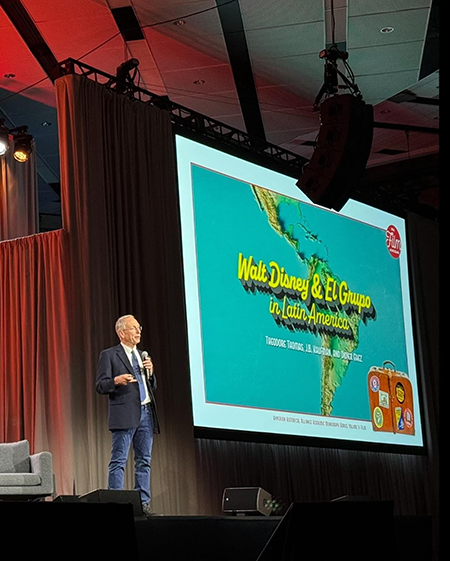
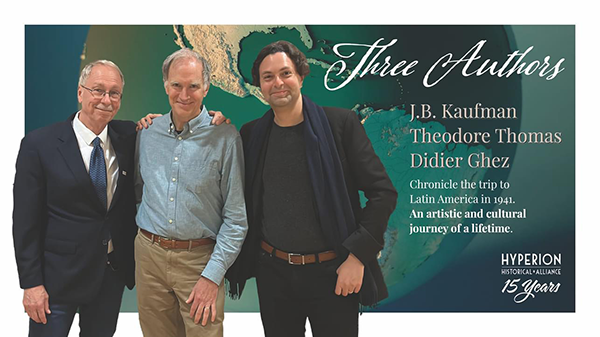
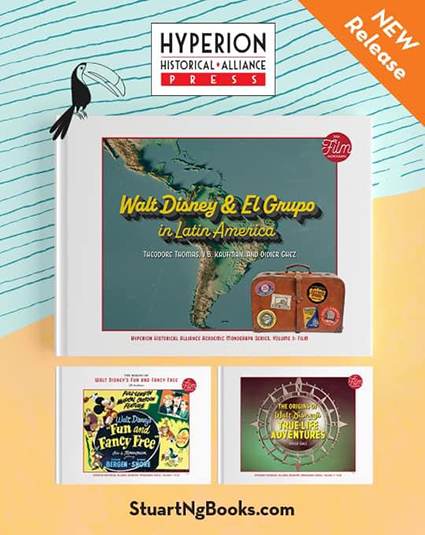
The new book Walt Disney & El Grupo in Latin America includes a remarkably detailed accounting of each day of the Latin America trip. Authors Theodore Thomas, J.B. Kaufman, and Didier Ghez join me on this episode of the Tomorrow Society Podcast to talk about their book and the 1941 trip. Each one is an expert on Disney history and provide interesting context for what Walt and “El Grupo” experienced.
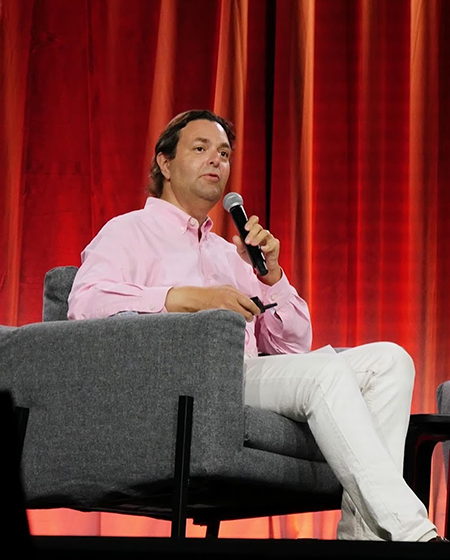
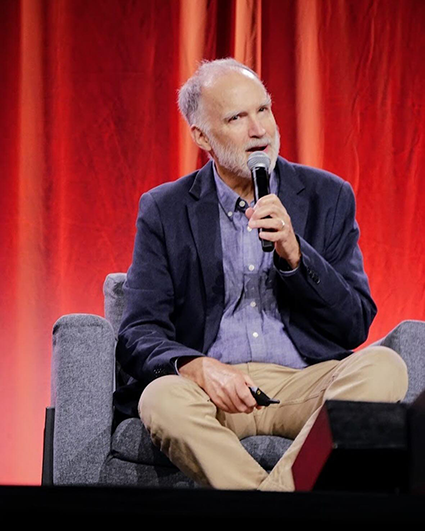
During this episode, we talk about what inspired Ted, J.B., and Didier to dive even further into this material. They describe the most important resources for gathering all the details and amazing photos. This book is the third volume of the Academic Monograph Series from the Hyperion Historical Alliance. We also learn about what the HHA does and exciting future books in this series. I really enjoyed chatting with such a smart and talented trio of authors for this podcast.
Show Notes: Walt & El Grupo
Purchase a copy of Walt Disney & El Grupo in Latin America from Stuart Ng Books or through Amazon.
Follow the Hyperion Historical Alliance Press on Facebook or Instagram.
Make a one-time donation and buy me a Dole Whip. Thanks so much for all the support!
This post contains affiliate links. Making any purchase through those links supports this site. See full disclosure.
Transcript
Ted Thomas: For me, the point is it brings you much closer to the experience of these artists, what they lived, how they felt, how they were inspired, what they brought back with them by knowing with more detail where they were, who they met, you get a much better appreciation for did they have time to wash out their socks back at the hotel and would they drive by the morning and little minutiae like that that I think makes this whole thing a lot more human.
Dan Heaton: That is author and director Ted Thomas, who’s here along with J.B. Kaufman and Didier Ghez to talk about their new book, Walt Disney and El Grupo in Latin America. You’re listening to the Tomorrow Society Podcast.
(music)
Dan Heaton: Hey there. Welcome to this special episode of the Tomorrow Society Podcast. I’m your host, Dan Heaton. The reason it’s special, one, I have three guests that has never happened before in the past 240 episodes of the show. Second thing is we’re talking about a really cool book as part of the monograph series from the Hyperion Historical Alliance. It’s about the trip Walt Disney and his El Grupo took to South America in 1941.
The book includes a detailed itinerary from what they did, some amazing photos, and we talk all about how the book came together and also the impact on the Disney company, including films like Saludos Amigos and The Three Caballeros, but just a lot more from these three accomplished historians that have done so much to spread the word about Disney and its past. So let’s do this. Here are Ted, Didier, and J.B.
(music)
Dan Heaton: Let’s introduce each of these three talented authors individually. So I’m going to start with my first guest is a film director and producer whose work includes the documentaries, Walt & Grupo, Growing up with Nine Old Men and Frank and Ollie, where one of the subjects is his father, Disney animator Frank Thomas. It is Ted Thomas. Ted, thank you so much for being here.
Ted Thomas: It’s a pleasure to be with you.
Dan Heaton (00:02:34): Oh, definitely. I’m very excited to talk with you. Well, next up is an author and film historian who’s written regularly about Disney history in books like The Fairest One of All, South of the Border with Disney, The Making of Walt Disney’s Fun and Fancy Free, so much more. It is J.B. Kaufman. J.B., thank you so much for being on the show.
J.B. Kaufman: Well, thank you. Thank you for having me for having us. It’s a pleasure to be with you.
Dan Heaton: Oh, definitely. And my final guest is also a historian and author who’s written countless articles and books about Disney, including his “Walt’s People” interview series, which I believe is up to 28 volumes and it might even be more at this point. There’s so many. It is Didier Ghez. Didier, thank you so much for talking with me.
Didier Ghez: Thank you so much, Dan. 29 volumes and the next one is about to be released. So yes.
Dan Heaton: Wow. I can’t even keep up with all of them. And I’ve read quite a few, but I mean that in a good way, not in a bad way. So I’m going to start and kind of ask each of you. First, we’re talking about this book, which includes what I think is so cool and has a really detailed itinerary. And I wouldn’t just say itinerary, but like what people did and so many great photos.
But before we do that, just in case listeners aren’t as familiar with what Disney did in 1941 and the trip, I’d love to know a little bit more about this. So I’m going to ask you, Ted, to get us started here since you have directed a documentary on this, but if people aren’t familiar with the trip that’s commonly known as Walt & El Grupo, what’s a quick overview of kind of why they did it and how it happened?
Ted Thomas: It’s real important to remember that this was in 1941. World War II had already begun on the European continent, and there was quite a lot of concern in Washington D.C. that the U.S. was going to be pulled into it pretty soon. So there was a concerted effort in the government to try and improve relations with the rest of the hemisphere. So that was the political reason for the trip, that the U.S. government wanted to have a goodwill tour to South America to try and strengthen alliances.
From the Disney standpoint, they had been asked as part of this to come up with ideas to make films about Latin American subjects. And it wasn’t just the Disney studio. The same request was being made of the other major studios in Hollywood as well. But what was very different about the Disney trip was that everybody had done their homework and the trip actually resulted in creating substantial goodwill. And one might also say strengthening alliances between the different nations of the hemisphere.
Dan Heaton: Oh yeah. And that’s interesting. I wasn’t as familiar with so many others being asked because Disney is the one I’m obviously most familiar with. Well, this leads well into a question I have for you, J.B., which if people aren’t as familiar, I know a lot of us know The Three Caballeros and Saludos Amigos, but just the impact on Disney’s film output, just as kind of a summary if people don’t know that much about it, just overall what impact it had on what they did going forward.
J.B. Kaufman: Well, it had a great impact. As Ted has just mentioned, they had kind of a twofold approach here. They were strengthening the Good Neighbor program just by being there. And then later on, they were making these films, which also became part of the Good Neighbor program. The obvious examples are Saludos Amigos and The Three Caballeros, but in fact, they started practically the minute they got back, they started working on any number of story ideas with Latin themes.
Some of those stories were absorbed into those two features, but there were many, many others, and some of them were released as standalone shorts and other ideas kept on being adapted and molded into different shapes. Blame It on the Samba was going to be in that third Latin American feature that was never completed, but Blame It on the Samba was too good to abandon. So eventually it shows up at the end of the 1940s in the package feature Melody Time. And you can find traces of many of those other ideas popping up unexpectedly in other stories for years after those two well-known Good Neighbor films.
Dan Heaton: Yeah, that’s so interesting that they’ve…because again, most people know about it through the main films, but how many more they ended up doing beyond that. Well, also I wanted to ask you, Didier, about what was happening with Disney at the time, because I know with the labor unrest and everything else, how important was this for Walt and the company, given what was going on? And also they were struggling with revenues too, given the war that Ted mentioned. What was the atmosphere like there as they then were gone for multiple months?
Didier Ghez: Sure. I’ll let also Ted and J.B. answer that one. But yeah, I mean, the studio was in a bad way. It had released movies that had not been as successful as they expected, Pinocchio being one of them. And so they were struggling a little bit financially. The strike obviously had just started in May of ‘41, and the strike wasn’t directly linked to the trip to Latin America.
In fact, it wasn’t, but it did help for the resolution of the strike that Walt wasn’t necessarily there, and therefore was let the strike resolution in the hands of his brother and a few others. So there were dark clouds, absolutely, at the studio at the time, and the business that the government was bringing to Disney was good to take. It was really helping the studio. Now, J.B. and Ted, you probably want to give more details about all of this because you have researched this in a lot more detail than I have.
Ted Thomas: Well, a common misconception is that the government paid Disney for this trip to take place, but actually to get into the nitty-gritty of it, the government put up loan guarantees against the films because the studio is so strapped for cash. I mean, they were having difficulty even making payroll, and the idea of starting a new project was almost impossible. So what this trip made possible was for the government to say to the bank, look, if Walt makes a film and it doesn’t earn its cost back, we’ll cover the difference, we’ll cover the loan. So with that guarantor on the loan, they were able to go forward. And that was the scenario that was in place for both of the features that we talked about. J.B .can give a little more context to that too, I’m sure.
J.B. Kaufman: Well, the others have pretty well laid out the whole story here, but the happy ending is that in the end, they didn’t need those guarantees. Saludos Amigos was tremendously successful. Three Caballeros, maybe not quite as much, but they didn’t have the same situation that they had had with Pinocchio and Fantasia.
But as Ted has suggested, this opportunity was a real lifeline for the studio. It was to Walt, especially, I think he really enjoyed the idea that instead of getting bogged down in all of these troubles, they were actually embarking on a new project. He loved new things. He loved to try new ideas and not just dwell on what had already been done. So you get a real feeling of joy, I think, from seeing these films and seeing the excitement that Walt and the artists had over getting into a new project like this, especially one with such a colorful side to it.
Ted Thomas: What is remarkable about this is that this was the first time the studio had undertaken a research trip like this. Since then, it’s become common practice that if you’re going to do a film about somewhere else or a different locale, you go there and scope things out first, but this was the very first time. And as a consequence, there was a tremendous amount of documentation that was done within the trip, mostly snapshots and a lot of 16-millimeter footage which was shot, but that was for reference purposes at first. There was no idea of folding that into a finished film the way it actually eventually became used.
Dan Heaton: It’s so interesting, just how much went into going into this trip. And so I’d love to know a little bit before we dive into the book itself about each of your kind of inspirations or what interests you about being involved in this type of book and even some of the work you’ve done in the past. So I’ll start with you, Ted, because obviously you directed the documentary, Walt & El Grupo, which came out in 2009. And I know your father, Frank, was a working animator who was the only one that was part of that group that went to South America. But I’m curious for you, even what interests you about the book, but also about that film where you were interested enough to spend a lot of time, I’m sure, in putting together that documentary.
Ted Thomas: It was so fascinating when we made the film of being in the footsteps of my father and the rest of El Grupo. And there’s a real interesting emotional, visceral thing happens when you stand in an exact place and in many cases see what they saw. I tried to communicate that in the film. And over time, J.B. and I and Didier also felt that, well, if you could bottle that again and put it between two covers of a book, wouldn’t that be sensational? If you could share with others in a book format where you can flip forward and flip back and cross reference, and it’d be terrific to take everybody on this trip, pack your bag and let’s go. So that was a big impetus for taking this project on.
Didier Ghez: Especially Dan, because when…there are a couple of things. The first thing is the experience that all of us, J.B., Ted, and I have had over the years is the more you focus on one very specific subject, the more new things you discover. Even when you think that the subject has been covered in depth already, you end up discovering a lot of new things. I had that experience when I worked on one of my books, the book about the trip to Europe in 1935, Disney’s Grand Tour.
And I started realizing that there were lots of misconceptions, that if you started digging into the sources in local language, you would find a lot more details, and that you would start really learning a lot of things and discovering lots of new photographs and new information and all of that. And thank you, J.B. So when it came to the Latin American trip, I mean, obviously J.B. had worked on an amazing book South of the Border with Disney, which really focuses on the making of all of the Latin American productions, Saludos Amigos, The Three Caballeros, but also some of the shorts and the educational shorts and so on and so forth.
And Ted, as you mentioned, had worked on that wonderful documentary. I was really interested in understanding on a day-by-day basis what the artists and world had done really during the trip. I knew that if the three of us worked on that together, we could achieve a couple of things. The first one is we would make some new discoveries by just going like literally day by day, we’re talking about the two months and a half trip.
So that’s a lot of days, but doing it day by day, you would start finding new information, new material. The other thing is, over the years, we had gathered diaries, we had gathered correspondence, we had gathered a lot of new elements from the people who were on the ground. So I was starting to wonder, well, how does that fit in? It would be great to see all of that in context.
Then the third thing that happened is I was in touch at the time with the son of one of the participants from the trip, Larry Lansburgh. And Larry Lansburgh also happened to be sort of the official photographer during the trip or one of them. And so he had shot a lot and lots and lots and lots of photographs. When his son sent me some documents, one of the boxes that were really one of the getting Christmas in August was a box full of photographs from that trip to Latin America, which wasn’t what I was researching at the time when I contacted him. So that came as a surprise. There were like 250 or 300 photographs from that trip. And I immediately obviously shared that with J.B. and Ted. And when we all looked at that, that was in the middle of the pandemic.
We said, you know what? That would be a great pandemic project and J.B. will be able to elaborate on that. But it was basically like, okay, that could serve as the basis of something that goes, I wouldn’t say beyond, but that would do something different than what the documentary and J.B.’s book achieved, that would look at it from a different angle and be really, really fun to work on. And J.B., if you want to provide more context, that would be fantastic.
J.B. Kaufman: Well, basically, my experience and my angle on this is an extension of what Didier was just saying, because in film history at large, and especially, and including this project, that’s my racket. And so what Didier was just saying is kind of my theme song. Every road leads to another road. Everything is connected, and you never get to the end of it. There’s one thing always leads to another.
So in this case, when I wrote the earlier book, I was just attracted to the subject because I love those films, Saludos Amigos and Three Caballeros. They’re not like any other Disney films. And I thought, how fascinating. It’s clear that there are things bearing on those films that were unlike the circumstances of any other. So I started with that long shot and then kind of pulled in closer. And at the time, that trip to South America in 1941 was literally just the first chapter in that story.
So in researching it, I did compile kind of a rough timeline of what happened when, and who was involved in each step of the trip, but it was more of a kind of a general overview. And then just as Didier has been saying, the more closely you look at that, the more there is to see.
And of course, as always in researching a book, you pile up a lot more research material than you actually use in the book. I had files of my own, and it turned out that Didier and Ted, from their differing experiences, had a lot of research material too. We discovered that by pooling all of that collective research, we could really drill down and get into lots and lots of detail about exactly what was happening every step of the way, and it’s fascinating stuff. So that was kind of the way that the monograph developed.
Dan Heaton: Well, that leads really well into my question now, diving more into the book. You guys really let me in well. I don’t even have to ask a lot of the questions. I just was going through my questions and you guys were just answering them all, which is great, but you kind of answered what I wanted. Yeah, you guys are pros.
But the itinerary, I mean, I know you mentioned the three of you pooled your resources, which makes a lot of sense, but I was still amazed by just how much detail for a trip that occurred quite a long time ago, more than 80 years ago, were there still gaps that were hard to fill or how difficult was it to then take all that information and really kind of drill down and say they did it on this day and this day and this day, which kind of is really the bulk of what is in the book.
Ted Thomas: What’s interesting to me is that we were able to use the photographic record to cross reference the written records. I mean, the written records were great in terms of journals day specific, and this was the age of letter writing also. So after maybe a 16-, 18-hour day of drawing and doing diplomatic chores and all the rest, the members of El Grupo would get back to the hotel and write a letter home in the wee hours of the morning. So we had those things.
But then back to my point, we had the photographs. In some cases, we knew where they were taken. On other times, we were able to say, “Well, that couldn’t have been that day. It must have been this day because of the written record.” There were, I think, at least three places where we made those discoveries. And the most unexpected of all was that another one of our colleagues found a photographic record of doing the voice recording for the Spanish version of Dumbo in Argentina.
And it was a real job of sleuthing for us to figure out what days that had to have taken place, because it could not have taken place before a certain window of days, and we know it could not have taken place after. So there were fun untying the knot experiences like that.
J.B. Kaufman: Ted has likened this to putting together a jigsaw puzzle. And I think that’s a good analogy. If you take all of these many, many moving parts that we had to deal with and start assembling them, it is like putting together a jigsaw puzzle, but it resulted in a pretty exact record of what was happening each day of the trip.
Didier Ghez (00:21:22): And Dan, the other level of complexity in all of this is that, as Ted or J.B. could point out, is the fact that at the beginning of the trip, El Grupo, Walt Disney and El Grupo, they’re all together. They’re all together in Brazil, they’re all together in Argentina. But then after Argentina, they split up. They split up into mini grupitos. So it becomes even more difficult to track them. And the person who’s there to keep the official record of what’s going on obviously is only on one of those trips, not on all of the ones that go in parallel.
So his record is based on the information that the others give him, but their memories are not always perfect. And so after Brazil and Argentina, it becomes a little bit sketchier, it becomes a little bit less precise. When you cross reference that with the correspondence, but also the diaries, the photographic record, the information in local newspapers, because that’s the other source of material, we got volunteers on the ground that sent us newspapers from Argentina, from Brazil, and so on and so forth.
And then obviously I’m lucky enough that I speak and read fluent Spanish and Portuguese. I was able to help translate all of that. When you pull all of that together and you cross reference all of that, you realize, huh, this could not really have happened like John Rose, the person who was making that official program, said it happened, it must have happened this way.
And then Ted, who has been on the ground and researched it for the movie said, “Well, it was physically impossible to be in this place at that point and in this other place at that other time, that was just not doable. So there must be another explanation.” And so we would pull all of our resources and say, “Okay, so what’s the other explanation?” Then the more you dig and the more you focus on it and the closer you get to a logical explanation and then you actually find the real story. And it’s really fun. It’s really like a detective story or detective work and it’s exhilarating.
Ted Thomas: And you might ask, “Well, what’s the point?” And for me, the point is it brings you much closer to the experience of these artists, what they lived, how they felt, how they were inspired, what they brought back with them by knowing with more detail where they were, who they met, you get a much better appreciation for did they have time to wash out their socks back at the hotel and would they drive by the morning and little minutiae like that, that I think makes this whole thing a lot more human.
Didier Ghez: And to be honest, Dan, I mean, there are things that I realized when I was researching this, which I should have known beforehand, but when the tech, the planes, there are some letters from Janet Martin who was on the trip where she mentions the fact that they have difficulty breathing and things like that. And I’m like, “Huh, why is that? “ And then I spoke with Ted. I said, “Ted, were the planes not pressurized at the time?” He said, “No, no, they weren’t.” I’m like, “Oh, oh my God.”
It dawned on me and I hadn’t realized that at the time I should have, but I didn’t. So it put things into a completely different perspective or different light. I was researching either part of this trip or another trip, and I realized, huh, this trip is taking really a long time to go to Los Angeles, to Mexico City, for example. And I realized, yeah, because there are like four stops in the middle, they have to refuel like four times and it just put things in a completely different context.
J.B. Kaufman: On several of those mini flights, they had little breathing tubes. They had to be supplied with oxygen, especially at the higher altitudes. When they went over the Andes from Argentina into Chile, that’s a really, really high altitude and they had to have these breathing tubes. Yeah, it’s a whole different experience.
Dan Heaton: Yeah. I noticed it too when you talked about like how the hotel issues they had or how the different group had to split up. And I’m picturing, oh, this was a really glamorous trip. Like you see the photos of them all in suits meeting the government officials. And I’m thinking, “This is really fancy.” And then you mentioned the plane and I think about the hotel and I’m like, “Oh.” So were there other things that surprised all of you as you dug further like that, that you maybe didn’t anticipate until you dug in this far?
J.B. Kaufman: Well, there were things like learning the differences between the different currencies of the various countries they went to. They had to learn how to recalculate tips and the cost of a meal and the cost of a taxi ride in terms of whatever currency was used in the country they were in.
Ted Thomas: Ted Sears, the head of the story department, real funny guy, he wrote home and said when they were in Brazil, Brazil was having hyperinflation at the time so that when you took a taxi ride, you had to dole out like a huge bag of coins in order to pay the cab driver. He said it made you feel like a real millionaire. It’s a $5 ride or something like that and you make you feel like you’re playing monopoly.
J.B. Kaufman: Yeah. Yeah. He said, “You really feel like a rich man if you’re handing out a million of anything, as Ted says, because of the inflation.”
Didier Ghez: And then to add to all of this, I mean, I would say that aside from the written record that shares sort of those specific experiences and so on in those different countries, the other thing that’s really great in this book, and I can say it’s great because it wasn’t me doing it, it was our art director doing this, is that we’re trying to really take people back there and give them the experience of traveling with El Grupo. And to do that, our director realized that there were two things that he needed to do beyond what we had provided to him.
One is that he created some maps that really, really clarify how things were happening and when and how. And then the other thing he did is that he gathered, collected artifacts from the time period that really allow you to have the experience of really traveling like baggage tags and postcards from some of the hotels where they were staying and different like visual elements that compliment the record in terms of photographs that were taken during the trip. And obviously the idea is to really immerse you into that trip in a very visceral way.
J.B. Kaufman: Yeah, that’s true. Our art director’s name is Steve Reeser, and he is a brilliant designer. I think a lot of what is great about this monograph comes from him because he really manages to visually immerse you in the trip. That goes a long way toward recreating the experience that El Grupo had. And actually we should mention his wife too, Virginia Reeser. She was the project director on this and there were so many little details of this. It was a huge job to coordinate everything and she doesn’t always get the credit she deserves, but she played a big part in this too.
Ted Thomas: I kind of knew we were onto something special when Steve and Virginia started asking us about details of the day and realizing, “Well, how long did it take for them to get from point A to point B? How long did it take to go from Copacabana Beach up to Portella?” And that was sort of the genesis of the idea of maps. The next thing you know, every day Steve was like sending me a new version of a map, whether it be Buenos Aires or Rio de Janeiro or the hop over the Andes, you name it. And it really has…we’ve joked, but I think it gives you the feeling of the ultimate triptych that you have in your hands. It’s a historical trip tik.
Dan Heaton: Well, I mean, that brings up a great point because if you just said, “Hey, this is an itinerary of what they did every day for multiple months and didn’t really explain.” No, it’s presented in this artistic way. I’d be like, “Really? That sounds kind of dry.” But when you look at the book itself, especially combining with the photos and with everything, like you mentioned, it’s really attractive to look at and go through. It’s not something that’s dry or just boring history. It’s really interesting. And so I know you mentioned this already, Didier, but for all of you, any of you about the photos, because I feel like I’m still amazed of how you gathered all of it.
So I’m curious to know a little more about those photos, whether it came from Walt Disney Archives or personal collections or whatnot. You mentioned one example already, but kind of how you were able to get so many and so many clear, really good photos where you’d see things happening in the foreground in the background. And there’s just so much within them, just within each page. I’m constantly looking at captions and figuring out what it is. How did all that come together where you had enough photos where you could just document so much?
J.B. Kaufman: It actually came together over a period of years, just gradually in phases. I can tell you that when I first started working on my earlier book, my experience was a lot like the one that Didier described earlier, except this came from the daughter of Norm Ferguson, the great Disney artist, Norm Ferguson, who was the supervising director of the Good Neighbor films. He was on the trip. And his daughter contacted me, and this is a good 15 or 20 years ago, she contacted me and said that she had this big box of material that her father had saved from his time at Disney, and would I be interested in going through it? Well, I thought it over for a fraction of a second and said, yes, I would. At the time, I wasn’t even thinking about the Latin American films.
But it turned out that a lot of what was in this box was photos from the trip to South America in 1941. And just that really lit the fuse for me. And again, one thing led to another, but starting out with that little collection of photos that Ferguson had saved, then we went on to some of the other collections that have turned up in other places. I think that’s what Didier was starting to tell you about.
Didier Ghez: Yeah. What I was going to say then is basically 95% or 98% of the photographs in this book appear in a book for the very first time. They haven’t been released in other books before. And that was a very conscious decision. All of us, Ted, J.B., myself, have all of the books ever published on the subject or related to the subjects. So we really wanted to show new material. And the material is coming from, I would say, four different sources. Obviously, the material that J.B. had gathered at the time for his book, a little bit of material from the Disney Archives, but not a huge amount, but some good amounts, some very important things.
A lot of material that Ted had gathered for his documentary, and he’ll be able to tell you more about that. And then obviously this massive collection of photos that came from Larry Lansburgh that was sort of at the start of that very project that made us realize, oh, this is a good foundation to build on. Ted, you wanted to say something?
Ted Thomas: Well, I had the advantage of being in the countries, retracing the footsteps of El Grupo. So naturally, I met descendants of the people who hosted them and interacted with them. And in every instance, there would be photographs, snapshots, or mementos that we could share with each other. Then also there were the national archives in these different countries that we were able to have access to and private foundations as well who allowed us to use some of their photographic material at the time.
And of course, I banked those. We’ve had them since the time that we made Walt & El Grupo. And I think that they… domething about this topic that has always fascinated me is that it was never a one-way trip. It was never the Disney party helicoptering in and seeing different sites in Latin America. It was definitely a two-way exchange, and I think it had as much impact on the Disney group as it did on the people who hosted them. Time and again, I would be amazed at how fresh the memories were in the family stories or the histories that people I met in Latin America had. You would think it was not 60 years before. It was six months ago from the way they talk.
Dan Heaton: So I mean, that’s something that’s interesting too, just from your film and then also from the book, is just what was the atmosphere like from what you’ve learned when they would go to various places with the people there and how they connected? Because we’ve talked a lot about the book and then about what Disney did, but the overall back and forth, what did you guys learn about what the experience was like on both ends, I guess?
Ted Thomas: Well, what was remarkable about the trip, I think, is that they had interactions from the top of society to the most everyday folks you can imagine. It wasn’t targeted only at government people. You had the cream of the crop of people of arts in every single country, as well as, like I say, everyday folks.
J.B. Kaufman: And you have to remember that at that time in 1941, Walt Disney was a cultural hero. He was probably more highly regarded in artistic circles at that time than maybe any other time in his career, because this is just coming off of the making of beautiful films like, well, especially Fantasia. And in fact, they were in these various, and not by a coincidence. They were in these various South American nations just at the time that Fantasia opened there. So they were able to attend these premieres. So Walt, he was just on a level of celebrity that really made this an event. Everywhere they went, they were greeted by people who were just overjoyed to meet the great Walt Disney and the artists who worked with him.
Didier Ghez : And Dan, that’s valid not just during that trip in 1941, but then even with the return trip to Latin America in ‘42, ‘43 and so on, that still happens. I mean, just to take one or two examples, when Walt goes to Mexico for the first time in December 1942, he’s at meetings with the great muralist, Diego Rivera, and with his wife, Frida Kahlo. He meets with one of the most prominent characterists in Mexico, Miguel Covarrubias. He’s really meeting with the top of the intellectuals and artists in all of those countries really at the time.
Dan Heaton: That’s really interesting because again, looking at it less as looking at him as…which throughout his career is the case, but I think this is pre-Uncle Walt, pre-TV, and when he got on a different persona where he was an artist. I mean, related to that, basically when they returned, I mean, we talked about it a little bit, J.B. did in the intro, but how did this…do you guys feel knowing everything you know impact Disney just going forward because especially coming out of the war or even what they created right away, what was the impact maybe even long-term on Walt and on Disney there?
Ted Thomas: Well, I have always felt that the trip was fundamental to Walt getting his creative rhythm back because of the financial problems and the labor problems at the studio. I think he was really going through a dry spill when the trip began because he was blunted at every turn. He couldn’t go forward. The trip working with a small group of people doing creative brainstorming for the entire length of the trip, he really got his juices flowing again and was ready to go when they got back to Burbank. But I mean, six weeks, six weeks after they got back to Burbank, Pearl Harbor happened.
Anybody who knows Disney history knows how the studio lot was transformed overnight and suddenly you were a war plant. So it’s really quite remarkable that they were able to go ahead with the films planned at all. It really is nothing short of extraordinary, especially when you realize that now the talent pool at the studio was being pulled away either through enlistment or by the draft. So you had many, many of your top artists in uniform now, or if they were still at the studio, they were doing war-related projects. To me, you look at the way the films came out, J.B. sort of alluded to this, that circumstances had a very heavy thumb on the scale about how these films were done.
Didier Ghez: One of the other ways, Dan, that that affected Walt, and you can see that, especially after the ‘40s, throughout the ‘50s, is that I feel that he got even more interested than he already was in other cultures. So I think you can trace the root of the “People and Places” series, for example, to that very specific trip. A lot of the other things that he will explore in terms of movies that take place in other countries, especially in live action and so on and so forth. I think all of that can be traced back to that trip to Latin America that really opened his eyes to not just sort of occidental cultures, but even beyond that.
Dan Heaton: Yeah. And Dider, you mentioned that they also had return trips, which…so I’m curious, I know that you guys are still working on possibly another part to this. So I’m curious to know a little more about the subsequent trips too, if people aren’t familiar with that, but then also what it might lead into for you guys doing something in the future.
Didier Ghez: So yeah, I mean, in a nutshell, after they went to that trip for two and a half months to Latin America in 1941, there are some follow-up trips and there are quite a few trips to Mexico, especially. There are a few trips to Central America, and those are more linked to the health educational projects, and J.B. can tell you more about those. Then they are also planning…so the trips to Mexico are really focused on additional research for The Three Caballeros, the second of the Latin American package features. Then there was supposed to be a third one that was in development, and that was going to include a big Cuban sequence. So for a while, it was called Cuban Carnival. And so there were two trips to Cuba, one in 1943 and one in 1944. Walt wasn’t part of those trips.
Walt had been to Cuba once in 1931 for vacation, but he wasn’t part of those research trips to Cuba in ‘43 and ‘44, but quite a few of his artists were part of those trips. Mary Blair was part of the first one. And then Freddie Moore, among others, was part of the 1944 trip. And all of those trips have been documented in part by J.B. in his book. But again, it was a small part of a fascinating and very long book. So the idea of that sequel to the monograph we just released is to say, okay, what do we know about those follow-up trips and what else can we find out?
And can we do the same thing we just did with the 1941 trip and follow those new Grupos to those different places day by day and understand what they did? And I’ll just conclude by saying that one of the main difficulties when we started looking into this, starting about a year ago, was that we realized that whereas for the 1941 trip, there were hundreds of photographs that we had discovered for the trips to Mexico and Cuba.
Well, for Mexico, the Disney archives had about five or six photos, and by the time we ended up digging a bit deeper, there were maybe 10 photos at the Disney Archives for those Mexican trips. Ted had one or two also for those Mexican trips. Then for Cuba, Ted had about 20 or 25 photos, and that was it. And we realized, okay, this is not going to be enough. We need to dig deeper. So with volunteers on the ground, especially in Mexico, and with also detective work where we found other people that were part of the trip and their families and so on and so forth, by now with local resources and all of that, we’re at about 150 to 200 photos.
So way, way more than what we had at the start. It’s becoming really enough to prepare a fascinating and really, really, really detailed volume about the subject, especially when we realized that one of our members and one of the other historians that in our group, Jim Hollifield, had some fascinating additional material on Cuba and photographs.
And I just yesterday got another photograph from that trip to Cuba that no one had seen before, which was incredibly exciting. So a lot of really, really good stuff happening at the moment, and we haven’t even started conducting the followup research visits to the Disney Archives. J.B., do you want to add a few things on all of this?
J.B. Kaufman: Didier has really pretty well covered it, but it is the case. It’s what we were talking about a little while ago. One thing always leads to another. So by the time…well, to back up a little bit, by the time they finished working with the material that they picked up in 1941, they were putting a lot of stress on the music of each of these countries.
And so with Mexico, it wasn’t as big an operation to plan a trip to Mexico as it was to South America because Mexico was just across the border from where they were working. So they could make multiple trips and they focused a lot on the music there. And a lot of what you see them doing in Mexico is auditioning musical talent, some of which shows up on the screen in The Three Caballeros. Well, they were going to do the same thing in Cuba and there was a very, very rich tradition of music, of popular music in Cuba, much of which was already internationally popular.
There was already a vogue for many of these Cuban popular songs in the U.S., even before the Good Neighbor Project started. So a lot of really wonderful music was turned up in these trips, not to mention all of the visual material that they picked up. Again, the closer you look, the more there is to see.
Didier Ghez: Sorry, I just add one quick thing because it ties directly to what J.B. mentioned. And then basically the really great thing about music being central to all of this is that in Mexico City and also in Cuba, the people who would sort of guide them in those trips in Mexico and in Cuba, where people linked to the music producer, Ralph Peer. What was great is that one of his family members is still around and preserved all of the diaries from his wife, plus some correspondence and photographs and other elements. And so that’s where we’re able to discover, for example, for the Mexican trip, the first color photographs from that trip, which are really, really amazing photos, just so full of colors. I mean, they are Kodachrome photos and it’s absolutely stunning. Go ahead, Ted. Sorry, I interrupted.
Ted Thomas: Well, talking about the music, it brings to mind what I think is one of the most beneficial pieces of fallout from this entire experience is the degree to which the Disney projects were positive pollinators around the world for popular culture from these different nations. The fact that before the 1941 trip, the samba was practically unknown outside of Brazil and after Saludos Amigos, everybody knew the samba. It was a similar thing with what Ralph Peer was doing with great musicians and songwriters in Mexico and in Cuba. And certainly after “Blame It on the Samba”, this music was much, much better known throughout the world.
Dan Heaton: Yeah, it’s a great point because it’s easy to think about, well, especially in the Internet age, but even in the … When I grew up, ‘80s, ‘90s, whatever, how music is just everywhere, but it’s very different at the time. So that’s a really great point. I want to make sure too, we’ve talked about so much with the history, and I mentioned the Hyperion Historical Alliance.
We also mentioned the monograph series, and I want to make sure if people aren’t familiar for you guys to get a chance to talk about, because I know you recently published J.B., your book on Walt Disney’s Fun and Fancy Free in this series, The Making of that, also True Life Adventures book, that Didier you did. So I’m curious if you guys could give a summary of what the HHA is really about, and then also this monograph series and kind of why you enjoy it and why it seems to work so well for this material.
J.B. Kaufman: As far as the publishing, the HHA, the Hyperion Historical Alliance is really Didier’s baby. I think that he can really shed the best light on that because he really started the ball rolling and is still the president of the Alliance. As far as the publishing projects are concerned, this grew out of the idea that we’re accumulating all this wonderful material and preserving it, and we should publish works that document this and let the rest of the world in on it.
So we’ve started these various publishing projects, one of which is the annual series, which is a journal that brings out articles by our various members about specific aspects of Disney history. And then the monographs of which this is one, taking the same idea to a higher level and taking one specific topic and really drilling down into it with much, much detail and many, many illustrations that have not been seen before.
What I really love about that is that we all, I think we all can say that we love Disney history, but within the field of Disney history, there are the famous milestones, and then there are all the little nooks and crannies that come in between. Well, we really love those nooks and crannies, and the idea of the monographs is to shed more light on those lesser known subjects and give people a window into all the stories that you haven’t heard before that are so crucial to Disney history and make sure that they are documented and don’t get lost.
Didier Ghez: And so Dan, a few elements about the Hyperion Historical Alliance and a few elements about what’s coming up in the monograph series. So the Hyperion Historical Alliance was started about 15 years ago, and the idea was that a lot of the Disney artists and even a lot of their family members were not getting younger. We realized that there were collections of documents, written documents, photographs, artwork and so on outside of the Disney Archives that needed to be preserved, needed to be scanned in high resolutions so that we wouldn’t lose whole aspects of Disney history when those document could get dispersed or God forbid thrown into the trashcan.
So we started working with all of those families to really preserve, to scan basically all of those documents and make sure that they were preserved for future generations of Disney historians. And as J.B. explained, that led to trying to share some of those documents with a wider audience put into context via those publication projects, both the annuals and the monographs.
Now, in terms of the monograph series, what’s coming up after the El Grupo monograph is pretty staggering. I mean, we have a series of four monographs being written by a former Imagineer, Tom Morris, about the origins of World Disney Imagineering and really the early years of Walt Disney Imagineering. It’s going to be absolutely revolutionary; it’s going to reestablish the foundation for all future history of the Disney parks and about Imagineering. It’s really mind blowing that the work he’s been doing and we’re hoping to have the first one released next year.
We’re working… I mean, talk about subjects where you think, okay, everything should have been written on that subject and then you find new information. Well, take Mickey Mouse in the 1930s, like the golden age of the studio and then the most famous character of the studio. Well, between my co-author, Libby Spatz, and myself, we found so much new material about Mickey outside of the big screen and outside of comic books, meaning the parades, the Christmas celebrations, marionette shows, radio shows, and the Mickey Mouse Clubs from the 1930s.
We found so much material that a monograph that was going to be just one monograph is now three monographs. And it’s all new stuff. It’s all new material visually and text wise. And then obviously we’re going to get into the live action movies. And so one of the first ones, well, actually two of the first ones.
One is going to be about the making of Swiss Family Robinson by Kevin Kidney, Jody Daily, and Aaron Willcott. And one is going to be about the making of Darby O’Gilland the Little People. And there is a whole research trip or actually several research trips that do happen, which is really the first big research trip after those ones in Latin America, the one to Ireland in 1946. Jim Hollifield and myself discovered so much new material about those research trips and about the actual making of the movie and a lot more to come. I mean, J.B. is working on quite a few new monographs also, and we have several other members that are tackling great things like one about the publicity artist, Hank Porter, and then way more than we could mention in just a few minutes. So it’s really exciting.
Dan Heaton: Yeah. I don’t know how I’m going to keep up with all of these. There’s just so much information you guys are releasing, which is great. I talked to Tom on this podcast. This was a few years ago. I remember when he was digging into the research, I know this has been something he’s been working on for a long time. So I’m super excited for that and just a lot more of what you’re doing. It’s amazing how much more information just keeps appearing like with this book that we’ve been talking about today.
Well, I have one last big question for you guys, which is just kind of as a takeaway question, it can be for you or for people that are reading. What’s something that as you kind of sum up this Walt and El Grupo book that you want people to take away or even that you kind of pull away from the experience? Ted, I’ll start with you, basically be anything that you, as you summarize it, that really stands out to you from the experience.
Ted Thomas: Well, one of the subjects that I have tried to explore in all of my work, and no less so in this book is the whole process of making art. I’m definitely interested in the history, but even more than that, I’m interested in the lives of artists, how they create, how do you go about creating? It’s not necessarily a lightning bolt that strikes you. There’s a creative personality and there’s a lot of elbow grease that goes into it. So being able to explore that and the way the artists and the world that they travel through rub off on each other, I think we’ve been pretty successful in distilling some of that and putting it across in the book. And I hope that people enjoy that when they crack the cover.
Dan Heaton: J.B., how about you?
J.B. Kaufman: There are any number of things, but I think one of the most important ones is to dwell on the diplomatic function. Again, the government, in proposing this trip in the first place, they wanted to cement good relations between North and South and Central America, mainly to stand against the access influence that was being established there. So there was an agenda there. But in fact, the bonds of goodwill that El Grupo established went far beyond just diplomatic requirements.
The artists really bonded with the artists in other countries and it wasn’t just a phony diplomatic thing. There were really some lasting friendships that were formed out of that and some genuine goodwill between all of these countries. And bear in mind, as Ted said earlier, this was all happening at the same time that the war was going on. So this was done against the context of the world at war.
And there was a radio broadcast just when Saludos Amigos was about to be released in the US, there was a big radio broadcast to celebrate that. One of the statements that Walt made on this radio broadcast, I always remember he said, while half of this world is being forced to shout, Heil Hitler, our answer is to say “Saludos Amigos”. And they put that positivity and that goodwill out into the world, I think that is so important and the effects are still being felt today. That’s something that I’d like people to take away from this.
Didier Ghez: And from my standpoint, Dan, I would say that there are two things. One, obviously having lived myself in Latin America for a few years and being married to Brazilian, one of the elements that really interest me is to understand how people on the ground reacted to that visit. And so I think we’re doing a really good job in terms of sharing some of those reactions.
At the end, you have a whole appendix with great newspaper articles that do share some of that from some very specific perspectives. And then the other thing is, I think it would be fun for a lot of people to try and sort of follow the footsteps of El Grupo at some point and try and go on a trip that would go to a lot of the same places. Well, some of the hotels still exist, some don’t, but I don’t know.
I had the pleasure of staying at the Hotel Gloria at some point in Rio de Janeiro. And once I was really, really fortunate to be able to stay for a few nights at the Alviar Palace in Buenos Aires. So that was on a professional trip and I could not afford that one. And so, yeah, I hope that some people will actually get the book and say, “Why don’t we try and travel in the footsteps of Walt and El Grupo one day?” That would be really fun. I would love to be part of that trip.
Dan Heaton: Oh, that’s great. That’s the framework for, I’m sure someone could take on that trip. I don’t know if they could do it for two to three months, but I guess you could just do parts of it at a time. But well, guys, this has been great. Thank you so much. I really love the book. So I’ll leave this to whoever wants to answer, but if listeners want to learn about this book or purchase a copy or learn about the HHA, where are some good places they should go online to find out about it?
Didier Ghez: Sure. So you have two the main places to go to on Facebook, there is a group called the Hyperion Historical Alliance Press, and that will give information about all of our new publication releases. And then to order the book, the best place is a bookstore in Los Angeles, which you can find online called Stuart Ng Books. So Stewart Ng Books, that’s the best place to all the monographs. It’s our official distributor in the U.S., and that’s really where to go to get the book.
Dan Heaton: Well, awesome. Well, guys, this has been great. I could ask you another 10 million questions about this, I think, about each day of the trip basically. But this has been great. And I hope that listeners, I really like the book. You guys should definitely check it out. Thank you all so much for being on the podcast.
J.B. Kaufman: Our pleasure. Thank you. It’s been our pleasure to do this.
Ted Thomas: A delight, really.


Leave a Reply